Insurance Agencies
Dynamics 365 for Insurance Agencies
Insurance agencies run in a regulated, data-sensitive world where accuracy, accountability and consistency decide whether a book of business is defensible. Microsoft Dynamics 365 suits that shape: long policy lifecycles, renewal calendars that do not move, producer accountability, and compliance workflow, all on a platform that audits itself.
The harder truth is that no CRM earns its place in an agency on its own. Your producers already live in a rater. Your service team already lives in the AMS. Documents are already in SharePoint, certificates are already going out, and carrier downloads are already landing. A CRM that does not reach those systems just becomes a fifth place to type the same account, and it gets abandoned inside a year.
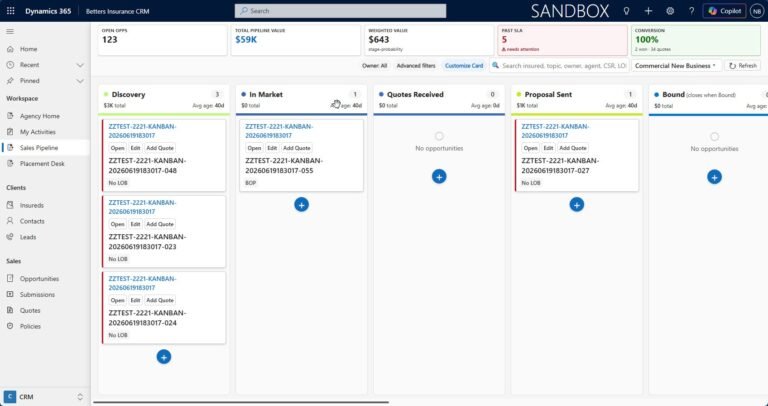
So most of our insurance work is integration work, and most of the value shows up there. We have built a Chrome extension that pulls client quote data out of EZLynx and creates the matching records in Dynamics 365 in under five clicks. We run live integrations against Momentum AMS, formerly NowCerts, on its open API. We connect raters, prefill services and certificate tools so the pipeline reflects what actually happened rather than what somebody remembered to log.
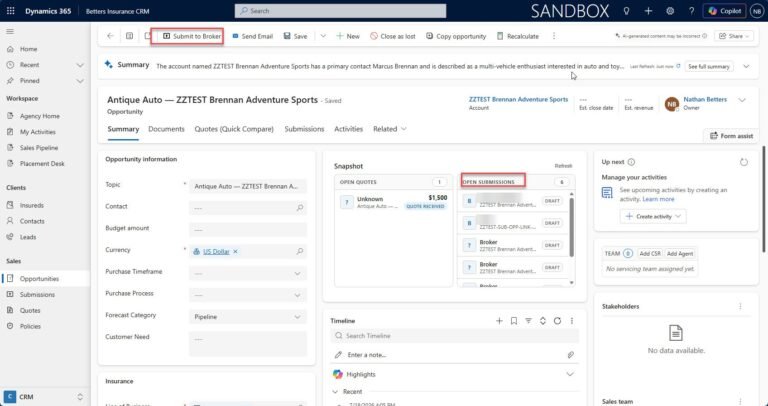
Where the product stops, we keep building. AI-driven policy comparison reads an expiring policy against what is being proposed and flags the coverage gaps worth a conversation, which turns a slow manual review into something a producer can run on every renewal instead of only the big ones. Submission tracking built for large commercial and excess and surplus lines handles what a standard opportunity record cannot: many markets, many submissions, and many rounds with wholesalers and underwriters on a single account.
Underneath all of it, the data stays yours. It sits in your Dataverse environment, in your Microsoft tenant, with your security roles, your field-level restrictions and your SharePoint holding the documents. That is the difference between renting a vendor’s database and owning your book, and it is why agencies end up here rather than on an insurance-specific SaaS CRM at a similar price.
Integrations
A CRM is only as good as what it talks to
An agency runs on a rater, an AMS, a prefill tool, a certificate service and a carrier download feed. If the CRM does not reach them, producers end up re-typing the same account into four systems and trusting none of them.
This is where being native to Microsoft changes the maths. Your data sits in Dataverse, and every record in it is reachable the moment it exists, through Azure Function Apps, Azure Logic Apps, Power Automate, the Dataverse Web API, and MCP servers for the AI tooling now arriving. There is no separate integration product to license and no middleware tier to stand up first.
"Open API" means the vendor publishes self-serve developer access. "Available" means we can integrate it, usually through that vendor's own API program or a subscription on your contract with them. Listing a product describes what we can build against. It does not imply a partnership or endorsement, and each name belongs to its owner.
Agency management systems
The system of record. Usually the first integration an agency asks for, and the one that decides whether the CRM gets adopted.
-
Momentum AMS (formerly NowCerts) Open API
Open API. We already run live integrations here.
-
EZLynx Available
Enterprise and partner API covering applicants, policies, quotes and automated rating.
-
Applied Epic Available
Partner API program, with Ivans connectivity underneath.
-
Vertafore AMS360 and Sagitta Available
Vertafore developer portal and the Orange Partner Program.
-
HawkSoft Available
Partner API, already proven with third-party sales tools.
-
QQCatalyst Available
Vertafore stable, integrated through the same partner route.
Rating and quoting
Where producers actually spend their morning. Pulling quote and premium data back into the CRM is what makes pipeline numbers real rather than typed.
-
Vertafore PL Rating Available
Personal lines comparative rating.
-
Tarmika Available
Commercial lines, roughly 31 carriers by API. Applied owned.
-
Semsee Available
Commercial lines, roughly 48 carriers, with a free tier to start on.
-
Bold Penguin Available
Terminal and Exchange, reaching 45 or more carriers and MGAs.
-
Herald Open API
A single API reaching 60 or more commercial products across carriers.
Lead sources and lead flow
Bought leads are perishable. The agency that calls first usually wins, so the gap between a lead being sold and a producer seeing it is worth closing to seconds.
-
EverQuote Available
Consumer lead delivery straight into the CRM rather than an inbox.
-
QuoteWizard by LendingTree Available
High volume consumer leads, posted in real time.
-
SmartFinancial Available
Real-time leads and phone-qualified call transfers.
-
ActiveProspect LeadConduit Open API
Documented API. Routes, filters and enriches every lead before it lands.
-
TrustedForm Open API
Consent certificates on each lead, which is your TCPA evidence.
-
boberdoo Available
Ping-post distribution, so your rules accept or decline before you pay.
-
LeadsPedia Available
Lead distribution and source-level return on spend.
-
Apollo Open API
Documented API. Prospecting data for commercial and benefits lines.
Prefill, intake and verification
The fastest wins usually live here. Every field a client does not have to repeat is a field nobody has to correct later.
-
Canopy Connect Open API
Carrier-sourced policy data, with a sandbox and self-serve developer accounts.
-
InsurGrid Open API
REST API for dec pages, loss runs and structured policy extraction.
-
Certificial Available
Live certificate of insurance tracking and verification.
Carrier connectivity and standards
The plumbing the whole distribution channel already runs on. Worth building against rather than around.
-
Ivans Download Available
Policy, claims and activity download from carriers on ACORD standards.
-
ACORD forms and standards Open API
The data shapes your carriers and wholesalers already expect.
The rest of the business
Phones, payments, e-signature, accounting and marketing. Where a system has no API of its own, or buying one is not worth it, a connector platform closes the gap in days rather than months.
-
AgencyZoom Available
Sales automation, with API credentials available on the agency account.
-
Zapier, Make and n8n Open API
Thousands of endpoints reachable without a custom build each time.
-
Power Automate and Azure Functions Open API
Anything bespoke, running inside your own tenant.
-
Microsoft 365, Teams and SharePoint Open API
Mail, meetings and documents, already where your staff work.
And the rest of the stack you already pay for
Phones, payments, e-signature, accounting, marketing and storage. These connect through the same Microsoft-native surface, which is why adding one is usually a conversation about your process rather than a development project.
Product names and marks are the property of their respective owners and are shown to describe integration capability only.
What we have built
Where the product stops, and we keep going
A quoting bridge that takes five clicks
We built a Chrome extension that lifts client quote data straight out of EZLynx and creates the matching records in Dynamics 365 in under five clicks. No re-keying, no copying between tabs, no quotes that exist in the rater but never reach the pipeline. The same pattern works against any system that exposes an API, and against several that only expose a screen.
AI policy comparison and gap analysis
We have built AI-driven comparison into the CRM: read the expiring policy against what is being proposed, surface the differences in coverage, limits, deductibles and endorsements, and flag the gaps a client should be told about. It turns a slow manual review into something a producer can run on every renewal rather than only the large ones, which is both a service story and an E&O story.
Submission tracking built for large commercial and E&S
Excess and surplus lines work does not fit a standard opportunity record. One account can carry many markets, many submissions, and many rounds of back and forth with wholesalers and underwriters. We built dedicated submission tracking so a team can see which markets are out, who is waiting on what, what has been declined and why, and where a deal actually stands, without reconstructing it from an inbox.
Live integration with Momentum AMS
Momentum, formerly NowCerts, publishes an open API, and we have integrations running against it today. Insureds, policies and service activity stay aligned between the AMS and the CRM, so producers work the pipeline in Dynamics 365 while the AMS keeps doing what it is good at.
Marketing
Marketing automation, sized to the agency
There is no single right answer here, and pretending otherwise is how an agency with one part-time marketer ends up paying for an enterprise platform nobody opens. All three run on Dataverse, so your contact data stays in the same environment as your book instead of being copied into a marketing vendor.
Touchdown
Email and SMS campaigns built and sent inside Dynamics 365 itself, with a drag-and-drop builder and marketing lists off your existing contacts, accounts and leads. Nothing synchronizes to an outside tool, so the contact data and the engagement statistics never leave your environment. For an agency where marketing is one person wearing three hats, this is usually the right answer.
ClickDimensions
A mature marketing automation layer for Dynamics 365: nurture campaigns, web tracking, forms and surveys, scoring, and reporting that ties activity back to the opportunity. The step up you take when campaigns need to run themselves rather than being sent one at a time, without carrying the cost and configuration weight of the enterprise product.
Dynamics 365 Customer Insights, Journeys
Formerly Dynamics 365 Marketing. Real-time journey orchestration, AI-assisted scoring and content, event management, and the unified customer profile behind it, with Copilot and Power BI in the same stack. Worth it where there is a marketing team to run it and the volume to justify the orchestration.
Product names and marks are the property of their respective owners.
Ownership and control
Your data stays in your environment
This is the part that decides it for most agencies. An insurance-specific SaaS CRM holds your book in someone else's database, on their security model, with their retention rules. Dynamics 365 does not. You get an enterprise platform for a fraction of what Salesforce or Oracle cost at the same tier, and the client data never leaves ground you already control.
When I call a vendor about a problem and they can open my clients' records and read a driver's license number, a date of birth, a Social Security number, and there is no control on my end that could have stopped them, that does not make me feel warm and fuzzy that my data is secure and private. It is my name on that relationship, and my exposure if it goes wrong.
On Microsoft it does not work that way. Their own engineers cannot get into my data unless someone on my side grants it, in my admin center, and even then the fields I have put a security profile on stay hidden from them. That is better control, better security, and a lot more confidence that I am actually meeting the standards I tell my clients I meet.
Your tenant, your data
The data lives in your Dataverse environment, inside your Microsoft tenant, under your own agreements. Not a vendor database you rent access to and cannot leave cleanly.
Your documents, your SharePoint
Policies, applications and loss runs sit in your SharePoint, under the retention and sharing rules you already set for everything else.
Role-based access control
Producers see their book, managers see their team, leadership sees the agency. Enforced by the platform on every record, not by hiding a tab.
Field-level security profiles
Commission, premium, dates of birth, license and tax identifiers can each be restricted to the people who need them, with read, update and create controlled separately.
Auditing you can hand to a regulator
Column-level audit history, retention rules, and a real trail of who changed what and when. The evidence exists before anyone asks for it.
Microsoft cannot look without asking
Support engineers do not get standing access to your records. Where elevated access is ever needed, it has to be requested and approved by your own administrator, and columns you have put behind a security profile stay hidden even then.
GDPR and HIPAA obligations supported
Microsoft will sign a business associate agreement covering Dataverse, and the platform carries the residency, encryption and subject-request tooling those regimes ask for. Compliance stays a shared responsibility, but you are not depending on a small vendor to carry it.