
Blog
Data Governance Consulting: Scope, Process and How to Choose
nbetters · · 11 min read
What data governance consulting covers, how an engagement runs, what stays with your organization and how to choose a consultant for a Dynamics 365 environment.
Data governance consulting gives your organization named owners, written rules and working controls for the data it already depends on, so that a sales figure, a customer record or a project margin means the same thing in every report. For a growing business running on Dynamics 365 and Power Platform, the most useful version of this work is built into the systems where data is created, not delivered as a policy binder that nobody opens. As an independent Microsoft partner and a small firm, we approach governance this way: decisions about architecture, ownership and data quality come first, and configuration follows.
Key Takeaways
- Data governance consulting defines who owns each data domain, which rules apply, and how quality is measured and enforced.
- Master data management, data quality and data migration are separate disciplines. A weakness in one limits the value of the others.
- Governance that lives inside your CRM and workflows survives staff turnover. Governance that lives only in documents decays.
- US privacy and data-security rules keep changing by state and by federal agency, so governance needs a maintained inventory of what data you hold and where it goes.
- The right consultant depends on your platform. If your data lives mostly in Salesforce, HubSpot or HighLevel, a specialist in that platform is sometimes the better choice.
Table of Contents
- What data governance consulting covers
- How governance, master data, quality and migration fit together
- What an engagement looks like
- What stays with your organization
- US rules that shape governance work
- Governance inside Dynamics 365 and Power Platform
- How to choose a data governance consultant
- Governance and data integrity with BetterS Agency
- Perspective
- FAQ
- Sources
What data governance consulting covers
Governance answers four plain questions about your data: who is accountable for it, what the rules are, how you know the rules are followed, and what happens when they are broken. A consultant helps you answer each in a form your staff can actually apply.
In practice that work usually touches these areas:
- Ownership and decision rights. Each data domain (customers, projects, contracts, policies, vendors) gets an accountable owner and stewards who maintain it day to day.
- Definitions and standards. What counts as an active client, a closed opportunity or billable hours is written down once and used everywhere.
- Quality rules. Required fields, duplicate detection, validation at entry and exception handling.
- Access and security. Who can see and change what, based on role.
- Lineage and documentation. Where a number came from and which systems touched it on the way.
- Measurement. Evidence that the rules work, such as fewer manual corrections and faster audit responses.
The business problems that start these projects are familiar. Two departments report different revenue for the same month. A privacy or industry audit exposes records nobody can trace. A migration to a new system copies years of duplicates across. An AI or reporting plan stalls because nobody can say which data is reliable.
How governance, master data, quality and migration fit together
Buyers often search for these services separately, but they depend on each other. Governance sets the rules. The other three put those rules to work on real records.
| Discipline | What it does | Typical output |
|---|---|---|
| Data governance | Sets ownership, policies, definitions and stewardship roles | Operating model, glossary, named owners, review cadence |
| Master data management | Creates one authoritative version of core records such as customers, vendors and products | Matching and survivorship rules, hierarchies, stewardship workflows |
| Data quality | Finds and prevents bad data | Profiling results, validation rules, monitoring, exception queues |
| Data migration | Moves data into a new system with controls | Field mapping, cleansing, reconciliation, cutover checks |
The order matters. Migrating before you have agreed on what a customer record is simply moves the disagreement into a new system. Our CRM data migration implementation guide walks through the migration side, and the leadership decision framework for CRM data migration covers the questions an executive should settle before a cutover date is set.
Master data management (MDM) deserves a note for smaller firms. A full MDM platform is sometimes more than you need. When most of your critical records live in one CRM and one finance system, clear ownership, matching rules and automated duplicate handling inside the CRM often give you the single version of the truth without a separate hub. The trade-off: once you have many systems that each create customer records, a dedicated MDM layer starts to earn its cost.
What an engagement looks like
The details vary by firm size and industry, but a well-run engagement follows a recognizable sequence.
1. Assess what you have
The starting point is an honest inventory: which systems hold which data, who touches it, where the same fact is entered twice, and which reports leadership distrusts. This is also where a consultant interviews people in sales, operations, finance and legal, because the real rules are usually in their habits and not in any document. The step goes wrong when the assessment covers only the IT view. Insist that business users are in the room.
2. Set priorities and a target
You cannot govern everything at once. Pick the domains that cause the most cost or risk, such as client and project data in a professional services firm, policy and producer data in an insurance agency, or job and vendor data in construction. Define the target in business terms: reports that agree, handoffs that do not lose information, audits that take hours instead of weeks.
3. Assign roles and decision rights
Name an executive sponsor, a data owner for each domain and stewards who handle exceptions. Without a sponsor, policy has no funding and disputes have no tiebreaker. Without named owners, quality rules are nobody’s job.
4. Write the rules, then build them into the systems
This is the step where many programs fail. Rules that exist only in a document depend on memory. Rules built into required fields, validation, approval flows and role-based security apply themselves. In a Microsoft environment this typically means Dataverse table design, business rules, Power Automate flows that validate and route exceptions, and security roles that match your ownership model. Our article on a data quality control plan for sales-to-delivery handoffs shows how this works at one of the most failure-prone points in a services business.
5. Monitor, measure and adjust
Governance is an operating routine. Track the signals that show the rules are used: how many exceptions are resolved and how fast, how many duplicates are caught at entry, how much manual cleanup remains, and whether reports agree. Adoption is the best evidence. A set of beautifully documented policies that people bypass has not improved anything.
6. Train the people who run it
Stewards and managers need to know the model well enough to run it without outside help. Good consulting leaves your staff more capable, which is why adoption and enablement belong inside the governance plan and not after it.
What stays with your organization
A consultant can design the model, build the controls and train your people. A consultant cannot supply your business knowledge, your authority to settle disputes or your day-to-day discipline. Three things always remain with you:
- Sponsorship. An executive must back the rules and resolve conflicts between departments.
- Stewardship time. Owners and stewards need time in their week for exceptions and reviews. If nobody has the time, the program will not hold.
- Decisions about meaning. Only your leaders can decide what counts as a qualified lead, a completed project or a recognized revenue event. A consultant structures that conversation and records the outcome.
Plan for this before you sign anything. The projects that stall are rarely short of technology. They are short of an owner with the authority to say “this is the definition”.
US rules that shape governance work
There is no single US data governance law, so the rules that apply depend on your industry, your states and the data you hold. That is why an up-to-date data inventory is the foundation of compliance work.
Two recent examples show how much the landscape moves:
- The US Department of Justice’s Data Security Program applies to certain transactions involving countries of concern. According to the DOJ compliance guide, its prohibitions and restrictions began on April 8, 2025, and the due-diligence, audit and reporting obligations began on October 6, 2025. Meeting them depends on knowing what sensitive data you hold, who can access it and where it is sent.
- State privacy law keeps expanding. The American Bar Association’s 2026 compliance checklist reports that Kentucky, Indiana and Rhode Island privacy laws took effect on January 1, 2026, with thresholds and assessment duties that differ by state. It also notes that California’s privacy risk assessment rules became effective January 1, 2026, and that Connecticut amendments took effect July 1, 2026.
A governance consultant does not replace your attorney. Whether a specific law applies to your business is a question for your counsel. What the consultant provides is the operational layer: the inventory, the access controls, the records and the audit trail that let counsel give you a reliable answer and let you act on it.
Governance inside Dynamics 365 and Power Platform
If your business runs on Dynamics 365, the most durable governance is built into the platform. That has practical consequences.
Architecture before configuration. Table design, relationships, ownership and security roles determine what you can govern later. Retrofitting them is expensive. Our overview of data architecture consulting and its business value explains why these decisions deserve time up front.
Lineage and exceptions. When a figure is wrong, you need to know where it came from and who changed it. For professional services firms, see how data lineage exception audits work, and how to measure lineage from CRM sales to project handoff.
Ownership across the sales-to-delivery chain. Estimates, resources and invoices all draw on the same underlying records. The case for automating estimating to project delivery rests on clear data ownership.
AI readiness. Copilot and other AI tools reflect the data they can reach. Documented, owned and permissioned data is a precondition for trustworthy output, which is the subject of our guide to scoping, governing and deploying AI integration.
The trade-off is plain. Platform-native governance works best when most of your critical data is already in, or moving to, the Microsoft stack. If your records live mainly in Salesforce, HubSpot or HighLevel and you have no reason to move, a governance engagement on that platform is sometimes the better choice, and we say so. Our comparison of Dynamics 365 CRM and its alternatives sets out when each fits.
How to choose a data governance consultant
Use criteria that reveal how the work will actually be delivered:
- Who does the work. Ask who will personally design and build your system. In a small firm you can meet that person before you sign.
- Business outcomes, not document counts. A good engagement is judged by reduced rework, faster audits and reports that agree, not by the number of policies written.
- Built-in controls. Ask how rules will be enforced inside your systems, not only described.
- Fit with your platform. A consultant who knows your CRM, automation and reporting tools can tie governance to real workflows.
- Knowledge transfer. You should finish with stewards who can run the model and documentation they can maintain.
- Honest scoping. The right consultant tells you when a lighter approach, or a different platform, is the better fit.
The recommendation to choose a specialist in your own stack is wrong in one case: when your biggest risk is enterprise-wide, spans many unrelated systems and needs a regulatory program office. That calls for a larger organization with a dedicated governance practice, and it is a reasonable choice for a business of that scale.
Governance and data integrity with BetterS Agency
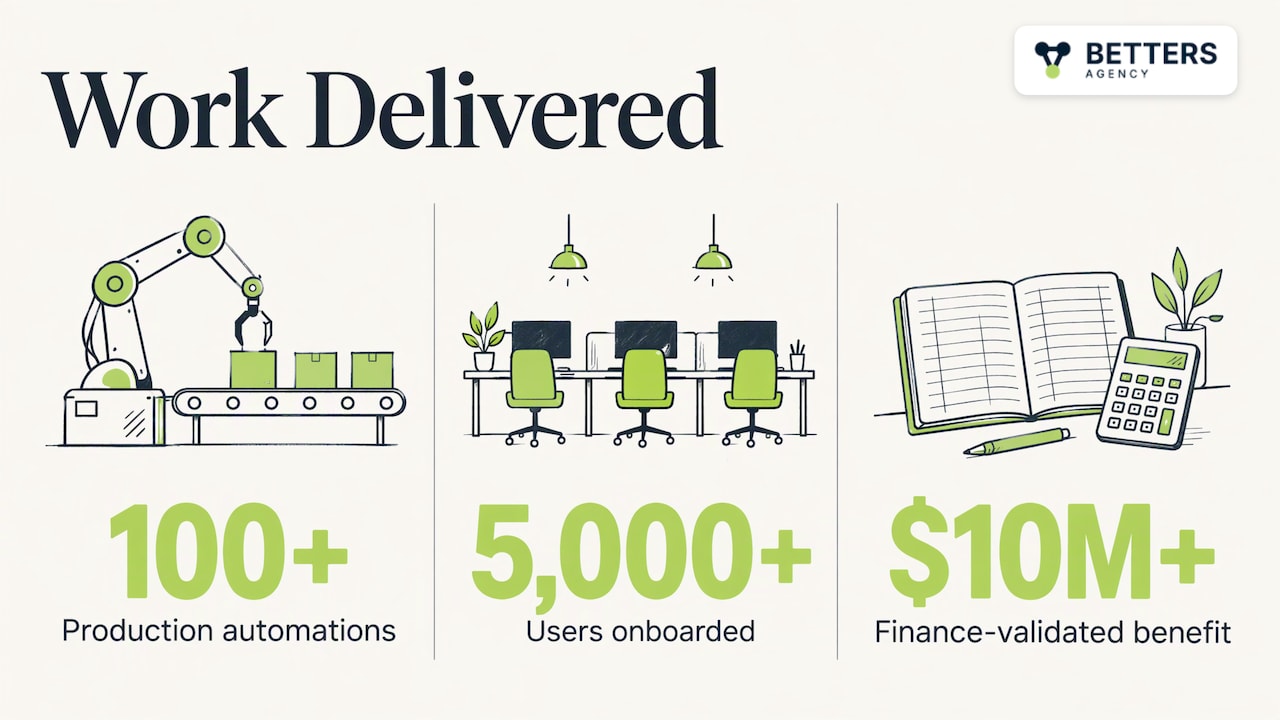
Our governance and data integrity work covers ownership models, validation rules, exception handling and monitoring inside Dynamics 365 and Power Platform. It sits alongside CRM strategy and architecture, adoption and enablement, and Power BI data intelligence, so rules, workflows and reports are designed together. As an independent Microsoft partner and a small firm, we have delivered 100+ production automations and onboarded 5,000+ users, and our work has produced $10M+ in finance-validated benefit.
If you are ready to scope governance for your own environment, start with our services overview.
Perspective
We think most data governance programs fail for one reason: the rules are written by people who will never enforce them, in a place where nobody will ever see them.
When you work with a small firm, you work directly with the person who builds your system. That changes the quality of governance, because the person who decides who owns a record also decides how the required field, the validation rule and the approval flow will enforce it. Nothing gets lost in a handoff between a strategy deck and a build.
We get the architecture and data decisions right before anything is configured, because retrofitting ownership into a live system is slower and costs more than designing it in. We build for adoption as much as for control. A rule that people route around is worse than no rule, because it creates false confidence.
Our approach is not right for everyone. If your data lives in a platform we do not work in, or your needs are a multi-system regulatory program, we will tell you.
Derek
FAQ
What does a data governance consultant do?
A data governance consultant assesses how your data is created, owned and used, then designs and helps implement the roles, policies and controls that keep it reliable. The work typically includes definitions, ownership, quality rules, access controls and training for the people who run the model afterward.
How is data governance different from data quality?
Governance sets the rules and accountability. Data quality is the practice of measuring and improving records against those rules through profiling, validation, cleansing and monitoring. Quality work without governance tends to fade, because nobody owns the standard being enforced.
Do I need master data management software?
Not always. If your critical records sit mainly in one CRM and one finance system, clear ownership, matching rules and duplicate controls inside those systems often deliver a single trusted record. A dedicated MDM platform becomes worthwhile when many systems each create their own versions of the same customer or vendor.
Should governance come before a data migration?
Yes. Agreeing on definitions, owners and quality rules before a migration prevents you from copying duplicates and conflicting fields into the new system. Governance decisions made first also give your reconciliation checks a clear standard to measure against.
How do I know whether governance is working?
Look for behavior and outcomes: stewards resolving exceptions, fewer manual corrections, reports that agree across departments and audit requests answered quickly. Usage and business results are better measures than the number of policies produced.
Sources
- NSD Data Security Program Compliance Guide, US Department of Justice
- 2026 Data Security and Privacy Compliance Checklist, American Bar Association
Recommended
- Data Architecture Consulting: Value vs Efficiency Gains
- Data Architecture Consulting Implementation Guide
- Data Architecture Types Compared for Business Intelligence
Articles are for informational and educational purposes only, Betters Agency LLC is not a licensed financial advisor or legal counselor and does not provide these services, readers are encouraged to check multiple sources for accuracy.