
Blog
Sales to Delivery Automation Framework for Leaders
nbetters · · 16 min read
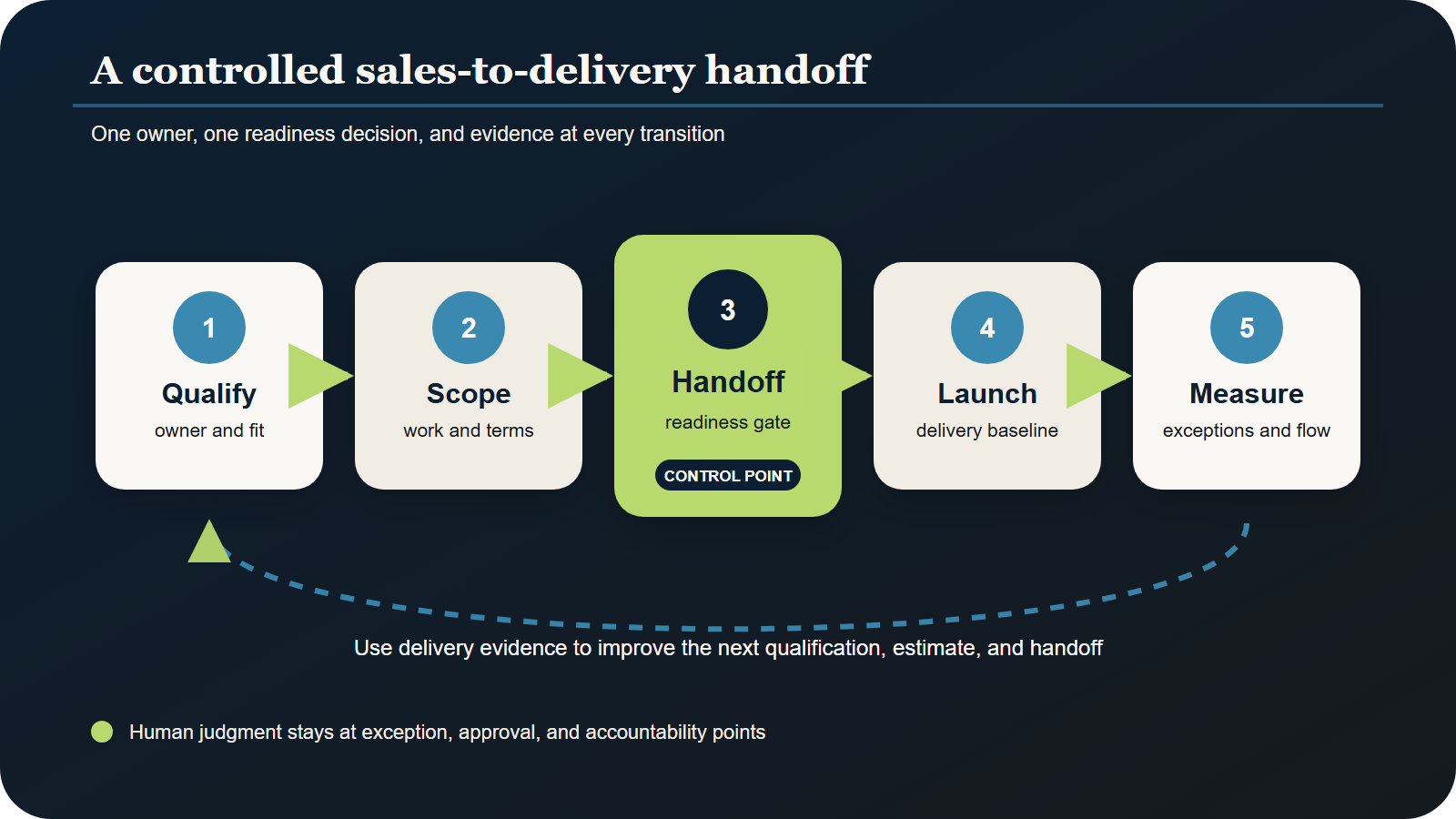
Sales-to-delivery automation creates business value when it makes a critical handoff faster to understand, easier to govern, and more reliable to operate.
Sales-to-delivery automation creates business value when it makes a critical handoff faster to understand, easier to govern, and more reliable to operate. It does not create value merely because a notification fires or a project record appears.
For a leadership team, the decision is straightforward: automate one bounded handoff only after the firm can name the required information, the accountable owners, the judgment points, the exception path, and the measures that will show whether the handoff improved. If those conditions are unclear, fix the operating model before adding automation.
That standard matters in Minnesota professional services firms. Consultative sales, mixed billing methods, shared specialists, and multiple concurrent projects can turn a weak handoff into scope clarification, resource reshuffling, delayed starts, and finance reconciliation. The right question is not, "Which tool can connect our systems?" It is, "What evidence would let us transfer ownership from sales to delivery with confidence?"
To evaluate sales-to-delivery automation business value honestly, a leadership team weighs the workflow itself, the controls around it, the people who must change how they work, and the support model that keeps it running. This article gives you a structure for that decision, a hypothetical example to make it concrete, and a scorecard you can reuse.
The executive decision comes before the technology
Treat sales-to-delivery automation as a controlled transfer of operating responsibility. Sales remains responsible for representing the agreement accurately. Delivery accepts a usable baseline. Finance reviews the commercial assumptions that affect billing or margin analysis. An application owner supports the mechanism, but does not own the business decision.
A responsible control loop has five stages:
- Qualify the opportunity and name the accountable sales owner.
- Define scope, assumptions, billing method, and approval state.
- Apply a readiness gate that exposes missing information and exceptions.
- Establish the delivery baseline and name the accountable delivery owner.
- Measure exceptions and downstream changes, then use that evidence to improve the next handoff.
Leaders should fund the workflow, controls, adoption, and support model together. A technically successful flow can still fail as an operating change if people bypass it, required data remains vague, or nobody owns exceptions.
Define the handoff contract before you automate
A handoff contract is the shared agreement that says what "ready" means. Write it down before any tool is chosen, because automation encodes whatever definition it is given, including a vague one. A useful contract names six elements.
- Entry event: the exact moment the handoff can begin, such as final commercial approval or a signed statement of work. Name one event, not a general sense that the deal feels done.
- Required evidence: the smallest set of fields, documents, and approvals delivery needs to accept ownership, such as scope assumptions, billing method, rate or fee basis, staffing needs, key dates, and any nonstandard terms.
- Acceptance event: the point where delivery formally takes the baseline and the record becomes authoritative. Before this event the deal is a proposal; after it, delivery owns the plan.
- Owners: the named sales owner who vouches for the commercial picture and the named delivery owner who accepts it. Roles with names, not a shared inbox.
- Exceptions: what happens when required evidence is missing or disputed, who can approve a temporary gap, and where that decision is recorded.
- Decision rights: who may change scope, override a readiness check, or return a handoff, and who is only informed.
Once those six elements are explicit, automation has something concrete to enforce. Without them, an automated flow simply moves ambiguity downstream faster. The contract is also the artifact you can review, revise, and audit as the business changes, which keeps the workflow honest over time.
Start with the business problem and value levers
The business problem is usually not the absence of automation. It is the absence of a dependable handoff contract between teams.
Sales may believe the deal is ready because the client approved a proposal. Delivery may still lack task assumptions, staffing needs, acceptance criteria, or a clear billing method. Finance may discover that commercial details were interpreted differently. Operations may build a project plan from information that changes in the first delivery meeting.
Automation is useful when it makes those gaps visible before ownership moves. Its value should be evaluated through observable workflow outcomes, not a generic return claim.
Value lever 1: shorter elapsed handoff time
Measure the time from the agreed starting event, such as final commercial approval, to delivery acceptance of a complete baseline. The objective is not instant transfer. The objective is less idle time that cannot be explained by a necessary review or client decision.
Value lever 2: better first-pass completeness
Define the fields and approvals required for a handoff to pass on the first review. Track the share of handoffs accepted without being returned for missing information. A readiness gate is valuable when it exposes incomplete work instead of quietly copying it downstream.
Value lever 3: less rework and scope clarification
Track how often delivery must revisit estimates, assumptions, task mappings, or billing details because the original handoff was incomplete or ambiguous. Keep client-driven change separate from internal handoff rework. Otherwise the measure will blame the workflow for legitimate changes in client needs.
Value lever 4: younger exceptions
An exception has an owner, a reason, an opened date, and a next action. Measure how long unresolved exceptions remain open and how often they recur. An inbox alert is not an exception process if nobody can see status or accountability.
Value lever 5: a more stable delivery baseline
Compare the estimate and assumptions accepted at handoff with the initial delivery baseline. Then track downstream plan changes caused by missing or misunderstood sales context. This does not prove margin improvement. It shows whether the handoff is giving delivery a more stable starting point.
These measures create an evidence base for an investment decision. They do not, by themselves, establish savings, ROI, capacity gains, or margin improvement.
An illustrative Minnesota handoff (hypothetical)
Picture a Twin Cities professional services firm with roughly a hundred employees that sells fixed-fee and time-and-materials engagements from the same pipeline. This example is illustrative, not a customer account, but it shows how a handoff decision plays out in practice.
A regional client approves a proposal for a phased engagement. Sales marks the opportunity won and expects delivery to staff it within the week. Delivery opens the record and finds a clear fee but no confirmed billing method for phase two, no named client approver for change orders, and staffing assumptions that require a specialist who is already committed to another project.
Now walk the same deal through a defined contract. The entry event is final commercial approval, which has occurred. The required-evidence check flags three gaps: the billing method for phase two, the change approver, and the specialist assumption. Because the readiness gate exposes those gaps, the handoff does not silently become an authoritative delivery plan. An exception is opened with an owner and a next action. Sales confirms the billing method, finance reviews the margin assumption behind the blended rate, and delivery resolves staffing before the project start rather than during the first client meeting.
Nothing in this example promises a faster project or a better margin. It shows the mechanism: missing scope, billing, staffing, or acceptance information changes the decision path from "start delivery now" to "resolve a named exception first." That is the value automation should protect, and it is also value a disciplined manual process can protect without any automation at all.
Risk, governance, and human accountability
The main risks are operational before they are technical.
Bad data can move faster. Automation should not convert an incomplete deal into an authoritative delivery record. Required information needs a business definition, a responsible steward, and a visible exception when it is absent.
Commercial judgment can be hidden inside a rule. Scope acceptance, nonstandard terms, billing assumptions, and delivery accountability may require human approval. Preserve those judgment points. Automate evidence movement and routine checks, not accountability.
A repeated system event can repeat an action. Microsoft documents that multiple updates to a Dataverse row can produce multiple flow runs, including situations where submitted values match existing values. Narrow trigger conditions, an in-flow readiness check, and an idempotent create-or-update pattern are prudent design recommendations, not a promise of exactly-once processing. See Microsoft’s Dataverse trigger guidance.
Access can exceed the workflow’s need. Dataverse uses security roles and access levels to control available records and operations. Apply least privilege to people, teams, and service identities, then test it against the actual handoff. A platform feature does not prove that a particular tenant is secure. Microsoft’s Dataverse security role guidance explains the control model.
Audit records require deliberate configuration. Dataverse auditing can log selected record changes and identify who changed what and when when the required auditing is enabled. It consumes log storage, has unsupported operations, and is not a compliance guarantee. Use Microsoft’s Dataverse auditing guidance to define what the firm actually needs to retain.
Governance should also include failure handling, licensing verification, request and service-limit review, environment configuration, and a manual reconciliation path. Microsoft’s robust error handling guidance notes that retrying an action can repeat an effect if the target write is not idempotent. The leadership requirement is clear: every exception must land somewhere a named owner can act on it.
Build an operating model with named owners
Sales-to-delivery automation crosses functions, so ownership cannot sit only with IT. Use a role model that separates business accountability from technical support:
- Executive sponsor: sets the business priority, resolves cross-functional conflict, and decides whether evidence supports expansion.
- Process owner: owns the end-to-end handoff definition, measures, policy, and improvement backlog.
- Sales owner: confirms that client, scope, estimate, and commercial information meet the readiness standard.
- Delivery owner: accepts the baseline, assigns exceptions, and confirms that delivery can begin responsibly.
- Application owner: maintains the automation, connections, environments, monitoring, and release process.
- Data steward: defines required data, monitors quality, and resolves recurring definition problems.
- Finance reviewer: reviews billing and margin assumptions at the appropriate judgment points.
Think of this as a plain-language RACI. The process owner is accountable for the handoff working; sales, delivery, data, and finance owners are each responsible for their part of the evidence; the executive sponsor is accountable for the expansion decision; and the application owner is consulted on feasibility and informed of business changes that affect the design. Do not fold these into one person to save headcount, because that hides the exact conflicts the model exists to surface.
Set a simple operating cadence. Review current exceptions frequently enough to keep work moving. Review measure trends and recurring causes on a regular management cycle. Review controls, licensing assumptions, support ownership, and platform fit before expanding the workflow. The cadence should match handoff volume and risk rather than an arbitrary calendar.
Understand the cost and total operating effort
A leadership decision that only counts license fees will underestimate the commitment. Sales-to-delivery automation carries total operating effort across its whole life, and most of that effort is human. Budget for the following without inventing numbers you do not have.
- Discovery and design: mapping the current handoff, agreeing on the contract, and defining readiness and exceptions.
- Data cleanup: making required fields reliable, consistent, and owned, since automation exposes weak data quickly.
- Build and configuration: creating the flow, connections, environments, and readiness checks.
- Testing: validating the happy path, the exception paths, retry behavior, and the manual recovery route.
- Training: preparing sales and delivery together so both sides understand the new contract.
- Support and monitoring: watching for failures, reconciling records, and responding when an exception stalls.
- Licensing verification: confirming current entitlements, connectors, request use, and service limits for the firm’s own tenant before committing to a design.
- Ongoing exception handling: the recurring cost of people resolving the cases the automation deliberately routes to a human.
Treat these as ongoing operating lines, not a one-time project. A firm that funds the build but not the monitoring and exception work usually ends up with an automation nobody trusts, which is a worse position than a clear manual process.
When a visible manual control beats automation
Automation is not the goal; a dependable handoff is the goal. Some handoffs are better served by a visible manual control, at least for now.
Prefer a manual control when the handoff is rare, so there is little repetition to observe or improve. Prefer it when each deal is highly variable and the required evidence changes every time, because a rule that must handle every case becomes its own source of risk. Prefer it when the underlying data is not yet defined or owned, since automating unreliable data just distributes the unreliability. Prefer it when a single human review already catches the problems cheaply and a failure would be expensive to unwind.
Automation earns its place when the handoff repeats often enough to learn from, when readiness can be defined clearly, when the data has an owner, and when the manual version is slow or inconsistent in ways people can describe. A visible manual checklist, used honestly, is often the right first step and the best preparation for automating later. Choosing not to automate yet is a legitimate outcome of this framework, not a failure of it.
Adopt through one bounded workflow
Start with a handoff that has a clear beginning, a clear acceptance point, enough repetition to observe, and a real owner on both sides. Do not begin with every sales path, service line, billing model, and exception.
Use this sequence:
- Map the current handoff. Record the trigger, information exchanged, judgment points, wait states, exception types, and systems involved.
- Baseline the current state. Capture elapsed handoff time, first-pass completeness, rework, exception age, start delay, estimate-to-baseline variance, and relevant downstream changes.
- Define readiness. Agree on the smallest set of data and approvals required to transfer ownership. State who can approve an exception.
- Design the controlled path. Move only the information needed downstream. Keep a correlation key, visible exception record, bounded retry behavior, and a manual recovery option.
- Train both sides together. Sales needs to understand what delivery requires. Delivery needs to use the accepted baseline and report defects consistently. Managers must reinforce the same policy.
- Observe before expanding. Compare the pilot with its own baseline, inspect exceptions, and fix the workflow or data definition before adding scope.
Wrap the pilot in light governance so the evidence is trustworthy. Fix the baseline before go-live so later comparisons are fair. Agree on readiness criteria and who signs off on exceptions. Put changes to the flow through simple change control so nobody quietly alters behavior mid-pilot. Keep the training and support owners named, and confirm a rollback that lets the firm pause the automation and complete the handoff manually without losing accountability. Define, in advance, the evidence you would need before expanding to a second workflow.
If the firm already uses Dynamics 365 Project Operations, the documented product flow maps project-based selling across Opportunity, Quote, and Project Contract. Winning the quote creates the project contract and begins delivery in the applicable Project Operations deployments. Microsoft also documents quote-line details that can carry into contract lines. That native lifecycle can provide a useful foundation, but the firm must still define readiness, approval, ownership, and exceptions. Review Microsoft’s project opportunity process and project quote-line guidance against the deployed configuration.
The sales-to-delivery automation implementation guide covers the technical control pattern and validation scenarios.
Measure improvement without inventing ROI
Create a measurement definition before the pilot begins. For each measure, name the event that starts the clock, the event that stops it, the system of record, the owner, and the exclusions. Without those definitions, a dashboard can make inconsistent events look precise.
Use a compact scorecard:
- Elapsed handoff time: approval event to delivery acceptance, with necessary client waits separated.
- First-pass completeness: accepted handoffs divided by reviewed handoffs, using the agreed readiness standard.
- Rework: internally caused returns or corrections, categorized by missing data, unclear scope, estimate issue, ownership, or commercial detail.
- Unplanned scope clarification: clarification caused by handoff ambiguity, separated from new client requests.
- Project-start delay: planned start compared with actual start, with the cause recorded.
- Exception age: time from exception creation to resolution, grouped by reason and owner.
- Estimate-to-baseline variance: difference between the accepted estimate and initial delivery baseline, with the reason for material changes.
- Downstream plan changes: changes attributable to missing or misunderstood handoff information.
Compare a stable pre-pilot period with the bounded pilot, but interpret the result in context. Mix of work, seasonality, deal complexity, and client changes can affect the measures. Use the evidence to decide whether to keep, revise, expand, or stop the automation. Add financial modeling only when finance has approved the inputs and attribution method.
Use a decision scorecard before funding expansion
Rate each item as clear, partly clear, or unresolved. Require written evidence for a clear rating.
- Workflow fit: Is the handoff repeated, bounded, and important enough to govern?
- Data quality: Are required fields defined, available, and owned?
- System-of-record clarity: Does each key fact have one authoritative source?
- Exception cost: Can leaders describe the operational consequence without inventing a financial value?
- Integration complexity: Are systems, dependencies, failure points, and throughput understood?
- Security: Are identities, privileges, data sensitivity, and access testing defined?
- Application lifecycle management: Can the change move through environments with testing and controlled configuration?
- Support ownership: Who monitors, repairs, reconciles, and communicates failures?
- Adoption load: What behavior changes for sales, delivery, finance, and managers?
- Licensing verification: Has the firm checked current entitlements, connectors, request use, and service limits for its tenant?
- Exit and rollback path: Can the firm pause the workflow and complete the handoff manually without losing accountability?
Use a repeatable decision rule. Treat workflow fit, data quality, system-of-record clarity, integration complexity, security, application lifecycle management, support ownership, licensing verification, and exit and rollback as must-clear gates. Proceed with a bounded pilot only when every must-clear gate is clear and no other item is unresolved. A partly clear rating for exception cost or adoption load may proceed only as a named pilot assumption with an owner and a test; it must be clear before expansion.
Repair before proceeding when any must-clear gate is partly clear or unresolved, when any other item is unresolved, or when required data or authority remains disputed. Rescore after the repair. Decline automation when a must-clear gate cannot be made clear responsibly, or when the handoff is rare, highly variable, or better handled by a visible manual control.
Executive questions leaders ask
Will automation remove the need for human judgment?
No. Automation should move evidence and run routine checks, not replace accountability. Scope acceptance, nonstandard terms, billing assumptions, and delivery ownership stay with named people. Preserve those judgment points deliberately, and design the workflow so a human decision is required exactly where the business needs one.
Can we guarantee the automation runs exactly once?
No. Microsoft documents that multiple updates to a Dataverse row can create multiple flow runs, including when submitted values match existing values, and that retrying an action can repeat an effect when the target write is not idempotent. Narrow trigger conditions, a readiness check inside the flow, an idempotent create-or-update pattern, and a manual recovery path are prudent design choices, not a promise of exactly-once processing.
Does a platform capability prove our tenant is secure or compliant?
No. Dataverse security roles and access levels constrain records and operations, and configured auditing can record who changed what and when, but a platform capability is not proof that a particular tenant is secure or compliant. Least privilege and auditing must be designed, tested, and maintained for your own environment.
How do we show value if we cannot claim ROI up front?
Baseline the current handoff, run one bounded pilot, and compare the pilot with its own baseline using defined measures such as elapsed handoff time, first-pass completeness, rework, exception age, and estimate-to-baseline variance. Those measures support a trend judgment. They do not, by themselves, establish savings, ROI, capacity gains, or margin improvement, and any financial model needs finance-approved inputs and a documented attribution method.
We already use Dynamics 365 Project Operations. Do we still need this?
Yes. In the applicable Project Operations deployments, the documented process maps project-based selling across Opportunity, Quote, and Project Contract, and winning the quote creates the project contract and begins delivery. That native lifecycle is a useful foundation, but it does not define your firm’s readiness gate, approvals, ownership, or exceptions. Those remain business decisions your leadership team must make.
What is the smallest responsible first step for a Minnesota firm?
Choose one costly, repeated handoff, write its contract, and baseline it. Then decide honestly whether a visible manual control or a bounded automated pilot fits better for the way your Twin Cities teams sell and deliver. Expand only after evidence supports it.
Review a Workflow
Bring one costly manual handoff to a 25-minute Workflow Opportunity Review. We will examine the trigger, owners, readiness evidence, exceptions, systems, and measures, then identify the smallest responsible next step.
Betters Agency has a commercial interest in implementation work that may follow this review. We are Microsoft-deep and platform-pragmatic. The useful recommendation may be a Microsoft-centered pattern, a lighter cross-system option, a process correction, or no automation yet.
Review a Workflow