
Blog
Sales-to-Delivery Automation Implementation Guide
nbetters · · 19 min read
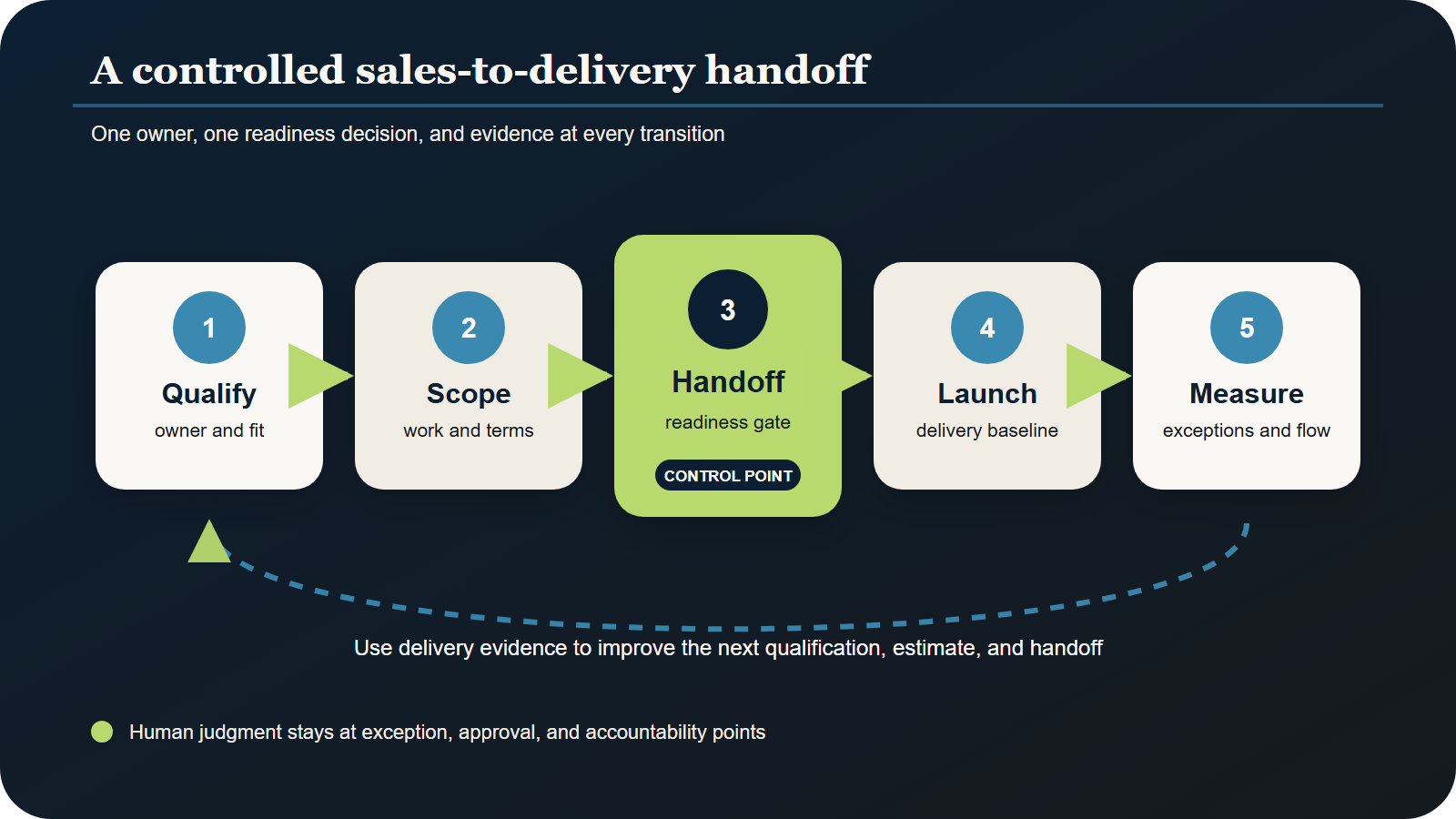
The practical pattern is to keep the native sales and project-contract lifecycle intact, add a clear readiness gate, trigger a bounded automation from one…
Sales-to-Delivery Automation Implementation Guide
Sales-to-delivery automation should be built as a controlled handoff, not a blind record copy. The practical pattern is to keep the native sales and project-contract lifecycle intact, add a clear readiness gate, trigger a bounded automation from one scalar signal, recheck the conditions inside the flow, and make every downstream write traceable and safe to repeat.
That design matters for a Minnesota engineering, IT consulting, or other project-based services firm because the handoff transfers operating responsibility. Sales is no longer just pursuing work. Delivery is accepting scope assumptions, a billing approach, ownership, and a starting baseline. Automation can enforce the agreed gate and expose exceptions, but it cannot decide whether an ambiguous scope is acceptable.
Common symptoms of a weak handoff include:
- Delivery learns about the work through an email or meeting instead of an authoritative record.
- The quote is approved, but the delivery owner, billing method, or delivery assumptions are missing.
- A record update creates a second project or duplicate downstream task.
- A failed step leaves some records written and others absent.
- The flow succeeds technically, but no one can tell who owns the exception.
- A production issue cannot be paused without disrupting the native sales process.
The solution below addresses those symptoms without duplicating the native Project Operations quote-to-project-contract transition. Read it as an operating design you adapt to your deployment, not a copy-and-paste recipe. Every field name, table, and control it names is an example your firm still has to confirm against its own configuration.
Prerequisites and readiness rules
Do not open the flow designer until the operating contract is written. Your prerequisites should be testable.
First, name the system of record for the opportunity, quote, contract, delivery baseline, and exception. If the firm already uses Dynamics 365 Project Operations, preserve its documented project-based lifecycle. Microsoft documents a Project Operations lifecycle across Opportunity, Quote, and Project Contract; winning the quote creates the project contract and begins delivery. See the Project Operations opportunity lifecycle.
Second, identify the information that delivery must accept. A reasonable gate for a project-centric firm can include an approved scope, accountable sales owner, accountable delivery owner, billing method, delivery assumptions, and an explicit approval state. Microsoft documents that selected project quote-line details can be copied to the project contract line when the quote is won. The exact fields available still depend on the deployment, so confirm them against the firm’s configuration and the project quote-line behavior.
Write the gate as acceptance criteria
A readiness gate that lives only in someone’s head cannot be tested, and an untestable gate cannot be automated safely. Turn each gate condition into a concrete acceptance criterion that a reviewer can mark pass or fail without discussion. Vague criteria such as "scope is clear" invite disagreement at the worst possible moment. Bind each criterion to a specific, observable record state instead.
A workable set of acceptance criteria for a project-centric firm reads like this:
- Scope is approved: the scope statement is attached to the authoritative record and the approval state is set by the person authorized to set it.
- The accountable sales owner is present and is a real, active user, not a shared mailbox or placeholder.
- The accountable delivery owner is present, has accepted the baseline, and is distinct from the sales owner unless the firm’s model deliberately allows one person to hold both roles.
- The billing method is populated with one of the firm’s allowed values, and any value that requires additional approval carries that approval.
- The delivery assumptions are recorded in a durable field, not only in a conversation or a quote attachment that can change silently.
- The explicit readiness state is set last, after every prior criterion is satisfied, so that the signal never leads the evidence.
Each criterion should name the record and field that proves it, and each should have exactly one accountable owner who can resolve a failure. When a criterion fails, the reader of the gate should be able to answer three questions immediately: which criterion failed, which record shows it, and who owns the fix. If any of those three answers is missing, the gate is not finished.
Map each rule to an owner
Assign people to five roles:
- A process owner defines the gate and accepts changes to it.
- A sales owner resolves commercial or scope omissions.
- A delivery owner accepts the operational baseline.
- An application owner supports the automation and deployments.
- A data or security owner approves access and audit settings.
Ownership is not a formality. When a handoff stalls, the difference between a quick correction and a week of ambiguity is whether a single named person is accountable for each rule. Record the owners next to the acceptance criteria so the gate specification and the accountability map are the same document. If the firm cannot name a real owner for a criterion, that criterion is not ready to enforce, and automating it will only move the confusion downstream.
At a lean Twin Cities engineering or IT consulting firm, one principal or senior consultant may hold both the sales owner and the delivery owner roles for the same client. Whether that applies is a question about your firm’s actual operating model, so answer it from your own role assignments rather than an assumed pattern. If one person does hold both roles, treat the dual role as a deliberate, approved exception rather than a silent default: document it, have the process owner approve it, and confirm the accountability map still shows a real, resolvable owner for each rule. Because no single person is reachable at all times, name a covering owner who accepts each rule during any period that person is unavailable, and base that coverage on the firm’s real staffing and calendar.
Finally, require a test environment, representative test records, a least-privilege service identity, a solution for the flow and its components, a manual reconciliation procedure, and an approved stop control. Verify current licensing, connector entitlements, and request limits for the actual tenant. Do not infer them from another environment.
Reference architecture and security boundary
Use five bounded stages: qualify, scope, gate, launch, and measure. The native application owns qualification, quote, and contract behavior. Your automation owns only the additional control work that the firm has defined, such as validating readiness, creating or updating a bounded delivery record, writing an exception, and notifying the accountable owner.
A practical architecture has six parts:
- Authoritative source record. Choose the record that owns the readiness decision in your deployment.
- Scalar readiness signal. Use a Boolean or constrained status value that can be selected directly by the trigger. It summarizes the gate result; it does not replace the underlying evidence.
- Solution-aware cloud flow. Keep the trigger, actions, connection references, and configuration inside a governed solution.
- Handoff control record. Store the source identifier, correlation key, processing status, and timestamps in a locally designed record. These are implementation concepts, not standard Project Operations field names.
- Bounded downstream write. Create or update only the delivery artifact that the handoff is responsible for.
- Exception trail. Persist failures and reconciliation state in an authoritative location instead of relying on email alone.
The security boundary starts with Dataverse permissions. Dataverse security roles and privileges can constrain table operations and record access depth. Give the flow identity only the read, create, update, and append permissions required by the selected tables and scope. Do not grant organization-wide access merely to make a failed test pass.
The service identity in practice
Decide early which identity the flow runs as, because that choice sets the blast radius of every action the automation takes. A flow that runs under a departing employee’s personal account will break when the account is disabled and will carry whatever broad access that person accumulated over the years. Prefer a dedicated service identity whose access exists only to support this handoff, so that its privileges can be read at a glance and revoked without collateral damage.
Scope that identity to the specific tables and the specific access level the handoff needs, and no further. If the flow only needs to read the opportunity, create the delivery artifact, and append to the exception record, then read access on the opportunity table, create access on the delivery table, and append access on the exception table are the whole grant. It should not be able to delete contracts, edit unrelated records, or reach records owned by other business units. When a test fails because the identity cannot perform an action, the correct response is to confirm whether that action is genuinely inside the handoff’s job. If it is, grant the one missing privilege. If it is not, fix the flow, not the permission.
Keep human approval at judgment points. The flow may verify that a billing method or owner is present. It should not decide whether the billing method is commercially acceptable or whether delivery should accept unclear scope. This separation is what lets you automate the mechanical parts of the gate without letting the automation quietly make decisions that belong to an accountable person.
When configured at the required levels, Dataverse auditing can record selected changes and help answer who changed a record and which values changed. Auditing consumes storage, has unsupported operations, and is not a compliance guarantee. Choose audited tables and columns deliberately. Turning auditing on everywhere to feel safe will grow storage and noise without improving the specific questions you need to answer after an incident. Audit the readiness signal, the ownership fields, the billing method, and the downstream artifact, and you will have the trail that matters for this handoff.
Reproducible implementation steps
1. Define the local control contract
Write a one-page specification with:
- The source record and immutable source identifier.
- The conditions that make the handoff ready.
- The person authorized to set or approve readiness.
- The exact downstream artifact the flow may write.
- The correlation-key formula.
- The success status, exception status, and manual owner.
- The stop control and rollback decision maker.
Illustrative local labels might be Handoff Ready, Handoff Correlation Key, and Handoff Status. Treat those as design examples, not universal product fields.
2. Add the scalar readiness signal
Calculate or set readiness only after the required business checks are complete. If the underlying owner is a lookup or readiness depends on several related rows, evaluate those conditions before setting the scalar value.
This avoids asking the trigger to infer a complex business decision. It also respects documented trigger limits. A Dataverse row trigger can respond to create, update, or delete events; multiple updates can yield multiple runs, and Select columns constrain only Update events. Lookup columns are not supported in that Select columns filter. Review the Dataverse row trigger guidance before choosing the trigger table and filters.
3. Create the solution-aware flow
Add the flow to a solution. Use connection references for connections and environment variables for environment-specific configuration. Solution-aware flow guidance explains how these components support movement between environments. Environment variable guidance explains how environment-specific keys and values can be separated from consuming components. Environment variables are not connections, and secret or data-source scenarios need additional review.
Configure the trigger for the narrow event you need. For an update-driven gate, include the scalar readiness signal in Select columns. Avoid columns that are present in nearly every update request. Use a filter row expression only when it is valid for the selected scalar field.
Immediately after the trigger, read the current source state and recheck every readiness condition. If the record is no longer ready, terminate the business path without creating a downstream artifact and record the reason when the attempted handoff requires follow-up.
4. Make the downstream action idempotent
Build a deterministic correlation key from stable source context, such as the source record identifier plus a locally controlled handoff version. Search the downstream system or control record for that key before writing.
The correlation key is the single most important decision in the whole design, because it is what lets a flow that runs more than once still produce the effect of running once. Choose inputs that do not drift. A record identifier is stable; a display name, a status label, or a timestamp is not. If you ever need to intentionally reissue a handoff for the same source record, change the locally controlled handoff version rather than mutating the identifier, so the new key is deliberate and traceable rather than accidental.
Once the key is in hand, the decision logic is a short, explicit table:
- The key is not found: create the bounded artifact, save the key, and record success.
- The key is found and the contract permits an update for this case: update the same artifact, do not create a second one, and record the update.
- The key is found and the contract does not permit an update: do nothing to the artifact and route the case for human review with the correlation key attached.
- The key lookup itself is ambiguous or errors: treat the result as unknown, stop before writing, and send the case to the exception path rather than guessing.
This pattern limits duplicate effects when multiple trigger runs occur, but it does not promise exactly-once processing. Do not use a generic Create action without a preceding key check. Also do not retry a create blindly after an ambiguous timeout. The first request may have succeeded even when the response did not return. When you cannot tell whether a write happened, the correlation key is what turns an anxious guess into a lookup.
5. Add failure handling and evidence
Group the main work in a Try scope: read the source, recheck readiness, find by correlation key, perform the permitted create or update, write the control result, and notify the owners.
Add a Catch scope that runs after failure or timeout. Record the source identifier, correlation key, failed stage, available error summary, processing time, and reconciliation owner. Use bounded retries only for failures judged transient and only when the target operation is safe to repeat. Microsoft’s Power Automate error-handling guidance supports scope-based handling, retry policies, logging, notification, and explicit termination.
Successful and failed actions, retries, and pagination can consume platform requests. Check the current Power Platform request limits and allocations for the tenant rather than publishing a fixed limit.
6. Add the stop control and deploy
Place an approved Boolean stop control at the beginning of the business path. Store its environment-specific value through the governed configuration approach. When active, the flow should avoid new downstream writes and route the run to a controlled stopped state.
Deploy through the firm’s solution process. In the target environment, supply environment variable values, bind connection references, confirm the flow identity, test its privileges, and run the scenario suite before enabling normal use.
Scenario-based validation
Record the source identifier, correlation key, run identifier, resulting records, exception state, and owner response for every test.
- Complete handoff. Use a record with approved scope, owners, billing method, assumptions, and readiness. Expect one correlated downstream artifact, a success state, and the intended owner notification.
- Missing delivery owner. Attempt readiness without the accountable owner. Expect the gate to remain closed or the in-flow recheck to stop the business path. No downstream artifact should be created.
- Missing billing method. Repeat the test with the billing method absent. Expect a visible, owned exception or a blocked readiness decision.
- Repeated update. Submit the readiness value, then update the source again without changing the business decision. Expect additional runs to find the same correlation key and avoid a second artifact.
- Permission failure. Remove one required test-environment privilege from the flow identity. Expect the Catch path to preserve the failure evidence. Restore only the required privilege and rerun.
- Downstream timeout. Simulate or safely induce a timeout in the test integration. Expect bounded retry behavior and no blind duplicate create. Reconcile the target by correlation key before retrying manually.
- Partial write. Fail a later step after the downstream artifact is written. Expect the exception record to identify the completed and incomplete stages. The next action should reconcile, not start over.
- Rollback. Activate the stop control and submit a ready record. Expect no new downstream write. Confirm that native sales and contract activity remains available and that the manual handoff procedure works.
Evidence you must capture
A screenshot of a green run is not enough. A green run tells you the flow completed; it does not tell you whether the downstream state is correct, whether a duplicate was avoided, or whether the permission boundary held. Treat each scenario as passed only when you can point to durable evidence that answers the specific question the scenario was designed to ask.
For each test, save the evidence that proves the outcome, not just the run history:
- For the complete handoff, save the single downstream artifact record and its saved correlation key.
- For the missing-owner and missing-billing tests, save proof that no downstream artifact exists and that the exception or blocked state is visible to the named owner.
- For the repeated-update test, save both run identifiers pointing at the same artifact, showing the second run took the update-or-skip path rather than creating a new record.
- For the permission-failure test, save the exception record produced by the Catch path, including the failed stage and correlation key.
- For the timeout and partial-write tests, save the reconciliation record that shows how the target state was confirmed by correlation key before any manual retry.
- For the rollback test, save proof that native sales and contract activity remained available while the stop control was active.
Define the pass and fail expectation for each scenario before you run it, so that an ambiguous result becomes a fail to investigate rather than a fact to explain away. Evidence collected this way also becomes the baseline you compare against the next time the flow changes.
Failure modes and targeted fixes
Duplicate downstream records: Multiple source updates reached a non-idempotent create. Find the duplicates by source context, stop new writes, preserve the approved record, and repair the correlation-key lookup before resuming.
The flow fires on unrelated changes: Select columns are too broad or include a field present in most update requests. Narrow them to the scalar readiness signal and keep the in-flow recheck.
The gate says ready while required data is missing: The scalar signal was set without validating the underlying business rules, or the source changed after approval. Recalculate the gate and recheck current state inside the flow.
A deployment works in test but not production: Check target connection references, environment variable values, the selected table and scope, and the service identity’s privileges. Correct the specific boundary; do not respond with blanket access.
A timeout creates uncertainty: Do not assume failure means no write occurred. Search by correlation key, compare the source and target, and choose update, retry, or manual review.
Exceptions disappear into inboxes: Make the exception record authoritative. A notification should point to the record and owner, not become the only evidence.
Incident triage and manual reconciliation
When something goes wrong in production, the goal of the first hour is to stop making it worse, not to fully diagnose the root cause. Triage in a fixed order so that a stressed operator does not have to invent a process while the clock runs.
- Contain first. Activate the approved stop control so no new downstream writes occur while you investigate. Containment is reversible; a flood of duplicate artifacts is not.
- Classify the incident. Decide whether you are dealing with duplicates, a false-ready gate, a partial write, a permission boundary failure, or an ambiguous timeout, using the failure modes above as a checklist.
- Establish the cutoff. Record the time you contained the flow and the last known successful correlation key, so the reconciliation window has clear edges.
- Reconcile by key. Compare source, control, target, and exception records inside the cutoff window using the correlation key rather than names or timestamps.
- Assign a single owner. Name one person accountable for driving the incident to closure, even when several people do the work.
Rollback should stop additional automation effects while preserving the native business record. The steps below assume you have already contained the flow.
- Activate the approved stop control or use the documented operational procedure that prevents new downstream writes.
- Record the cutoff time and last known successful correlation key.
- Leave the native opportunity, quote, and project contract intact unless a separate business decision authorizes a change.
- Compare source, control, target, and exception records from the cutoff window.
- Reverse only artifacts proven to have been created by the automation, and only with the process owner’s approval.
- Route unresolved handoffs through the manual procedure with a named sales and delivery owner.
- Fix the defect in the test environment, repeat all affected scenarios, deploy through the solution process, and resume intentionally.
The reconciliation log should capture the source identifier, correlation key, target identifier, current states, chosen action, owner, approval, and completion time. Keep the manual handoff procedure rehearsed, not just documented. The first time anyone follows the manual path should not be during a live incident, because that is exactly when missing owners and unclear steps turn a contained problem into a stalled one.
Ongoing operating controls and measurement
A handoff automation is not finished when it passes its first scenario suite. It runs against a changing tenant, changing licensing, and changing business rules, so treat it as something you operate rather than something you install once.
Decide what you will watch and who reads it. Useful operating signals for this handoff include the count of ready records that produced exactly one downstream artifact, the count and age of open exceptions, the rate of repeated-update runs that correctly found an existing correlation key, and any run that hit the stop control. None of these require a fabricated benchmark; they are counts and ages you already produce, made visible to a named owner on a regular cadence.
Give open exceptions an aging review. An exception that no one revisits is functionally the same as a lost email. Set a standing review where the reconciliation owner walks the open exceptions, confirms each has an owner, and escalates anything past its expected resolution window. The point of persisting exceptions to an authoritative record is defeated if the record is never read. If your firm’s delivery load rises and falls across the year, set the review cadence from your own documented delivery calendar and exception baseline: tighten the aging review ahead of the periods your booked pipeline shows will carry the most concurrent project starts, so a stalled handoff has less room to collide with a committed start date. A Minnesota firm should read that cadence from its own scheduled work rather than an assumed regional season.
Re-verify the platform boundaries on a schedule, because they move underneath you. Current licensing, connector entitlements, and request limits should be confirmed for the tenant on a recurring basis, and again before any material change to the flow, rather than assumed to be the same as launch day. When the business changes a gate rule, treat it as a change to the acceptance criteria: update the specification, update the tests, run the affected scenarios in the test environment, and deploy through the solution process. Ad hoc edits directly in production are how a controlled handoff quietly becomes an uncontrolled one.
Operational checklist
Before go-live, confirm:
- The native quote-to-project-contract behavior is preserved.
- Readiness rules and accountable owners are documented.
- One scalar field signals readiness, and the flow rechecks current state.
- Every downstream write uses a deterministic correlation key.
- The service identity has tested least-privilege access.
- The flow, connection references, and environment variables are solution-aware.
- Try and Catch scopes produce usable evidence.
- Retries are bounded and safe for the selected action.
- Complete, incomplete, repeated-update, permission, timeout, partial-write, and rollback tests pass.
- Exceptions have an authoritative record, owner, and aging review.
- A stop control and manual reconciliation procedure are rehearsed.
- Current licensing, connector entitlements, request limits, and support ownership are verified for the tenant.
Frequently asked questions
Should the automation create the project contract itself? No. Preserve the native Project Operations lifecycle where it exists. Winning the quote is documented to create the project contract and begin delivery, so let the platform own that transition. Your automation owns only the additional control work the firm has defined around the gate.
What if the firm does not use Project Operations? The pattern still holds. Replace the named lifecycle with whatever record owns the readiness decision in your deployment, keep the scalar readiness signal and in-flow recheck, and keep the correlation key on every downstream write. The design depends on the control loop, not on one specific product module.
How many signals should the trigger watch? One scalar readiness signal. Asking the trigger to evaluate several related rows or a lookup pushes a complex business decision into a place that cannot express it reliably, and lookup columns are not supported in the Select columns filter. Do the evaluation in the business logic, set one signal, and trigger on that.
Can bounded retries guarantee exactly-once processing? No. Retries help with transient failures when the target operation is safe to repeat, but they do not promise exactly-once behavior. The correlation-key check is what protects you from duplicates when a run happens more than once.
Who owns an exception when the flow fails? A named person recorded in the control contract, not an inbox. The exception record is authoritative, the notification points to it, and the aging review makes sure it is actually resolved.
For the investment, governance, and measurement decision, read the sales-to-delivery business-value framework.
Betters Agency is Microsoft-deep and sells workflow assessment and implementation services. That commercial interest is why the responsible next step is a bounded review, not a platform promise. Bring one costly manual handoff to a 25-minute Review a Workflow conversation.