Blog
Enterprise Data Governance: A Practical Guide for Business Leaders
nbetters · · 12 min read
Enterprise data governance explained for business leaders: what a framework contains, who owns decisions, which model fits, and how to govern CRM and automation.
Enterprise data governance is the set of policies, roles and decision rights that determine who may create, change, access and rely on your company’s data. It works when it is built into the systems where people do their daily work, the CRM, the project and billing tools and the automations between them, rather than kept in a policy binder. As an independent Microsoft partner and a small firm, we implement Dynamics 365 and Power Platform with governance and data integrity designed in from the first architecture decision. This guide covers what a framework contains, who is accountable, which operating model fits, and how to apply it to business systems.
Key Takeaways
- Governance defines who decides and who is accountable. Data management executes those decisions through pipelines, storage and access controls.
- A framework needs decision rights, named owners and stewards, data standards, quality workflows and metrics. A policy document alone is not a framework.
- Governance has to be sustainable, embedded in software and processes, and measured. A one-time cleanup project does not meet that bar.
- In a CRM or automation environment, governance shows up as required fields, duplicate rules, role-based access, change control and monitored workflows.
- Match the model to your maturity: centralized for early programs, hybrid for most growing firms, federated where domains are strong and standards are enforced.
Table of Contents
- What enterprise data governance means in practice
- Governance versus data management
- What an enterprise data governance framework includes
- Who is accountable: owners, stewards and custodians
- Choosing a model: centralized, federated or hybrid
- Governance across your CRM and business systems
- Where to begin
- Where this advice is wrong for you
- How we help
- FAQ
- Sources
What enterprise data governance means in practice
Databricks describes enterprise data governance as a formal framework of policies, processes, roles and technologies that manages data assets across their lifecycle, defining how data is collected, stored, accessed, protected and used, and by whom. The Texas Department of Information Resources puts it more bluntly: governance is authority and control over the management of data assets that guides every other data management function.
For a business leader, the cost of weak governance is easy to recognize. TechTarget notes that when customer names differ across sales, logistics and customer service systems, integration becomes harder, reports lose accuracy and compliance with privacy laws such as the California Consumer Privacy Act is harder to demonstrate. Databricks adds the human side: business users meet conflicting definitions, engineers chase quality issues instead of building, and compliance staff scramble when asked to prove readiness.
The reader we write for is usually not a chief data officer. It is an operations leader, a department head or an owner at a growing professional services, construction, insurance, legal or manufacturing firm who has noticed that the numbers in two systems disagree. For that reader, governance is the discipline that makes one answer the answer.
Governance versus data management
The two terms are often used as if they were interchangeable, and the confusion leads to projects that buy tools without assigning decisions. IBM describes data governance as a subset of data management: governance sets the policies, standards and procedures for collection, ownership, storage, processing and use, while data management teams carry out the mechanisms, such as role-based access control, that those policies call for.
A simple way to hold the distinction: governance answers who, what and why. Management answers how. If nobody has decided who may change the definition of an active client, no amount of engineering will keep that definition stable.
What an enterprise data governance framework includes
Frameworks from different sources use different vocabularies, but the substance converges. The Texas guide lists program components as strategy, policy, standards and quality, oversight and stewardship, compliance, issue and operational management, data management projects, and data asset valuation. Deloitte’s U.S. guidance says a policy should state strategic direction and the desired behavior and outcome, with standards defining the rules data must meet.
Translated into what a mid-sized firm actually needs, the working parts look like this:
| Component | What it settles | How it appears in a business system |
|---|---|---|
| Decision rights | Who may approve a new field, definition or integration | Change-approval step before configuration changes |
| Ownership and stewardship | Who answers for accuracy of each data domain | Named owner on each record type |
| Data standards | Formats, definitions, required values | Required fields, picklists, validation rules |
| Quality workflows | How errors are reported and corrected | Duplicate detection, exception queues |
| Access and security | Who sees and edits sensitive data | Security roles, field-level permissions |
| Compliance and audit | Proof of how data was handled | Audit logging, lineage records |
| Metrics | Whether governance is working | Dashboards on completeness and error rates |
The Data Governance Institute’s framework makes the ordering point that matters most: decision rights must be established before any rule is created, meaning who makes the decision, when, and by what process. Firms that start with a long list of rules and no decision-makers end up with rules nobody can change or enforce.
Three tests of a program that lasts
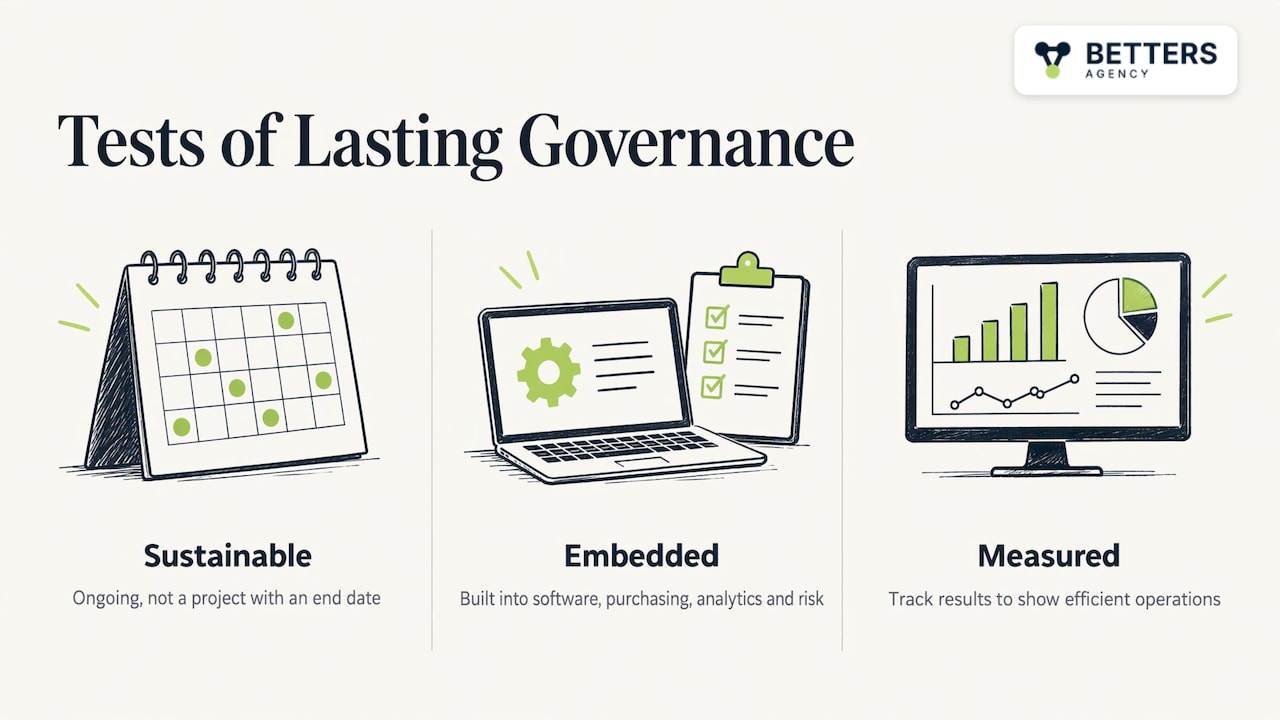
The Texas guide states that an effective program must be sustainable (ongoing, not a project with an end date), embedded (incorporated into software development and purchasing, analytics and risk management) and measured (results tracked to show efficient operations). We use these as a practical test. If governance lives only in a document, it is not embedded. If it ended when the consultants left, it was not sustainable. If nobody can show a trend in data quality, it is not measured.
Who is accountable: owners, stewards and custodians
The Commonwealth of Virginia’s enterprise information architecture standard defines three pivotal roles:
- Data owner: a senior executive accountable for quality, accuracy, integrity and value, with authority over usage, classification and access decisions.
- Data steward: a subject-matter expert who handles day-to-day quality, definitions, metadata and access labeling.
- Data custodian: technical staff who manage storage, backups, recovery and security controls.
Oklahoma’s state data governance resources draw a useful line between governance as a strategic function and stewardship as a tactical one: governance covers committees, principles, policies and roles, while stewardship covers defining key data, business rules, quality targets and remediation.
In a growing firm, the owner of client data is typically the head of sales or client services, the steward is a power user in that group, and the custodian is whoever administers the platform. Writing these three names down, and giving the steward actual time to do the work, is the single most effective first step. Our guide to a data stewardship charter shows how to document those responsibilities, and our piece on a data quality ownership model shows how to attach them to project delivery.
Choosing a model: centralized, federated or hybrid
Boston Consulting Group advises treating governance design as a spectrum. Standards, central regulation policies and compliance requirements can be centralized for consistency, while data curation and processing can benefit from domain-driven governance. Size, data maturity and legacy systems influence how far to centralize. BCG also cautions that decentralization is not right for organizations with insufficient data maturity, where it can multiply inconsistent versions of the truth.
In plain terms:
- Centralized: one group holds the decision rights. It suits smaller firms and early programs. The risk is a bottleneck as the number of data uses grows.
- Federated: departments or domains decide under shared standards. It suits large, diverse organizations with strong domain expertise, and it needs enforcement to avoid drift.
- Hybrid: policy, standards and escalation stay central while domains handle daily work. For most firms past the first stage, this is the practical answer.
For the firms we work with, a hybrid arrangement is usually the natural fit: a small governance group sets definitions and access rules, and each department keeps a steward for its own records. The trade-off is that hybrid models need a clear escalation path when two departments disagree. If you cannot name who breaks the tie, choose a more centralized design until you can.
Governance across your CRM and business systems
This is where most governance efforts succeed or fail. Dun & Bradstreet illustrates the problem with a customer known as one name in sales, another in billing and a third in logistics: to an automated invoicing system, these are three separate entities, which skews analytics and creates rework. The same source describes survivorship rules, for example that a phone number updated yesterday in the CRM should overwrite one updated last year in the ERP.
Those are governance decisions, and they have to be implemented as configuration:
- Define the record of truth. Decide which system owns each entity, such as accounts, contacts, projects and invoices, before integrating anything.
- Set standards in the platform. Required fields, controlled picklists and duplicate-detection rules enforce definitions at the moment of entry. Our article on preventing duplicate CRM data walks through the cross-functional side of this.
- Control access by role. Security roles and field-level permissions in Dynamics 365 and Dataverse put the owner’s access decisions into practice. Billing leakage is often an access problem, which we cover in governing access to prevent billing leakage.
- Control change. The Dun & Bradstreet framework points out that adding a new CRM field can compromise downstream financial reporting if nobody reviews it. A change-approval step prevents that.
- Govern the automations. Microsoft’s Power Platform governance whitepaper says governance should be embedded across the full lifecycle of apps, flows and agents. Every Power Apps app and Power Automate flow should have an owner, an environment strategy and monitoring.
- Keep an audit trail. Lineage and exception records show how a figure was produced. See how leaders evaluate data lineage and exception audits.
For a fuller treatment of the CRM layer, our CRM governance framework sets out the practical structure.
Governing AI and Copilot use
IBM notes that modern programs must account for AI inputs and outputs, including retrieval-augmented generation systems, vector databases and agents that access data in place of human employees. When you add Copilot or custom agents to Dynamics 365, the same ownership, classification and access rules decide what those agents can read and write. Regulated sectors feel this first. For insurance and professional services organizations, governance controls for responsible insurance AI illustrate how security and privacy requirements shape what an automated workflow may touch.
IBM also observes that governance supports compliance with U.S. rules such as HIPAA and industry requirements such as PCI DSS. Which of these applies to you depends on your sector, and your counsel or compliance officer should confirm the obligations that bind your firm.
Where to begin
A workable first ninety days does not require an enterprise-wide program. It requires a narrow scope with real consequences:
- Pick the one domain whose errors cost you most, usually client and account data, or project and billing data.
- Name an owner, a steward and a custodian for it.
- Write the five or six definitions people dispute, such as what counts as an active client or a billable hour.
- Implement those definitions as validation and duplicate rules in the system.
- Track two or three measures, such as completeness of required fields and duplicate rate, and review them monthly.
Then extend to the next domain. This sequence keeps the program sustainable, embedded and measured in the Texas sense, and it produces visible results before executive attention fades.
Where this advice is wrong for you
We name the exceptions because they matter. If your firm is a handful of people with one system and a simple sales process, a full governance structure is more overhead than value; a light set of naming and access rules is enough. If your main need is marketing automation or a fast-deploy sales pipeline, Salesforce, HubSpot or HighLevel are sometimes the better choice, and we will say so. And if nobody in the business will own data decisions, no platform configuration will compensate: governance needs a human who is accountable. Our comparison of Dynamics 365 against Salesforce and HubSpot lays out when each fits.
Our perspective on governance
Most governance failures we see described are architecture failures that were disguised as policy failures. The policy was fine; the system was configured before anyone decided what a customer, a project or an owner was. That is why we insist on getting architecture and data decisions right before anything is configured.
We are a small firm and an independent Microsoft partner, and you work directly with the person who builds your system. That matters for governance because the person who hears why a definition is contested is the same person who writes the validation rule, so intent is not lost between a sales conversation and a build.
Our work spans Dynamics 365, Power Platform, custom development, Copilot and AI solutions, and automation, and we treat governance and data integrity as part of each of them rather than a phase at the end. Our track record includes 100+ production automations and 5,000+ users onboarded, and adoption is part of governance: a rule people route around is not a rule.
Our advice is to start small, name owners early and let the platform enforce what the policy says.
Derek
How we help
Our governance and data integrity work covers the decisions this guide describes: architecture and data models, ownership, security roles, duplicate and validation rules, automation oversight and the adoption support that keeps them in use. The scope and process are described on our data governance consulting page, and the full list of what we deliver is on our services page. Our Dynamics 365 Sales CRM package starts from $1,495 one-off, and package details are on the packages page.
If your CRM, project and billing systems disagree, the quickest route is a conversation about which domain to govern first, and you can start one through Betters Agency.
FAQ
What is the difference between enterprise data management and data governance?
Data management is the overall practice of collecting, processing, storing and securing data. Data governance is the part that sets the policies, standards and accountability for how that work is done, a distinction IBM draws when it calls governance a subset of management. Governance decides who may do what with data, and management carries it out.
Who should own data governance in a mid-sized company?
Accountability belongs with a senior business executive for each data domain, not with IT alone. Stewards from the business handle daily quality, and technical staff act as custodians of storage and security. A small council, often the department heads plus whoever administers the platform, sets cross-domain standards.
Does data governance apply to a CRM like Dynamics 365?
Yes. A CRM holds some of the most shared and most disputed data in the firm, so ownership of records, field standards, duplicate rules and access roles are governance decisions made inside the platform. Our CRM governance guide covers the structure.
How long does it take to see results?
Results depend on scope. A single domain with named owners and enforced validation rules can show measurable improvement in completeness and duplicate rates within a few review cycles, while enterprise-wide programs are ongoing by design. Track a few measures from the start so progress is visible.
Sources
- Databricks: Enterprise Data Governance, A Complete Modern Framework
- TechTarget: What is data governance and why does it matter?
- IBM: What is Data Governance?
- Texas DIR: Data Management Framework Fast Start Learning Guide
- Deloitte: Data governance for next-generation platforms
- Data Governance Institute: 2014 Data Governance Framework
- Commonwealth of Virginia: Enterprise Information Architecture standard
- Oklahoma OMES: Data Governance Resource Index
- BCG: Federated Data Governance
- Dun & Bradstreet: Data Governance in the Age of AI
- Microsoft: Power Platform admin and governance whitepaper
Recommended
- Enterprise Data Integration: A Practical Guide for Growing Firms
- Data Governance Consulting: Scope, Process and How to Choose
- CRM Governance: A Practical Framework for Business Leaders
- Leaders: Assess Data Stewardship Charter
Articles are for informational and educational purposes only, Betters Agency LLC is not a licensed financial advisor or legal counselor and does not provide these services, readers are encouraged to check multiple sources for accuracy.