
Blog
PSA Estimating Accuracy Scorecard Implementation Checklist
nbetters · · 18 min read
Professional Services Estimating Accuracy Diagnostic Scorecard Implementation Guide Minnesota professional services firms can implement an estimating…
Professional Services Estimating Accuracy Diagnostic Scorecard Implementation Guide
Minnesota professional services firms can implement an estimating accuracy diagnostic scorecard by freezing each approved estimate, aligning delivery actuals to the same comparison grain, separating approved scope change from baseline error, and assigning an owner to review variance and update estimating standards. The scorecard is an operating control. It is not a packaged Microsoft feature, and software alone will not create the learning loop.
This professional services estimating accuracy diagnostic scorecard implementation guide lays out the data model, calculation choices, Microsoft options, validation tests, failure handling, and rollback plan needed to make that control dependable. It is designed for operations, finance, delivery, PMO, and business application owners who need a reproducible implementation rather than another dashboard with unexplained percentages.
Start with the operating decision
Before designing fields or reports, decide what the scorecard must change. A useful answer is specific: it should help an estimating leader identify where approved estimates repeatedly diverge from delivered effort, cost, schedule, or role mix, then decide which estimating assumption, template, review gate, or delivery practice needs attention.
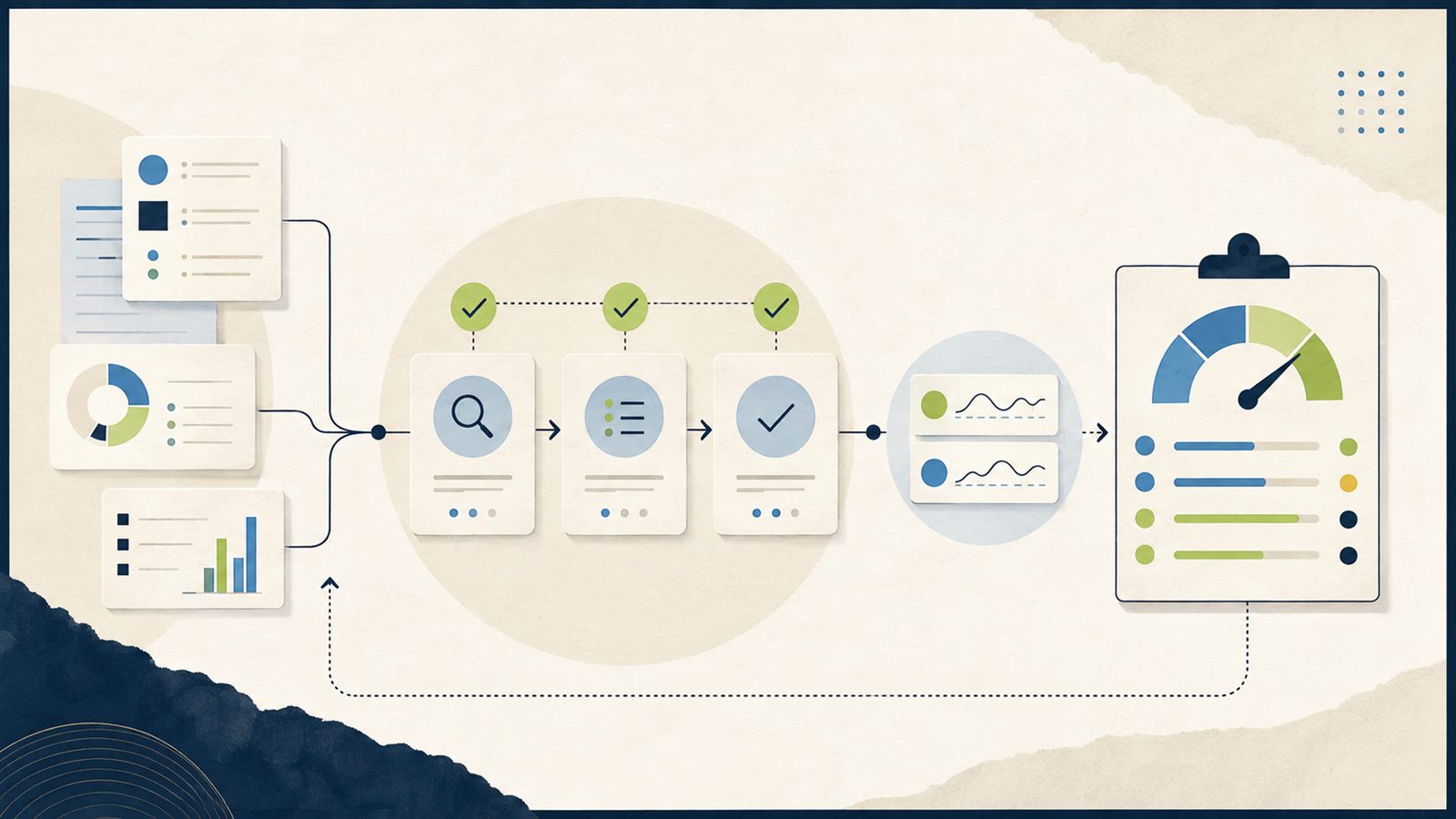
That decision creates a bounded workflow:
- Approve and freeze an estimate version.
- Deliver the project while retaining approved scope changes.
- collect actual time, expense, fee, and delivery-date records.
- Normalize the baseline and actuals to a common grain.
- Calculate signed and absolute variance.
- Review the result by meaningful cohort.
- Record a finding, owner, action, and follow-up date.
- Feed accepted learning into future estimating standards.
This sequence matters because a visually polished scorecard can still mislead. If reopened estimates overwrite the baseline, late time entries arrive after the review, or scope changes are blended into the original promise, the displayed variance no longer answers a stable question.
Name an executive sponsor, an estimating process owner, a delivery operations owner, a finance or commercial owner, a data owner, a platform owner, and a report owner. Smaller firms may assign several responsibilities to one person, but the responsibilities should remain explicit. The estimating owner defines how learning changes future standards. Delivery operations owns timely, usable actuals. Finance governs cost, rates, currency, and commercial interpretation. The data owner defines keys and quality rules. The platform owner manages environments and automation. The report owner protects calculation and filter definitions.
For Twin Cities firms operating across multiple service lines, this role clarity is especially useful when one central team supports several practices. Each practice may interpret complexity differently, while finance and operations still need one controlled definition for the enterprise scorecard.
Establish prerequisites and stop conditions
Implementation is ready to begin when the team can identify an approved estimate, preserve its version, find corresponding delivery actuals, and name the person responsible for resolving exceptions. Begin with a limited cohort, such as one service line or project type, where the source records can be reconciled manually.
Use these prerequisites:
- A stable project or engagement identifier carried from estimate through delivery.
- A clear approval event and timestamp for the baseline.
- Estimate lines or work packages with quantities, roles, rates, currency, dates, and assumptions where applicable.
- Actual time, expense, fee, and delivery-date records that can be associated with the same project and comparison unit.
- A governed record of approved scope changes.
- Defined accounting and operational periods.
- Named owners for data quality, calculation logic, review, and remediation.
- A test environment and a representative test set.
- A retention decision for baseline versions, changes, actuals, calculations, and review notes.
Pause the implementation when the project key changes between systems without a dependable cross-reference, approved estimates cannot be distinguished from working drafts, or actuals routinely arrive after the intended review window with no correction process. Those conditions make the scorecard ambiguous. Fixing the input workflow comes before automating interpretation.
A controlled spreadsheet can be a reasonable pilot for a low-volume practice. It can prove the fields, grain, formulas, review cadence, and ownership before platform work begins. A warehouse and BI layer may fit when the firm already has governed analytics infrastructure. Dataverse, Power Automate, Dynamics 365 Project Operations, and Power BI are optional components. Select them because they fit the operating environment, not because the diagnostic requires a specific product.
Design the canonical data model
The baseline record is the anchor. Create an immutable approved estimate version with a unique baseline version ID, project ID, approval timestamp, approver, estimator, currency context, and change-control identity. Its child lines should retain the estimating detail required for later comparison.
At minimum, consider these line attributes:
- Baseline version ID and estimate line ID.
- Project ID and, when available, task or work-package ID.
- Service line, project type, contract type, and complexity classification.
- Role or labor category.
- Transaction class such as time, expense, or fee.
- Estimated quantity and unit.
- Estimated rate and extended amount.
- Currency and the governed conversion context used for comparison.
- Planned start, finish, or duration where schedule variance is in scope.
- Assumption text or assumption category.
- Estimator and approval identity.
Actual records need their own source identity plus the canonical project and comparison keys. Retain source system, source record ID, ingestion timestamp, posting or work date, transaction class, quantity, rate or amount where applicable, currency context, task, role, and reversal or correction status.
Create a distinct approved-change record. It should identify the affected baseline version, approved change ID, approval time, approver, reason, and the quantities, amounts, dates, roles, or work packages changed. Keeping changes distinct makes two questions answerable: how accurate was the original approved baseline, and how accurately did the team deliver against the currently approved scope?
The scorecard result should also be a governed record. Store the calculation version, cohort definition, as-of timestamp, included and excluded record counts, completeness flags, variance values, score band, reviewer, commentary, action owner, and follow-up status. A displayed score without a calculation version or as-of date is difficult to reproduce after data changes.
Use canonical keys and comparison grain
Grain is the level at which estimate and actual records are paired. A project-level comparison is easy to produce but may hide offsetting errors. A line-level comparison can be precise but unreliable when estimating and delivery use different structures. Choose the lowest stable shared grain.
A practical hierarchy is project, approved baseline version, transaction class, task or work package, and role. When task IDs or roles are unstable, step up to a coarser level and expose that limitation. Avoid fabricating a detailed match from description text alone. Maintain an explicit crosswalk when source and delivery classifications differ.
Canonical keys should survive label changes. Use identifiers rather than project names, client names, or task descriptions. For each actual, construct or resolve a comparison key from governed fields. Route unmatched records to an exception queue. Silent exclusion produces a clean chart and a false conclusion.
Define duplicate detection from source identity and business context. If a source record can be revised, preserve its revision or correction status and make ingestion idempotent. A repeated load should produce the same result rather than another copy of the actual.
Freeze the approved baseline
The snapshot process should run from a controlled approval event. It reads the approved estimate and its lines, assigns a unique baseline version, records the source identifiers and approval metadata, and writes an immutable snapshot. A checksum or row-count control can support later reconciliation, but it does not replace field-level checks.
Use this conceptual flow:
“text when estimate is approved: validate required identifiers and currency context reject or route incomplete records for review create immutable baseline version copy approved estimate lines into baseline lines record source IDs, approval identity, timestamp, and calculation version reconcile source line count and control totals mark snapshot complete only after reconciliation passes “
Reopening an estimate requires an explicit rule. Preserve the original approved baseline. If the reopened estimate becomes a newly approved version, create another version and link it to the prior one. Never update the original snapshot in place. The report can then compare delivery with the original commitment, the current approved commitment, or both, while stating which view is active.
Microsoft documents that project-based quote lines in Dynamics 365 Project Operations can map projects and tasks, billing method, included transaction classes, not-to-exceed limits, and quote-line details used for estimates in applicable deployments. See Microsoft Learn on quoted values and budget limits. Treat those records as possible source material, then preserve the approved snapshot needed by this diagnostic.
Microsoft also documents that quote-line details support estimates for time, expenses, and fees, while material estimates are not supported there, and that estimates can be generated from project plans. Review the Project Operations quote-line estimate guidance against the deployment in use. A firm with material-heavy work needs another governed source for that estimate component.
Ingest and normalize actuals
Actuals ingestion should be repeatable, observable, and reversible. Record the source watermark or extraction boundary, batch ID, row counts, rejected rows, and run time. Land source values before applying transformations so a calculation can be traced back to what arrived.
Normalize transaction classes, units, roles, tasks, dates, and currency before comparison. Maintain mappings as governed reference data with effective dates and owners. When a consultant changes role halfway through a project, retain enough detail to explain whether variance came from effort, rate, or role mix.
Late time entry deserves explicit handling. Store both work date and ingestion or posting date. Publish the scorecard with an as-of date and a late-entry exposure flag. Recalculate an affected period through a controlled refresh, retain the prior result where audit needs require it, and explain the revision to reviewers. The team can then distinguish a real estimating miss from incomplete actuals.
For duplicate actuals, identify records using the source record ID plus any required revision context. Quarantine conflicting duplicates. For reversals or corrections, keep the relationship to the original transaction and calculate the net effect according to the governed accounting rule.
Currency conversion needs one documented convention. Record the source currency, comparison currency, rate source identity, effective date convention, and converted value. Avoid interpreting currency movement as estimating accuracy. Depending on the business question, report operational quantity variance separately from financial variance so exchange-rate effects remain visible.
Define calculations before score bands
Write a calculation dictionary in plain language and formula form. Give each measure an owner, version, grain, inclusion rule, exclusion rule, and test case.
For an estimated value E and actual value A, signed variance can be expressed as:
“text signed variance = A - E signed variance percent = (A - E) / E “
Absolute variance removes direction:
“text absolute variance = absolute value of (A - E) absolute variance percent = absolute value of (A - E) / E “
Handle a zero estimate as an exception or a separately defined case because percentage variance has no meaningful denominator. State whether positive signed variance means an overrun in the displayed context.
Report both signed and absolute variance. Signed results show direction. Absolute results show error magnitude and prevent favorable and unfavorable misses from canceling each other in an average. When aggregating percentages, prefer a clearly defined weighted calculation based on underlying quantities or amounts over a casual average of line percentages. Document the choice.
Separate these diagnostic dimensions:
- Estimate completeness: required fields present at approval.
- Effort variance: estimated versus actual labor quantity at the common grain.
- Cost variance: estimated versus actual cost under the governed financial definition.
- Schedule variance: planned versus delivered dates or durations under a stated convention.
- Rate and role mix variance: effect associated with different rates or staffing mix.
- Change-order separation: amount or effort tied to approved changes rather than the baseline.
- Late-entry exposure: actuals arriving after the scorecard as-of boundary.
- Sample sufficiency: whether the cohort contains enough comparable observations for interpretation.
- Learning-loop completion: whether reviewed findings received an owner, action, and follow-up.
Score bands must be locally baselined and governed. Avoid universal red, amber, and green thresholds. Start by observing a representative historical cohort, checking data quality, and agreeing on action-oriented bands. Label low-volume cohorts and suppress a comparative rating where the sample cannot support a useful conclusion. The score is a prompt for review, not a substitute for judgment.
Account for Project Operations pricing behavior
For firms using Project Operations, understand how source estimates were produced. Microsoft documents that financial time estimates derive from resource assignments, work attributes, rates, and distributed effort, with parent-task estimates summarizing child tasks. It also notes that on-demand pricing can leave prices at zero until Update prices runs. See Microsoft Learn on resource estimates.
That behavior creates a concrete validation control. Before freezing an approved baseline, test for missing rates and unexpected zero prices. Route failures to the estimator or commercial owner. If on-demand pricing applies, confirm the governed approval workflow includes the required pricing update before snapshot completion. The exact configuration matters, so validate behavior in the tenant instead of assuming every deployment acts alike.
Microsoft further documents that resource-assignment contours can be edited by task or resource to refine distributed effort estimates. The resource assignment guidance can help teams interpret how planned effort was distributed. Preserve the approved values used for the baseline because later contour edits should not silently rewrite the historical comparison.
Set security and governance boundaries
Treat baseline approval, actual ingestion, calculation, review, and standards updates as separate responsibilities. Use access appropriate to each role. Estimators may prepare estimates, while an authorized approver controls the baseline event. Integration identities write staged actuals. Calculation jobs read governed inputs and write versioned results. Reviewers add commentary and actions without changing source history.
Restrict direct edits to immutable baseline records and calculated outputs. Provide a correction workflow that records who requested a change, why it was needed, what record it supersedes, and who approved it. Retain operational logs long enough to investigate a disputed result under the firm’s policy.
Power Platform governance guidance recommends environment strategy, data policies, application lifecycle management, reusable components, documented standards, and a community of practice. Review Microsoft’s Power Platform adoption guidance as guidance, then adapt it to the firm’s ownership model. It is neither a mandatory architecture nor a guarantee of outcomes.
Keep development, test, and production changes controlled. Store solution components and calculation definitions under version control where the implementation supports it. Require review for changes to keys, mappings, formulas, score bands, or security roles. A scorecard version should identify the definition set used to calculate it.
Build automation around exceptions
Automation should move records through a controlled state model. Useful states include pending snapshot, snapshot validation failed, baseline active, actuals incomplete, ready to calculate, calculated, review required, action assigned, and closed. Each failure state needs an owner and a next action.
Use notifications for actionable exceptions such as missing rates, unmatched actuals, failed reconciliation, stale refresh, newly reopened estimates, or overdue review actions. Avoid flooding users with a message for every successful record. A daily exception summary may fit a moderate-volume workflow, while urgent baseline failures may require immediate routing. Choose frequency from the operational need.
If Power Automate is used, keep the flow subordinate to the state model and data contract. Record a run correlation ID and batch ID. Make repeated triggers safe. A failed step should leave the record in a diagnosable state rather than marking the process complete.
Build the reporting and Power BI layer
The report should answer four questions in order:
- Is the data complete enough to interpret?
- Where is variance concentrated?
- Which driver appears relevant?
- What action is owned and due?
Begin with coverage, excluded records, unmatched actuals, late-entry exposure, and cohort size. Then show signed and absolute variance by service line, project type, estimator, delivery lead, contract type, complexity, and period where those dimensions are governed. Provide drill-through from a cohort to the projects and lines contributing to it. Display the calculation version and as-of timestamp.
Power BI scorecards can track goals against objectives and connect current or target values to report data, with connected values following underlying refreshes. See Microsoft Learn on connected goals in Power BI scorecards. Licensing and capacity must be checked for the tenant. The diagnostic can also be delivered through ordinary report pages if that better fits the firm’s environment.
Use color as a secondary cue and pair it with labels. A band should map to an action, such as review required, monitor, or insufficient sample. Provide the denominator and included count close to the result. A cohort with two projects should never look equally authoritative to one with a larger, comparable history.
Validate with a controlled test set
Create a small test set where expected outcomes can be calculated manually. Include a clean project, a missing-rate estimate, a zero estimate, an approved scope change, a reopened estimate, two currencies, duplicate actuals, a reversal, late time, an unmatched task, a changed role mix, and a low-volume cohort.
Run these acceptance tests:
- Snapshot immutability: editing the working estimate after approval leaves the stored baseline unchanged.
- Version handling: a new approval creates a linked version and preserves the old one.
- Count reconciliation: copied baseline lines match the approved source under the stated boundary.
- Duplicate safety: loading the same actual batch twice produces the same net result.
- Scope separation: approved change values appear separately from original baseline variance.
- Currency traceability: each converted amount retains its source and effective-date context.
- Late-entry visibility: a late actual changes the appropriate refreshed result and sets the exposure indicator.
- Missing-rate control: the baseline cannot silently pass with an unexpected absent rate or zero price.
- Grain exception: an unmatched actual enters an exception queue and remains visible in coverage metrics.
- Signed and absolute variance: hand calculations agree with the system at line and aggregate levels.
- Sample label: a low-volume cohort receives the governed warning or suppression behavior.
- Learning-loop completion: a finding cannot be closed without its required owner and action fields.
Have finance, delivery, and estimating owners sign off on different aspects. Finance validates financial definitions and currency treatment. Delivery validates task, role, time, and change context. Estimating validates baseline meaning and actionability. The data or report owner demonstrates reproducibility from source records to displayed result.
Troubleshoot common failure modes
Rates or prices are missing
Inspect whether the approved source genuinely contains a rate, whether a mapping failed, and whether the tenant uses a pricing mode that requires an update. Keep the baseline in a failed-validation state until the responsible owner resolves or explicitly governs the exception. Preserve the original source value and the correction record.
Estimates changed after approval
Compare source modification time with baseline approval and snapshot time. Confirm the baseline remains immutable. If the business approved a new version, link and snapshot it. If a working edit occurred without approval, keep it outside the approved comparison and route the process breach to the estimating owner.
Scope growth looks like poor estimating
Trace approved change IDs to the affected work package, quantity, amount, and dates. Present original-baseline variance separately from current-approved-scope variance. Missing change records are a workflow issue requiring commercial and delivery review.
Actuals appear twice
Check source IDs, batch IDs, revision markers, and reversal relationships. Quarantine collisions and rerun from the last trusted ingestion boundary after correcting the mapping or idempotency rule. Reconcile counts and totals before releasing refreshed scores.
Time is still arriving after review
Compare work dates with posting and ingestion dates. Show late-entry exposure and the as-of timestamp. Reopen the affected review through a controlled state transition when the governed correction window requires it. Use the pattern to address time-entry operations separately from estimator performance.
Variance changed after a currency refresh
Identify the conversion convention and rate context used by each calculation version. Separate quantity and source-currency comparisons where useful. Recalculate only through the approved change process and retain the prior result needed for traceability.
A cohort score swings dramatically
Check included project count, mix, exclusions, and unmatched records before interpreting the movement. Apply the governed low-volume rule. A changed project mix may explain the swing without indicating that an individual estimator’s method changed.
Power BI shows stale values
Compare the report refresh time, source as-of time, calculation completion, and any connected scorecard value. Confirm the result record reached its completed state. Treat licensing and capacity as environment-specific checks. The report should display freshness so users can recognize an old result.
Roll back safely
Rollback protects trusted history. Keep immutable baselines, raw landed actuals, approved changes, mapping versions, calculation versions, and review records. If a new mapping or formula creates incorrect results, stop promotion, return the report to the last approved calculation version, mark affected results as superseded, correct the definition in development, and rerun the controlled test set.
After remediation, recalculate the affected scope from preserved inputs. Reconcile old and new results, document why they differ, obtain the required owner approval, and publish with a new calculation version and as-of timestamp. Never repair a bad result by deleting the evidence that explains it.
For an automation failure, disable or isolate the faulty path while preserving queued and failed records. Restore the last approved workflow version, replay only after duplicate controls have been tested, and reconcile source counts, target counts, and totals. Communicate any period whose score changed after publication.
Operational checklist
Before moving the scorecard into routine use, confirm:
- The operating decision and review cadence are written.
- Every responsibility has a named owner.
- Approved estimate snapshots are immutable and versioned.
- Project, version, line, actual, and change keys are stable.
- Estimate and actual grain is documented.
- Scope changes remain separately visible.
- Actual loads are idempotent and reconciled.
- Missing rates, zero estimates, currency, duplicates, reversals, and late entries have explicit rules.
- Signed and absolute variance definitions are versioned and tested.
- Score bands use local evidence and map to actions.
- Low-volume cohorts are labeled or suppressed under a governed rule.
- The report displays coverage, exclusions, as-of time, and calculation version.
- Development, test, production, access, and change controls have owners.
- Monitoring routes exceptions to someone who can act.
- Rollback and replay have been rehearsed.
- Findings feed a controlled update to estimating standards.
Frequently asked questions
Is this scorecard a Microsoft product?
No. It is an operating control that can use Microsoft products where they fit. Dataverse can hold governed records, automation can coordinate states and exceptions, Project Operations can supply relevant estimating records in applicable deployments, and Power BI can present analysis. A spreadsheet, warehouse, PSA reporting layer, or another platform can implement the same core control.
What should we score first?
Start with completeness plus one or two variances that leaders can explain and act on, often effort and schedule for a defined project cohort. Add cost, rate mix, and other dimensions after source quality and ownership are proven. This sequencing is Betters Agency guidance, and the right starting scope depends on the firm’s delivery model.
How many projects are enough for a score?
There is no universal threshold in this guide. Baseline the firm’s own history, define comparability, and govern a minimum sample rule. Show counts and suppress or label low-volume cohorts so a small sample is not presented with false certainty.
Should approved scope changes improve the original score?
Preserve both views. Original-baseline variance explains how the first approved estimate compared with delivery. Current-approved-scope variance explains performance against the authorized revised commitment. Combining them destroys useful diagnostic context.
Can we rank estimators?
Use care. Results can reflect project mix, data completeness, delivery decisions, scope practices, rate changes, and late actuals. Start with process learning and comparable cohorts. Any person-level use needs transparent definitions, adequate samples, and appropriate organizational review.
When is Microsoft a sensible implementation choice?
It can fit when the firm already operates Microsoft 365, Dataverse, Dynamics 365, or Power BI and has owners for the platform, data, workflow, and reporting. Improve the current PSA analytics, use a warehouse and BI, or pilot in a controlled spreadsheet when those paths are simpler and adequately governed.
Turn variance into an owned improvement
The scorecard becomes valuable when a reviewed variance produces a specific change and a later check. Record the finding, affected cohort, evidence, owner, due date, chosen update, and the future projects where the update will be evaluated. That closes the loop from estimate to delivery and back to estimating practice.
Betters Agency sells Microsoft and workflow consulting services, so this is a commercial invitation. If your firm has estimate and actual data but lacks a dependable comparison and learning loop, bring one workflow and one representative project cohort to a review. We can map the baseline, grain, exceptions, ownership, and smallest responsible pilot. Review a Workflow.
Written by Derek Betters. Published September 4th, 2026.
Contact Betters Agency about your next step