Blog
Power Platform Consulting: What to Buy and How to Judge It
nbetters · · 12 min read
Power Platform consulting explained for business leaders: what consultants deliver, how an implementation runs, what drives cost, and how to hold an engagement to results.
Power Platform consulting is paid help designing, building and governing the apps, automations, dashboards and data model that sit on Microsoft’s low-code platform, so that your processes run the way your business actually works. The engagement pays off when the architecture and data decisions are made before anything is configured, and when someone owns governance after launch. We are a small, independent Microsoft partner based in Minnesota, and this guide covers what a good engagement contains, what drives its cost and how you can tell whether it is working.
Key Takeaways
- Power Platform consulting covers Dataverse (the platform’s data layer), Power Apps, Power Automate, Power Pages and Power BI, plus the integrations between them and your CRM.
- The most expensive failures come from missing governance and poor data, not from missing features. Plan both before the first build.
- Cost and timeline follow scope: users, integrations, data condition, customization and compliance, not the tool list.
- Judge a consultant by whether you can work with the person who builds your system, by a walk-through of their method, and by measurable targets agreed up front.
- Dynamics 365 is not always the right answer. Salesforce, HubSpot or HighLevel are sometimes the better choice, and an honest consultant says so.
Table of Contents
- What Power Platform consultants actually do
- Why governance decides whether the platform pays off
- How a CRM or Power Platform implementation runs
- What drives cost and timeline
- What to look for in a consultant
- When Dynamics 365 and Power Platform are not the right answer
- How to tell whether the engagement is working
- Where to start
- Our perspective
- Start with a scoped conversation
- FAQ
- Sources
What Power Platform consultants actually do
The Power Platform is a set of connected Microsoft products: Power Apps for custom business applications, Power Automate for workflows, Power BI for reporting, Power Pages for external portals, and Copilot Studio for AI agents. Underneath them sits Dataverse, the database where the structured business data lives. Dynamics 365 applications such as Sales and Customer Service run on the same foundation, which is why CRM work and Power Platform work overlap so heavily.
Microsoft’s own description of the functional consultant role is a useful baseline. According to the PL-200 study guide, the consultant performs discovery, captures requirements, works with subject matter experts and stakeholders, and configures solutions using Dataverse, Power Apps, Power Automate cloud flows, Power Pages and environments. They also implement a solution architect’s design and build third-party integrations.
In practice that breaks into the following kinds of work:
- Strategy and architecture: deciding what the data model looks like, which processes deserve automation and which should be simplified first.
- Implementation: configuring Dynamics 365 and building the apps and flows around it.
- Custom development and integrations: connecting the platform to accounting, ERP, document and line-of-business systems when standard connectors fall short.
- Governance and data integrity: environment strategy, ownership, security roles, naming standards and data quality rules.
- Adoption and enablement: training and rollout so people use the system instead of working around it.
- Reporting: Power BI models and dashboards that leadership can trust.
- Copilot and AI solutions: agents and AI steps inside workflows, built on data that is already clean.
Our services cover each of these areas, from Dynamics 365 implementations to Power Platform customization and business process automation.
Why governance decides whether the platform pays off
Low-code tools make building easy, which is exactly the risk. When anyone can create a flow or an app, the platform fills with things nobody owns.
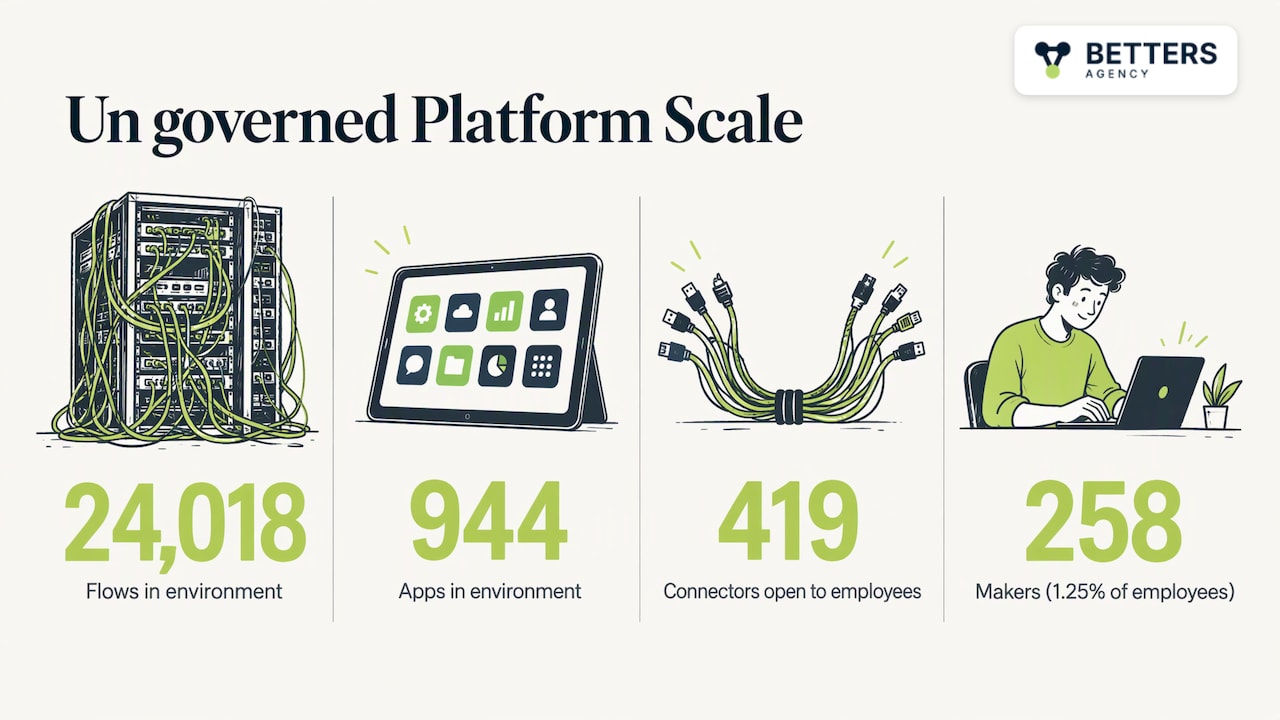
A peer-reviewed HICSS-55 study of a multinational consumer goods company shows how far this can go. Its ungoverned Power Platform held 24,018 flows and 944 apps, with 419 connectors open to every employee, while only 258 people (1.25% of employees) were actually making things. In that single environment, 695 flows used connectors that link internal data to external services, with no ownership controls or usage monitoring. The authors name organizational misalignment, low technical quality and data security and integrity issues as the recurring challenges.
That is a very large enterprise, and a growing business will not see those numbers. The mechanism is the same at any size: unowned automations, open connectors and one shared environment. Microsoft provides tooling for this. Managed Environments add sharing limits, weekly usage insights, data policies and solution checking for admins, and the Center of Excellence Starter Kit offers a reference implementation for governance, monitoring and adoption.
A consultant’s job is to decide how those controls apply to your company: which environments exist, who may build what, which connectors are allowed to touch customer data, and who is responsible when a flow fails at 2 a.m. This is a design task, and it is far cheaper before the first production flow than after the hundredth. Our governance and data integrity work is built around this idea, because systems tend to decay when nobody owns the rules.
How a CRM or Power Platform implementation runs
Whether the project is a Dynamics 365 rollout or a set of custom apps, the sequence is consistent. Microsoft’s CRM Implementation Guide lays out phases that map well to what you should expect.
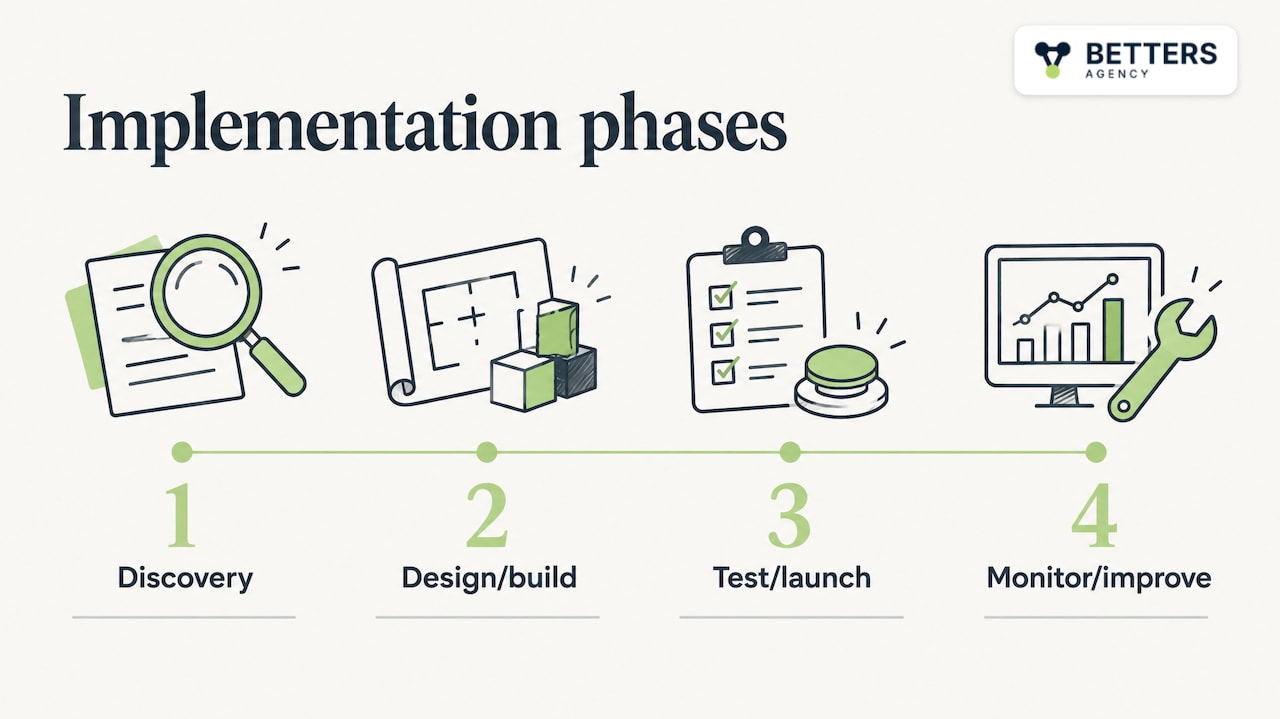
1. Discovery and planning
The consultant maps how work flows today, designs the target process, sets decision rights and writes project, change and risk plans. This is where most of the value is created or lost. If a process is unclear on paper, automating it only makes the confusion run faster.
What it takes from you: a person with authority to decide how a process should work, and access to the people who do the work. Where it goes wrong: leadership delegates discovery to whoever has time, and the design reflects one person’s habits. Because we are a small firm, you work directly with the person who builds your system, so what you explain in discovery is not passed through a sales layer before it reaches the builder.
2. Design and build
The platform is configured, integrations are built, security is set, and data is audited, cleaned and migrated in sections with backups. Microsoft’s own implementation guidance notes that source data quality for migration is typically the customer’s responsibility, which is why it needs an early owner on your side. Our data migration framework for business leaders covers the decisions involved.
Where it goes wrong: configuration starts before the data model is settled, and fields, relationships and security roles get reworked three times. We make architecture and data decisions before configuration begins for exactly this reason.
3. Test, train and launch
The guide describes technical testing, user acceptance testing, a pilot, role-based training and support through the first weeks after go-live. Skipping the pilot is the common shortcut, and it usually shows up as a rocky first month.
4. Monitor and improve
Adoption, data quality and KPIs should be reviewed on a regular cadence, because a CRM is a product that keeps evolving. Our adoption and enablement work focuses on this stage, since a system people avoid delivers nothing, however well it was built.
What drives cost and timeline
No honest consultant can quote a serious engagement without scoping it. Microsoft’s guide says effort scales with the scope of the first release, process complexity, the condition of your data, the number and difficulty of integrations, the degree of customization, compliance requirements, the number of users to train and the rollout model. It advises setting the timeline once scope is defined.
That gives you a practical way to estimate where you sit:
| Factor | Lighter engagement | Heavier engagement |
|---|---|---|
| First-release scope | One team, one process | Several departments at once |
| Data | Clean, single source | Duplicates across spreadsheets and old systems |
| Integrations | Standard connectors | Custom APIs, ERP or accounting systems |
| Customization | Mostly standard features | Custom modules and apps |
| Compliance | Standard security | Regulated data, audit trails |
| Rollout | Single go-live | Phased by region or team |
The risk of underestimating is real. One digital transformation study reports that between 2012 and 2016, 55% of ERP implementations exceeded their budgets and 66% ran longer than planned. It attributes the overruns to underestimated scope, unforeseen technical hurdles and organizational resistance, and it warns that unreliable migrated data, such as wrong customer information, quickly sends users back to their old methods.
For reference, our published packages begin with Dynamics 365 Sales CRM from $1,495 one-off and Dynamics 365 Project Operations from $2,995 one-off. Broader work such as custom development or integrations is scoped to your process, which is how it should be.
What to look for in a consultant
The PL-200 guide gives you a vocabulary for the skills: discovery, requirements, stakeholder engagement, configuration across Dataverse, Power Apps, Power Automate, Power Pages and environments, integrations, training documentation, application lifecycle management (how changes move from development to production) and quality assurance. Turn that into questions you can ask:
- Who will build my system? Ask to meet that person before you sign, not only a salesperson.
- Can you walk me through your method? You should hear discovery, design, data migration, testing and support in a clear order.
- How do you handle governance? Look for specifics on environments, ownership and data policies.
- Which automation tools do you know? The best answer for your process may be Power Automate, or it may be UiPath, Zapier, Make or n8n for particular jobs. We work across all of them, alongside Dynamics 365, custom development and Copilot agents.
- What do you expect me to own? Microsoft’s guidance lists scope definition, to-be processes, user training, UAT, security definitions and cutover among the areas typically outside a partner’s responsibility, so a good consultant tells you plainly what falls to your side and helps you prepare for it.
- What happens after go-live? Ongoing support should be discussed before the project starts.
We are an independent Microsoft partner, which means the recommendation is about fit for your process, not about steering you toward a single vendor’s catalog.
When Dynamics 365 and Power Platform are not the right answer
A trade-off belongs in any honest recommendation. Dynamics 365 with the Power Platform fits best when your processes are specific, when you want CRM, automation and reporting on one data foundation, or when you already run on Microsoft 365. Its flexibility comes with a cost: more decisions up front, and more need for governance.
Salesforce, HubSpot or HighLevel are sometimes the better choice. HubSpot can suit a company whose priority is marketing and a straightforward sales pipeline with fast setup. HighLevel is often chosen by agencies that want funnels, messaging and client sub-accounts in one place. Salesforce can be the sensible pick when your organization already has deep Salesforce skills and a mature configuration. If that describes you, a Power Platform build may be the wrong recommendation, and we would tell you so. If your needs are more specific, our comparison of Dynamics 365 against Salesforce and HubSpot sets out the criteria in detail.
How to tell whether the engagement is working
Efficiency gains are only real if you defined them before the work started. Agree three kinds of measure in discovery:
- Process measures: time from lead to quote, number of manual handoffs, time to close a project’s billing, rework from bad data.
- Data measures: duplicate rate, percentage of required fields completed, number of records with a named owner.
- Adoption measures: active users by role, share of work happening in the system rather than in spreadsheets and email.
Capture a baseline before configuration, then review at set intervals after go-live, the same cadence Microsoft’s guide recommends for adoption, data quality and KPIs. If a measure does not move, the cause is usually one of three things: the process was automated before it was fixed, the data feeding it is unreliable, or people were not trained for their role. All three are visible in the review, which is why the review has to be scheduled and not left to chance.
For leadership reporting, a Power BI layer on top of clean Dataverse data lets executives see the same numbers the teams see. Our guide to CRM visibility for executive operating reviews goes deeper, and the CRM implementation ROI guide explains how to frame the return.
Where to start
If you are comparing options for automation work, our overview of Power Platform against other business automation approaches helps you frame the decision. For a technical walkthrough of delivery, see the guide to implementing Power Platform services.
Our perspective
We build these systems for a living, and the pattern we see most often in our field is simple: businesses buy software when what they need is a process that works.
A good Power Platform engagement starts with the process, not the tool. We settle the architecture and the data decisions first, then configure. That order is slower in week one and much faster by month six.
Governance is the part buyers skip and then regret. We treat it as part of the build, with ownership, security and data rules designed alongside the first app, so the system stays usable as it grows.
Because we are a small firm, you deal with the person who does the work. Across our projects we have delivered 100+ production automations, onboarded 5,000+ users and produced $10M+ of finance-validated benefit. Those numbers matter to us because adoption and measurable results are what we are paid for.
And if Salesforce, HubSpot or HighLevel is the better fit for your situation, we will say so before you spend anything.
Derek
Start with a scoped conversation
If you are a business owner or operations leader in professional services, construction, insurance, legal or manufacturing, the practical next step is a scoped engagement. We offer fixed-entry Dynamics 365 packages for Sales CRM and Project Operations, and scoped work for Power Platform customization, automation, integrations and Copilot and AI solutions.
To discuss your process and what a first release would include, start at bettersagency.com.
FAQ
What does a Power Platform consultant do?
A consultant runs discovery, captures requirements and configures solutions using Dataverse, Power Apps, Power Automate, Power Pages and environments, as Microsoft’s PL-200 study guide describes. They also build integrations and document the result. At our firm, that extends to architecture, governance, Power BI reporting and adoption.
How long does a CRM implementation take?
It depends on scope, not a fixed number. Microsoft’s CRM Implementation Guide ties timeline to first-release scope, data condition, integrations, customization, compliance and the number of users, and advises setting the schedule once scope is defined. A single-team release with clean data moves faster than a multi-department rollout.
Why does governance matter for low-code apps and flows?
Without it, apps and flows multiply with no owners, open connectors and no monitoring, which creates security and data integrity risk. The HICSS-55 study documents this in a large enterprise environment. Tools such as Managed Environments and a defined ownership model keep a growing platform manageable.
What should I prepare before hiring a consultant?
Name a decision-maker for process design, identify who owns your source data, and write down two or three outcomes you want to measure. Microsoft’s guidance lists scope definition, data quality for migration, user training and UAT among the areas typically on the customer’s side, so having owners ready shortens discovery.
Sources
- Study guide for Exam PL-200: Microsoft Power Platform Functional Consultant
- CRM Implementation Guide | Microsoft Dynamics 365
- How to approach a Dynamics 365 implementation project
- Towards a Governance of Low-Code Development Platforms (HICSS-55)
- Managed environments overview
- Power Platform Center of Excellence (CoE) Starter Kit overview
- Digital Transformation through Enterprise Systems (IJISRT)
Recommended
- Power Platform vs PSA Software Solutions
- Power Platform PSA Consulting vs Alternatives
- Power Platform for PSA: Key Risks & Value Drivers
- Power Platform vs PSA Software for Consulting Firms
Articles are for informational and educational purposes only, Betters Agency LLC is not a licensed financial advisor or legal counselor and does not provide these services, readers are encouraged to check multiple sources for accuracy.