
Blog
Manual Reconciliation with Power Platform Guide
nbetters · · 20 min read
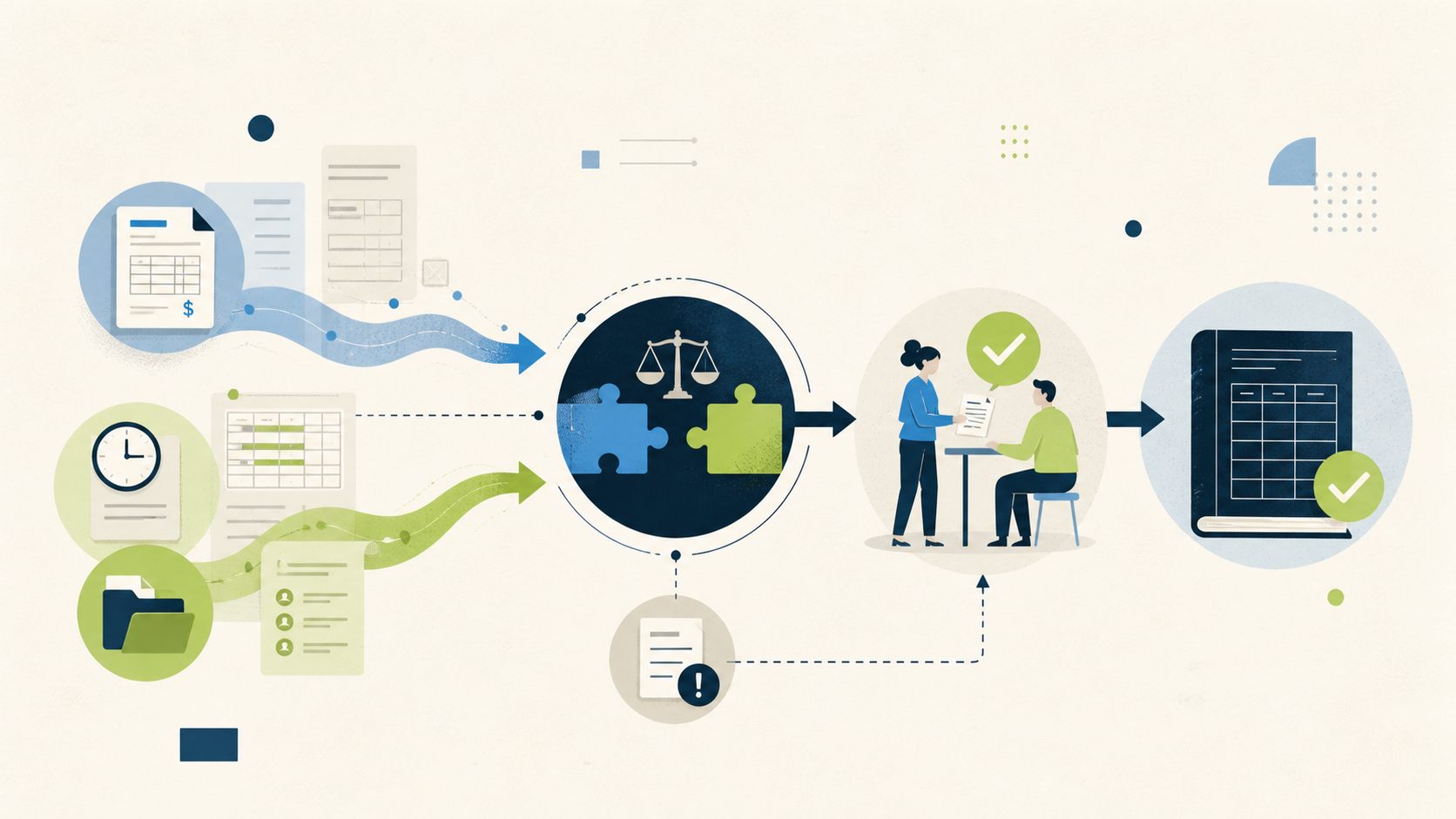
Give it a named process owner, a declared matching policy, and a baseline that shows the current burden.
Manual Reconciliation Automation With Microsoft Power Platform Implementation Guide
When two systems disagree, start with one bounded reconciliation case instead of automating the spreadsheet. Give it a named process owner, a declared matching policy, and a baseline that shows the current burden. Measure the same population before and after release: cases received, records matched without review, exceptions by reason, duplicate events, replayed cases, unresolved case age, and human review effort. Those measures show whether the workflow became more controlled without promising a financial result.
For Minnesota and Twin Cities professional services firms, a useful manual reconciliation automation with Microsoft Power Platform implementation guide should turn a recurring comparison into an auditable case flow. Source A and source B enter a controlled staging boundary. Their business keys, dates, currencies, statuses, and precision are normalized. Match rules run in an approved order. The system records matched, unmatched, ambiguous, and duplicate outcomes. People review only the exceptions assigned to them, and the case ledger retains the decision, reason, actor, time, and evidence.
This approach fits a Microsoft-centered organization that has stable source ownership, repeatable matching rules, accountable exception reviewers, and enough reconciliation work to justify a governed application. A process repair may be the responsible choice when the real problem is unclear ownership or inconsistent source entry. An existing ERP-native reconciliation feature may fit when the ERP already owns the complete process. A data-engineering platform may fit higher-volume or lower-latency workloads that exceed the operating design. A specialist RPA product may fit a UI-dependent estate with mature bot operations. Decide the workflow boundary before choosing the mechanism.
Define the release boundary and prerequisites
Start with one reconciliation, one accountable owner, and one release population. Avoid a program-wide promise to reconcile every system. A bounded first release might compare approved project records with an invoicing extract for one business unit and one period. The organization’s approved process evidence supplies the exact sources and rules; this example supplies only the control pattern.
For a Twin Cities professional services firm with Microsoft-centered operations, keep that first boundary narrow enough that its project-record owner, invoicing-input owner, exception reviewers, and Power Platform support owner can jointly accept it. This local operating context changes no control requirement. It makes ownership and support coverage concrete for the intended Minnesota reader.
The process owner approves the purpose, population, cutoff, tolerance policy, and exception categories. Each source owner confirms the authoritative identifiers, extract timing, correction route, and evidence that an input completed. A data owner approves normalization rules and retention. A platform owner controls environments, solution components, connection references, environment variables, deployment evidence, and monitoring. Security and compliance owners decide access, identity, data handling, auditing, and retention requirements. An operations owner accepts alerts and replay work. Exception reviewers need a documented decision scope, while a business approver owns changes to the match policy.
Collect a baseline before configuration. Count source records, reconciliation cases, unmatched items, ambiguous items, duplicates, manual touches, reopened cases, and unresolved case age for the same declared population. Record how the current team detects missing files, partial loads, stale extracts, and late corrections. Preserve the original denominator. A later comparison only means something when the population, cutoff, and measure remain aligned.
Confirm the technical prerequisites through current first-party evidence and tenant inspection. Verify source access, supported connector or API availability, environment strategy, least-privilege identities, Dataverse security design, auditing and retention needs, capacity, monitoring ownership, and support coverage. Verify current Power Automate licensing and connector entitlements before purchase or release. If a source lacks a practical API or connector, desktop automation can be evaluated, but the design must account for machine, session, credential, and exception operations.
The manual reconciliation automation with Microsoft Power Platform implementation guide in this article deliberately leaves tenant-specific schema, licensing, security roles, and connector configuration to accountable design. The supplied evidence clears neither a universal entity model nor an entitlement claim. The implementation contract below names the required behavior and evidence so the team can map it to supported features in its own environment.
Use a case ledger as the control boundary
Treat every reconciliation attempt as a case with a durable ledger. The ledger replaces an invisible flow run as the control boundary. It should retain an immutable case identity, the business population and cutoff, source references, the active match-policy version, current state, outcome counts, exception ownership, replay relationship, and release evidence. The exact names and storage design belong to the approved target schema.
Use immutable source identifiers whenever the source supplies them. A display name, row number, or editable description is a weak identity. Where a source lacks a durable identifier, the source owner must approve a deterministic identity rule and its collision response. Keep the original source values available as evidence. Normalized values support comparison while the original inputs preserve the basis for the decision.
Separate the case ledger from transient orchestration history. Flow history can help diagnose an execution, but the operating record should say what population was processed, which policy ran, which outcomes were produced, who resolved each exception, and whether a replay superseded an earlier attempt. This distinction keeps the workflow observable when execution logs age out or a run is restarted.
Use an explicit state model. A practical contract can include received, staged, matching, exception review, approved, completed, failed, and replay requested. The organization may use different labels. What matters is that every transition has an entry condition, accountable actor, persisted timestamp, success evidence, and exception route. A case cannot jump from received to completed because an automation call returned successfully. Completion requires the declared population, rule version, outcome counts, unresolved-exception test, and approval evidence.
Stage and normalize inputs without hiding source defects
Ingest source A and source B into a controlled staging boundary. Record the source owner, extraction reference, expected cutoff, received time, record count, file or request identity, and a completion signal. Reject or quarantine an input when its identity is missing, its population is incomplete, or its cutoff conflicts with the case. A partial file should produce a visible exception and block reconciliation of the incomplete population.
Normalize only the attributes needed for the approved rules. Common categories include identifiers, whitespace and case handling, dates and time zones, currency codes, decimal precision, status mappings, and null treatment. Write each transformation as a declared rule with an owner and test examples. Preserve the raw value beside the normalized value so a reviewer can explain the result.
Avoid silent coercion. Treat a blank invoice number as missing rather than zero. Route a missing date to the approved null rule. A text amount that cannot be parsed should become a data-quality exception with its source reference. When currency conversion is required, the organization must identify the approved rate source, effective date, precision, and accountable finance decision. Those facts come from the organization’s approved policy.
Add stage acceptance checks before matching begins. Compare the received counts with source evidence, confirm both cutoffs, test required identifiers, detect duplicate source identifiers, and verify the normalization-rule version. Persist the check results. A case that fails staging should transition to an exception state with a named owner and a safe replay route after the source issue is corrected.
Apply deterministic match rules in a declared order
Document the match policy as an ordered decision sequence. Begin with the strongest approved identity, then move to narrower fallback rules only when the business owner accepts their risk. Each rule needs inputs, comparison logic, tolerance, outcome, reason code, and examples for match, non-match, and ambiguity. Keep policy changes versioned. A replay must state which version it used.
Route conflicts that require judgment away from fuzzy or tolerance-based automatic resolution. If two candidates satisfy the same rule, classify the result as ambiguous and route it to review. If one source identifier appears more than once where uniqueness is expected, record a duplicate outcome. If a source record has no counterpart, record an unmatched outcome with its source identity and reason. A matched result should retain the rule that matched it and the paired source references.
Rule order is part of the control. Changing the order can change outcomes even when every individual rule stays the same. Require process-owner approval for a material policy change, preserve the prior version, and rerun a controlled regression set before release. Preserve historical decisions and relate any correction through an explicit correction or replay record.
Store outcome totals against the case ledger: matched, unmatched from source A, unmatched from source B, ambiguous, duplicate, and rejected during staging. Totals should reconcile to the declared population under a documented counting rule. If one source record can participate in more than one outcome, the denominator and aggregation must say so. A dashboard that hides this definition can create false confidence.
Make idempotency race-safe
Idempotency means the same business event can be received again without creating an ungoverned second case or duplicating outcomes. A simple search followed by create is vulnerable when two events arrive together. Select a race-safe pattern supported by the target environment: enforced uniqueness for the approved reservation key, an atomic reservation operation, or serialized single-writer handling. The platform owner must verify the chosen mechanism in the deployed environment and preserve evidence of its behavior.
Define the reservation key from stable business inputs. A reasonable contract may combine the reconciliation type, population owner, source cutoffs, and approved policy version. The exact fields come from the organization’s data model. Persist the reservation result before starting ingestion. If the reservation already exists, link the arriving event to the existing case and record that it was suppressed or attached. If reservation fails for another reason, transition the request to an exception route instead of continuing.
Test concurrency explicitly. Send two events with the same reservation key at the same time. The acceptance result is one authoritative case, one active processing path, and persisted evidence showing how the second event was handled. Then send two legitimate events with different keys and confirm both proceed. Repeat the duplicate event after completion and verify that it links to the completed case or enters the approved replay path instead of creating a silent duplicate.
Idempotency also applies inside the case. Outcome writes should use stable source identities and policy context so a retry cannot multiply matched or exception records. Any product-specific implementation must rely on a verified supported mechanism. This guide defines the acceptance contract while leaving tenant schema and supported race protection to accountable design.
Define activation as a verified operation
Treat activation as a controlled operation with named inputs and durable evidence. Inputs should include the reserved case identity, source A reference, source B reference, population cutoff, match-policy version, normalization-rule version, environment identity, and requested actor or event identity. Validate those inputs before processing.
The activation operation must bind to a product-supported trigger or invocation method that the platform owner has verified for the target environment. Record the bound component version and environment. On success, persist the activation time, component version, correlation identity, accepted case state, and input references. On rejected input, persist the rejection reason and owner. On an execution fault, move the case to failed or exception handling with diagnostic evidence and a replay decision. Completed business evidence requires the persisted case transition in addition to a successful HTTP response or flow start.
Activation acceptance testing should cover a valid request, a missing source reference, an unauthorized request, a duplicate reservation, a transient downstream fault, and a permanent validation fault. Confirm each request reaches the expected persisted state. Confirm an operator can trace the event from its correlation identity to the case, outcomes, exceptions, and release component.
Route exceptions to people with accountable evidence
Automation should narrow human work to cases that need judgment. Create exception categories that operators can understand: missing input, invalid identifier, normalization failure, unmatched source A, unmatched source B, ambiguous candidate, duplicate source identity, approval failure, policy conflict, and technical execution fault. Every category needs an owner, response instruction, evidence, and permitted resolution.
An exception record should retain the case, source references, rule and policy version, reason code, evidence, assigned reviewer, status, decision, decision reason, actor, and time. Keep the distinction between a business exception and a technical failure. A legitimate unmatched item may require business investigation. A failed connector call requires technical recovery. Combining both under failed makes support and measurement less useful.
If the design uses Power Automate Approvals, test the documented failure areas represented in the supplied Microsoft evidence: assignee formatting, attachment handling, Dataverse provisioning, connection ownership, and transient race conditions. Approval is a human decision boundary. Persist the business decision in the case ledger and retain the platform approval reference as evidence. A notification alone is insufficient as the durable decision.
Define separation of duties where the risk requires it. The person who changes a match policy may need a different approver from the person who resolves a material exception. The organization’s accountable security, finance, privacy, and compliance owners decide that boundary. Their judgment and accountability remain part of the automated operating model.
Package the solution and control environment differences
Keep development, test, and production separate. Package solution-aware components and move the same artifact through the approved sequence. Microsoft documents that Power Platform pipelines move solutions through sequential stages, store solution exports, can support deployment approvals, and have specific Managed Environment and service-principal connection conditions. Verify those current conditions for the target tenant before relying on them.
Use connection references and environment variables so a deployment binds to approved environment-specific values without editing logic in place. Name an owner for the underlying connections and for each connection reference. Record which identity executes each component, who rotates credentials, who approves a new connector, and who responds when a reference breaks. Verify the supported connection and service-principal behavior for every selected connector.
The deployment record should identify the solution artifact, source environment, target environment, component version, connection-reference mapping, environment-variable values, approver, deployment result, and validation evidence. Store the success evidence before activation. If binding fails, stop the release and transition to an exception path. Repair environment differences through a recorded, approved deployment change.
Establish rollback before deployment. Preserve the prior approved solution artifact and configuration record. Define which data writes are reversible, which require a compensating action, and which must be retained as audit evidence. Application rollback and data correction are separate decisions. The data owner approves any correction plan.
Apply data policy, security, and licensing controls
Power Platform data policies classify connectors and govern which connectors may share business data. Microsoft also documents an enforcement delay caveat and states that violating resources can be suspended or quarantined. Treat the policy as one connector-governance control. Identity, access, data protection, privacy, monitoring, and compliance require their own accountable decisions.
Design and test the policy scope before release. Record the connector classifications, applicable environments, administrators, exception process, and runtime verification. A policy change can affect running resources, so the change plan needs an owner, impact check, communication route, and rollback decision. The observed runtime result provides enforcement evidence beyond a saved policy screen.
Apply least privilege to source access, staging, case records, outcomes, exceptions, and administrative functions. Separate maker, deployment, service, review, and policy-administration responsibilities where the organization’s risk model requires it. Protect secrets through the approved credential mechanism. Keep real customer, employee, tenant, and confidential data out of screenshots and test evidence unless the relevant handling and permissions are recorded.
Licensing depends on the operating model. The supplied Microsoft evidence distinguishes Premium, Process, Hosted Process, premium or custom connectors, and unattended desktop automation entitlements. Recheck the current Microsoft guide and tenant entitlements on the purchase and release dates. Record the source, date, planned users or processes, connectors, desktop automation needs, environments, and accountable commercial approver. Coverage for a specific design requires that current verification.
Validate the workflow before production
Build a controlled test set that contains known matches, missing counterparts, ambiguous candidates, duplicate identifiers, invalid values, tolerance boundaries, partial inputs, late corrections, and replay cases. Include data that exercises each approved rule and exception path without exposing unauthorized information. Record expected outcomes before running the test.
Validate the entire state model. For every state, prove its entry condition, permitted next states, owner, timestamp, and evidence. Confirm that a rejected activation cannot enter matching, that a failed staging check cannot complete, and that unresolved exceptions block completion when the policy requires resolution. Confirm a completed case retains its policy version and outcome totals.
Run the concurrent-event acceptance test for the reservation key. Run retry tests during ingestion, outcome persistence, exception creation, approval, and finalization. Confirm one authoritative case and one set of outcomes after retries. Introduce a transient fault and verify the approved retry behavior. Introduce a permanent fault and verify that it stops, records evidence, assigns an owner, and remains replayable only through the controlled route.
Test access with representative roles. Verify that source operators, exception reviewers, platform operators, makers, and administrators can perform only their approved duties. Test data policy behavior with the selected connectors and scope. Allow for the documented enforcement-latency caveat, then verify the actual runtime result. Record the observed evidence.
Reconcile the reconciliation. Compare source A population, source B population, staged records, outcome totals, unresolved exceptions, suppressed duplicate events, and completed cases. State the counting rules. Orchestration success is one technical signal; case approval also requires the declared business evidence. The process owner approves the business totals and exceptions; the platform owner approves technical evidence; security and other accountable owners approve their applicable controls.
Define production stop conditions before launch. Examples include an incomplete source population, a conflicting cutoff, an unapproved match-policy version, duplicate authoritative cases, unexplained outcome-total differences, broken connection binding, unauthorized access, or an unresolved critical exception. The organization chooses thresholds from its baseline and risk decisions before the release begins.
Prepare reviewers and operators for release
Treat operational readiness as part of acceptance. The process owner and operations owner train exception reviewers on the approved categories, decision scope, evidence requirements, reason codes, and escalation boundaries. The platform owner trains operators on case tracing, alert intake, technical-fault isolation, support handoff, and the controlled replay path. Security, finance, privacy, or compliance owners introduce the decisions and escalation routes that fall within their accountability. Training materials should use the approved policy version, representative test data, and the same support runbook that production will use.
Before release, each exception reviewer should demonstrate a known unmatched case and an ambiguous case from assignment through a persisted decision. The demonstration includes the selected reason, supporting evidence, actor and time record, and escalation when the decision falls outside that reviewer’s scope. Each operator should trace a case from correlation identity to outcomes, distinguish a business exception from a technical fault, respond through the named support route, and execute a replay rehearsal under the approved authorization. A failed demonstration returns the relevant procedure, role, or configuration to correction before activation.
Introduce support through a short ownership walkthrough that names the intake route, process owner, operations owner, platform owner, source owners, exception-review lead, and specialist escalation contacts. Record who can pause new activations, who approves a replay, who decides a source correction, and who communicates a policy or connection change. The customer defines the support model, escalation thresholds, training format, and acceptance evidence for its environment.
After release, compare use of the workflow with the existing baseline for the same declared population. Review records matched without human review, exceptions by reason, unresolved case age, manual touches, reopened cases, review effort, duplicate events, and replayed cases. Also inspect whether decisions carry the required reason and evidence and whether escalations follow the named route. Those measures can show whether people are using the case flow as designed. The organization sets its own targets and decides whether the evidence supports continuation, repair, narrower scope, or a stop.
Troubleshoot from the case state and evidence
The case never leaves received
Check whether reservation completed, required activation inputs were present, and the accepted event was persisted. Trace the correlation identity to the bound component version. A trigger receipt without an accepted case transition points to activation or binding before matching. Repair the binding through the approved deployment path and preserve the failure record.
One source has fewer staged records than expected
Compare the source completion evidence, cutoff, extract identity, received count, rejected records, and normalization exceptions. Stop matching when the declared population is incomplete. Correct the source or extraction through its owner, then use the controlled replay route. Avoid manually inserting rows into production staging without an approved correction record.
Duplicate cases appear
Inspect the reservation key, uniqueness or serialization mechanism, and concurrent-event evidence. A search followed by create leaves a concurrency gap. Stop new activations if authoritative identity is uncertain. Repair the supported reservation mechanism, decide which case remains authoritative, link or close the duplicate through an approved correction, and rerun the concurrency test.
Outcomes changed after a policy update
Compare the match-policy versions and rule order. Reproduce the old and new results against the controlled regression set. Confirm the change approval and intended population. Preserve both versions and relate any replay to the original case. An in-place rule edit without version evidence weakens the audit trail.
Exceptions are created but reviewers cannot act
Check assignment format, role access, connection ownership, approval provisioning, attachment behavior, and persisted decision mapping. Microsoft documents these as relevant approval troubleshooting areas. Distinguish a notification problem from a missing durable decision. Restore the supported binding and verify that the decision reaches the case ledger.
A data policy change disrupts processing
Compare connector classifications, policy scope, resource state, recent changes, and runtime evidence. Account for the documented enforcement delay. Keep the correction within the approved connector policy. The policy owner decides the correction, and the platform owner validates the affected component after the change.
A replay creates additional outcome records
Inspect stable source identities, policy context, replay relationship, and the idempotent write design. Stop replay if outcome ownership is ambiguous. Correct the supported write mechanism and use a controlled data correction approved by the data owner. Confirm the original evidence remains available.
Rehearse rollback and replay
Rollback has separate component, configuration, and data decisions. For components, restore the prior approved artifact through the deployment path and verify connection bindings. For configuration, restore approved environment values and policy settings only under their accountable owners. For data, prefer a compensating or superseding record when audit evidence must remain intact. Never assume deleting failed cases is an acceptable rollback.
Define the replay request as a governed state. It should name the original case, correction reason, requesting actor, approved policy version, source references, and expected population. Reserve a new attempt identity while retaining the relationship to the original. Confirm the completed original stays visible and the replay produces one controlled outcome set.
Run a rollback rehearsal in test. Deploy the candidate artifact, process the controlled set, introduce the planned failure, restore the prior artifact, verify bindings, and process the regression set again. Record elapsed operational effort from the team’s own test if useful. Keep any recovery-time statement specific to that evidence. Confirm support knows where to find the artifact, evidence, owner list, and replay controls.
Use an operational release checklist
- One reconciliation population, cutoff, owner, and baseline are approved.
- Source A and source B ownership, access, completion evidence, and correction routes are recorded.
- Immutable source identity and collision handling are approved.
- Normalization rules preserve raw values and have test examples.
- Match rules, order, tolerances, outcomes, and policy version are approved.
- Every case state has entry, exit, owner, timestamp, evidence, and exception transition.
- A race-safe reservation mechanism is verified in the target environment.
- Concurrent duplicate and legitimate parallel events pass acceptance testing.
- Activation inputs, supported binding, component version, success evidence, and failure transition are recorded.
- Exception categories, reviewers, decision scope, reason codes, and escalation routes are active.
- Exception reviewers and operators demonstrate decision, evidence, escalation, support handoff, and controlled replay procedures before release.
- Development, test, and production are separated.
- The approved solution artifact, connection references, environment variables, and connection owners are verified.
- Data policy scope and runtime behavior are tested with the documented enforcement caveat.
- Least-privilege roles, identities, secrets, auditing, retention, capacity, and monitoring are approved.
- Licensing and connector entitlements are rechecked against current evidence and tenant facts.
- Retry, dead-letter handling, alerts, support ownership, and controlled replay are tested.
- Source counts, staged counts, outcomes, exceptions, duplicate events, and completed cases reconcile.
- Production stop conditions and rollback decisions are approved before activation.
- The prior artifact, configuration record, data correction route, and support runbook are accessible.
Questions implementation teams ask
Should every unmatched record become an approval?
Only when the approved operating model requires a human decision. Some unmatched results may wait for a later source, some may be valid exceptions, and others may reveal source defects. Define categories and routes before release. Human review should add accountable judgment beyond acknowledgment of an automation output.
Is Dataverse required for the case ledger?
The supplied research recommends Dataverse as a governed system of record when its security model, auditing, retention, and capacity are designed for the organization. Treat that as an architecture recommendation with tenant-specific design requirements. Another durable system can fit when it better owns the data, controls, scale, or support model.
When should desktop automation be considered?
Evaluate it when a source lacks a practical supported API or connector. Include machine, session, credential, exception, monitoring, and licensing operations in the design. Use the current maker guidance and tenant evidence. Select a screen-driven path because the source boundary and operating model support it, rather than for prototype convenience.
Can a data policy prove compliance?
A data policy controls connector data-sharing behavior within its documented scope. Identity, access, privacy, security, monitoring, retention, and compliance decisions remain with the organization’s accountable specialists.
What proves duplicate prevention?
The proof is a concurrent-event acceptance test against a race-safe reservation design. Two same-key events should produce one authoritative case and persisted evidence for the second event. A design description or an existence check leaves that behavior unproven.
What proves the release worked?
Use the baseline for the same declared population. Compare case counts, match outcomes, exception reasons, unresolved age, duplicate suppression, replay results, and review effort. The result should support a decision to continue, repair, narrow, or stop. Targets come from the organization’s evidence and risk decisions.
Primary Microsoft references
- Power Platform data policies
- Manage Power Platform data policies
- Power Platform pipelines
- Power Automate license types
- Troubleshoot Power Automate approval errors
- Power Automate data loss prevention
For investment, ownership, and measurement decisions, read the manual reconciliation automation with Microsoft Power Platform business value framework. For platform direction and credible alternative cases, read manual reconciliation automation with Microsoft Power Platform versus alternatives.
Betters Agency has a commercial interest in providing workflow review, implementation, and support services. If one reconciliation is consuming manual effort or leaving unresolved exceptions, Review a Workflow with Betters Agency. Bring the process owner, current baseline, source boundaries, and one difficult exception to a 25-minute Workflow Opportunity Review.
Contact Betters Agency about your next step