
Blog
PSA Software Evaluation Framework for Business Leaders
nbetters · · 15 min read
A deal is marked won in Dynamics 365, yet delivery cannot see who owns the kickoff, the scope details it needs arrive late, and leaders cannot say which…
Business Process Flow Business Value: A Leadership Decision Framework
For a Minnesota professional services firm, the question of business process flow business value usually arrives with a broken handoff. A deal is marked won in Dynamics 365, yet delivery cannot see who owns the kickoff, the scope details it needs arrive late, and leaders cannot say which stage a project is stuck in. This guide is written for that decision. It covers when a guided stage flow earns its place, when another approach fits better, and how a leadership team should govern, staff, adopt, and measure it. It uses no invented savings figures and treats the choice as an operating investment, not a feature purchase.
Leaders at Twin Cities consultancies, systems integrators, and engineering firms tend to arrive here the same way. Growth adds projects faster than informal handoffs can carry them, and the instinct is to buy or build a tool. The stronger first move is to name the single handoff that costs the most and decide, with clear eyes, whether a guided stage flow is the right instrument for it. That is the whole purpose of the framework below: to turn a capable Microsoft feature into an accountable leadership decision.
What a business process flow is, in plain terms
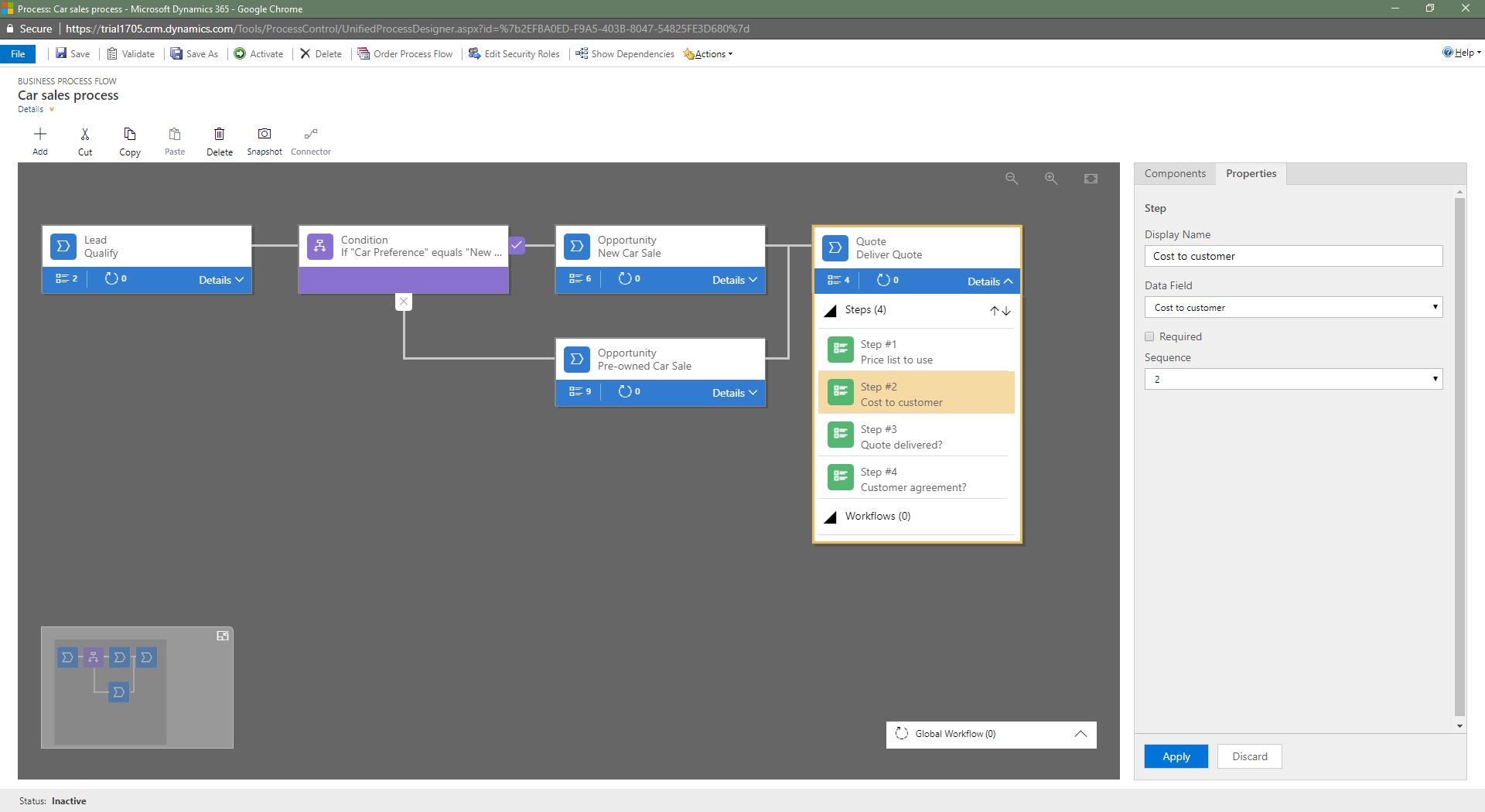
A business process flow presents a stage-and-step guide on a model-driven app form, and its steps map to Dataverse columns. You can mark a step as required so a record stays in its current stage until that value is supplied. That is the core of the control. It guides people through agreed stages and enforces the data the process depends on at each step.
The important boundary is that a business process flow guides work rather than automating it. The flow shapes data entry and stage progression, while the automated work still comes from related business rules, workflows, or cloud flows. Read the value through that lens. A business process flow standardizes how people advance work and what they must capture at each step. That standardization is where its leadership value comes from, or where it fails to materialize.
For a leadership audience, three properties matter most. First, the flow lives on the record form your teams already use, so it meets people where they work. Second, the required-step control turns a soft expectation into an enforced one, which is how a firm makes "capture the budget before kickoff" real instead of aspirational. Third, the flow produces its own data about where work sits, which becomes the raw material for the measurement framework later in this guide.
The business problem worth solving
Most services firms do not lose margin to a missing tool. They lose it to inconsistent handoffs and undefined stages. In a Twin Cities firm running fifteen or more concurrent projects, two account teams may define "qualified" differently, budget details may be entered a week late, and the delivery lead may inherit a record with no clear owner for the next step. A guided flow becomes a candidate answer when the problem is a repeatable, human-driven sequence that everyone should follow the same way.
Name the specific handoff first. If leadership can point to one costly, repeatable stage transition, the flow has something concrete to improve and the investment case has a spine. When leadership cannot name that handoff, the honest conclusion is that the firm has a definition problem or an accountability problem that a stage bar alone will not fix.
Consider a concrete Minnesota example. A Minneapolis engineering consultancy wins a fixed-fee study, and the sales-to-delivery handoff is where money leaks. The account manager knows the verbal scope, the project manager needs it in writing, and the controller needs the billing terms confirmed before work starts. Today that transfer happens in email and hallway conversation, and rework appears two weeks later when an assumption turns out to be wrong. That single transition, from won to mobilized, is the kind of bounded, repeatable, human-guided sequence where a business process flow has a real chance to earn its keep. Start there, prove it, and expand only after the value is visible.
Value levers, stated honestly
A business process flow can move several operating levers. Treat each one as a lever, not a guaranteed return, and tie each to a baseline you measure before and after a bounded pilot. That discipline keeps the business value honest and gives you something to hold the result against.
- Consistent stage definitions, so "qualified" or "ready to deliver" carries the same meaning across teams. A shared definition is what lets a resourcing lead trust a pipeline stage enough to plan staffing against it.
- Required data captured at the right step, which reduces the downstream rework of chasing missing fields. When budget and scope confirmation are required before mobilization, the delivery team starts from a complete record instead of a partial one.
- Visible ownership at each stage, so a stalled record has an accountable next actor. Leaders can ask a precise question, "who owns this record at this stage," and get a precise answer.
- One agreed sequence, which makes onboarding and cross-team coverage more predictable. A new project coordinator in a growing firm can follow the same guided steps that a tenured one does.
- Reporting on where work stalls, because business process flow instance data supports views, charts, and dashboards you can review with process owners. A measurable signal is a prompt for a conversation, and it does not by itself prove that the flow caused the change.
The leadership value of a business process flow is the sum of these levers minus the cost of the controls that make them trustworthy. A later section prices those controls so the comparison is fair.
Design the value baseline before you build
The single most common way these projects disappoint is that no one wrote down what "better" would look like before the build started. Design the value baseline first. For the named handoff, capture the current state in plain numbers your team already believes: how long records sit between the two stages, how often the delivery team reopens a scope question, how many kickoffs start without a confirmed budget. You do not need a perfect measurement system to establish a defensible baseline. You need an agreed number and a date.
Write the baseline as a short, signed statement the executive sponsor and process owner both accept. For example: "Over the last quarter, mobilization started an average of nine business days after the deal was won, and one in four projects reopened a scope assumption in the first month." That sentence becomes the yardstick. If the pilot cannot move it, the honest response is to repair the design or stop, and this guide gives you the rule for making that call.
Where a business process flow is the wrong fit
Value also comes from declining to build the wrong thing. A guided stage flow is the wrong default in several common situations, and naming them protects the budget as much as any feature does.
- When the primary job is event, button, or schedule triggered automation, a Power Automate cloud flow fits better than a human stage guide. A cloud flow is appropriate when automation is triggered automatically, instantly, or on a schedule, and it addresses a different job than guiding a person through stages.
- When the interaction needs a highly tailored interface or data that lives outside Dataverse, a canvas app gives more layout control and broader connector options.
- When the process is short, low-risk, and does not justify a governed application, a lighter checklist or your existing work-management tool is enough. Applying a full guided flow to a trivial sequence spends governance effort you will wish you had saved.
- When the process must coordinate complex events, human tasks, services, and APIs across many systems, evaluate a dedicated orchestration platform. Camunda models processes in BPMN and orchestrates human tasks, services, and APIs through executable process instances and job workers, and owning that path requires BPMN modeling and job-worker engineering as a real capability investment.
A business process flow fits best when the work is data-dense, human-guided progression on related business records. That is exactly the ground model-driven apps are built for, using Dataverse tables, forms, views, and relationships. When your named handoff matches that description, the fit is strong. When it matches one of the situations above, choose the tool that matches the job and treat that choice as a win rather than a compromise.
Honesty about fit is a business-value decision, not a courtesy. A firm that installs a guided flow where a cloud flow belonged pays twice: once for the wrong build and again for the change management to unwind it.
Risk and governance a leader should price in
The value case becomes real only when you also fund the controls. Each control below is ordinary Power Platform work, and each one has a cost that belongs in the investment case from the start.
Security has two layers that leaders should understand at a plain level. Process definitions are associated with security roles, and activating a flow also creates a custom Dataverse table for its process instances. By default only the System Administrator and System Customizer roles have access to that instance table, so the roles that actually run the process need explicit privileges granted to them. Budget for that configuration as deliberate design work, because runtime access is something you grant on purpose rather than inherit.
Stage shape is an information boundary, and this is a subtle risk worth executive attention. Branch conditions depend on the immediately preceding stage, and a user may see a branch stage name and infer sensitive work even when the underlying row data stays inaccessible. When simply seeing a stage name would disclose something sensitive, such as a confidential restructuring or an at-risk account, split the work into separate processes so the stage names themselves stop leaking context.
Operational defaults matter more than they first appear. When several flows apply to one table, process order decides the default a user sees, and a single record can hold multiple process instances with one rendered at a time. Set the order and role visibility deliberately so each user sees the correct process bar. A wrong default here shows up as confused users and quiet non-adoption rather than a loud error.
Change management is genuine engineering work. Business process flows are solution components, the generated process table must be added to the solution before export, and dependency tracking can block deletion or import when required components are missing. Two design choices deserve a decision at the executive level before the first build. Enabling a custom table for business process flows is a one-way door that cannot be undone, so treat table enablement as an irreversible design commitment. And a responsible rollback restores the prior active definition and security configuration rather than deleting process-instance data, which means your recovery plan is a configuration plan, not a data-deletion plan.
Governance is ongoing ownership rather than a one-time setup. Power Platform governance spans environments, security roles, Microsoft Entra ID, data policies, auditing, and admin analytics. Treat these as controls and operating responsibilities that a named owner maintains over time. They are the machinery that keeps the platform safe and legible, and they produce compliance, security, or adoption only when a person actually runs them.
On licensing, verify current Microsoft licensing for your own tenant and agreement before you commit. Licensing is a current commercial check that you confirm against your own contract, and this guide quotes no plan or price.
The total operating effort
The first build is the small part of the total cost. The recurring effort is what keeps the value alive: stage design that keeps pace with how the business actually sells and delivers, security and process-table privileges maintained as roles change, release management through solutions, adoption support for the people who use the flow daily, and triage when a process bar goes missing or a required field blocks progress. Price the ongoing effort alongside the initial configuration. A firm that funds only the build and starves the upkeep watches the flow decay into a field that people learn to work around.
For a leadership team, the practical translation is a small standing capacity, not a large one. Plan for a modest recurring commitment from a platform owner and a process owner, and name where that time comes from before the pilot starts. Capacity that is assumed but never scheduled is the quiet reason many well-designed flows lose trust in their second quarter of life.
The operating model: name the owners
A flow without named owners drifts back toward the informal handoffs it was meant to replace. Assign six distinct roles before a pilot, and keep them distinct rather than folding several onto one overloaded person. Each role carries a separate accountability, and the separation is the point.
- Executive sponsor: owns the business outcome, funds the work, and settles cross-team disputes over stage definitions when account and delivery leaders disagree.
- Process owner: owns the stages, steps, and required fields, and approves any change to the sequence so the flow stays coherent as the business shifts.
- Platform owner: owns the Dataverse environment, solutions, and release path, including activation, process order, and how changes move from draft to production.
- Adoption lead: owns training, communication, and the feedback loop with the people who use the flow every day, and carries their friction back to the process owner.
- Data owner: owns field definitions, data quality, and the security roles that govern access to the process and its instance table.
- Support owner: owns triage when the process bar is missing, a required field blocks progress, or a role cannot see the flow.
The reason to keep these separate is accountability under stress. When a required field starts blocking mobilization at quarter end, you want one person clearly responsible for the fix and another clearly responsible for deciding whether the field should have been required at all. Merge the roles and both questions land on the same overloaded owner, which is how urgent problems become slow ones.
Adoption plan and support handoff
Adopt one process, for one team, before any broader rollout. Train specifically on the required steps, because those steps are where the flow will either help people or frustrate them. Keep a visible feedback path to the adoption lead so friction surfaces early, while it is still cheap to change. Because a record can carry more than one process instance, plan how and when users switch processes so the guidance clarifies the work instead of cluttering it.
The support handoff deserves its own plan before go-live, not after the first complaint. Decide in advance who a user contacts when the process bar disappears, how quickly the support owner responds, and how a fix moves from support back through the platform owner’s release path. A guided flow that people cannot get help with becomes a guided flow that people quietly abandon. Write the escalation path down, share it with the pilot team, and rehearse it once before the flow carries real work.
For a Minnesota firm scaling its delivery team, adoption is also a hiring and onboarding asset. When the guided sequence is the documented way work advances, a new coordinator in Saint Paul follows the same steps as a tenured one in Minneapolis, and the firm depends less on the tribal knowledge that walks out the door when someone leaves.
Measurement framework: baseline before you build
Decide what "better" means and measure it before the pilot, not after. Business process flow instance data can support program measures such as the ones below, and you should baseline each one before the flow carries real work.
- Stage aging: how long records sit in each stage.
- Completion and abandonment: how many records finish the flow versus drop out along the way.
- Rework and backtracking: how often records move to an earlier stage.
- Required-field exceptions: where required steps block progress most often.
- Process switching: how often users change processes on a record.
- Adoption by role: who is actually using the flow, broken out by the role that should.
Interpret these measures with care. A measurable signal shows correlation, and it does not on its own prove that the flow caused the change. Pair the telemetry with process-owner review and direct user feedback before you credit or blame the flow. A drop in stage aging paired with users saying the flow made handoffs clearer is a strong signal. The same number with no supporting feedback is a prompt to look closer, because a metric can improve for reasons that have nothing to do with the flow. Read the data as the start of a conversation with the people doing the work, not as the verdict.
A business process flow business value scorecard you can repeat
Use the mandatory gates below. All of them must pass before you fund a build. When any gate fails, the outcome is repair before proceeding or stop, and proceeding anyway is off the table. This is how you keep the business process flow business value decision repeatable across projects and free of arbitrary financial thresholds.
- Right job: the work is human-guided record progression inside Dataverse and model-driven apps, rather than event or schedule automation.
- Named ownership: an executive sponsor and process owner exist and agree on the stages.
- Safe stage shape: no stage name discloses sensitive work to roles that lack the underlying data, or the process is split to prevent that disclosure.
- Planned security: role access and the generated process-table privileges are designed on purpose, not assumed.
- Baselined value: at least one named handoff has a measured baseline the flow is meant to improve.
The repeatable rule maps each outcome to a clear next action:
- All five gates pass: run a bounded pilot on one process and one team, then re-score against the baseline you designed earlier.
- A gate fails on something fixable, such as ownership, stage disclosure, security, or a missing baseline: repair before proceeding, then re-score before you fund the build.
- The core job turns out to be something other than human-guided Dataverse progression, or the work needs cross-system orchestration: stop and use another method such as a cloud flow, a canvas app, a lighter checklist, or Camunda.
Avoid arbitrary financial thresholds and invented ROI. The gates decide whether to pilot, the baseline decides whether the pilot worked, and neither depends on a made-up return number.
Frequently asked leadership questions
Does a business process flow automate our work? It guides data entry and stage progression, and it enforces required steps, while the automation itself comes from related business rules, workflows, or cloud flows. Read it as a way to standardize how people advance work, with automation added deliberately alongside it.
How do we keep sensitive stages private? Remember that a branch stage name can reveal context even when the row data stays locked, because branch conditions depend on the preceding stage. When a stage name alone would disclose something sensitive, split the work into separate processes so the names stop leaking.
Can we undo a flow if it does not work? Plan recovery as a configuration decision. A responsible rollback restores the prior active definition and security configuration rather than deleting process-instance data. Keep in mind that enabling a custom table for business process flows is permanent, so treat that specific step as a decision you make once.
How will we know it delivered value? Baseline the named handoff before the pilot, then re-score against it using stage aging, completion, rework, required-field exceptions, process switching, and adoption by role, and confirm the numbers with the people doing the work.
What about licensing? Confirm current Microsoft licensing against your own tenant and agreement before you commit. This guide names no plan and no price, because licensing is a check you run against your own contract.
Where Betters Agency fits, and the next step
Betters Agency is a Minnesota, Microsoft-focused consultancy, and we have a commercial interest when this work leads to an engagement. We say so plainly. Our recommendation stays the same one we would give without a contract: prove the value on one bounded workflow before broader change, and be willing to choose another tool when it fits the job better.
If you want to pressure-test a specific handoff against this framework, Review a Workflow with us and we will map it to the gates above. For the build details, see our implementation and troubleshooting guide. For the platform choice itself, read our Microsoft versus alternatives opinion. You can also learn more about our services.