Blog
How to Choose a Dynamics 365 Implementation Partner
nbetters · · 9 min read
How to choose a Dynamics 365 implementation partner: what they do, what drives cost and timeline, contract terms to settle, and the mistakes to avoid.
The right Dynamics 365 implementation partner is the one that settles your process, data and governance decisions before anything is configured, and then stays accountable for adoption after launch. For a growing U.S. business, that usually means a small, independent Microsoft partner where the person who designs your system also builds it. We are a small firm and an independent Microsoft partner, and this guide explains how to judge any partner against the things that decide whether a CRM project succeeds.
Key Takeaways
- A partner is worth the cost when internal expertise is thin, integrations or data migration carry real risk, timelines are tight, or you want post-launch support.
- Judge a partner on industry fit, verifiable references, current Microsoft credentials, and how they handle data, governance and adoption.
- Cost and timeline depend on scope, data condition, integrations, customization and training, so set the timeline after scope is defined.
- Settle ownership, support hours, change-order rules and data return in the contract before you sign.
- No platform or partner fits everyone: Salesforce, HubSpot or HighLevel are sometimes the better choice.
Table of Contents
- What a Dynamics 365 implementation partner does
- When you need a partner and when you may not
- How to evaluate a partner
- What a sound implementation plan covers
- What drives cost and timeline
- Governance, data integrity and adoption
- Contract terms to settle before you sign
- Mistakes to avoid
- Our perspective
- Start with a scoped conversation
- FAQ
- Sources
What a Dynamics 365 implementation partner does
Dynamics 365 is Microsoft’s business application suite, and it is delivered as a managed cloud service. Microsoft says its partners help organizations evaluate solutions, tailor them, and keep them optimized with ongoing support. In practice the work falls into five parts:
- Strategy and architecture: deciding which processes the system supports and how data is structured.
- Configuration and customization: building the modules, forms, security roles and automations.
- Data migration and integration: moving clean records in and connecting the systems around the CRM.
- Training and adoption: getting people to use the system as designed.
- Support and optimization: keeping the system healthy after go-live.
Our Dynamics 365 implementation services cover this range, together with Power Platform customization, custom development and integrations, Copilot and AI solutions, business process automation, CRM strategy and architecture, governance and data integrity, adoption and enablement, and Power BI data intelligence.
When you need a partner and when you may not
Microsoft’s own CRM implementation guide ties the decision to risk. A partner makes sense when:
- internal expertise is limited,
- the project is complex,
- integrations or data migration carry real risk,
- timelines are tight, or
- you want support after launch.
The guide singles out larger organizations with many users and custom configurations. The trade-off is plain: if you have a small team, a standard sales process and no integrations, a partner may be more than you need, and a packaged starting point can be enough. Our packages page lists Dynamics 365 Sales CRM from $1,495 one-off and Dynamics 365 Project Operations from $2,995 one-off for exactly that situation.
How to evaluate a partner
Industry fit and references
Microsoft advises looking for verifiable industry experience and references from similar customers. A law firm, a contractor and an insurance agency run different processes, so ask for references in your sector and ask what was automated, not only what was installed. Our work spans professional services, construction, insurance, legal and manufacturing firms.
Credentials
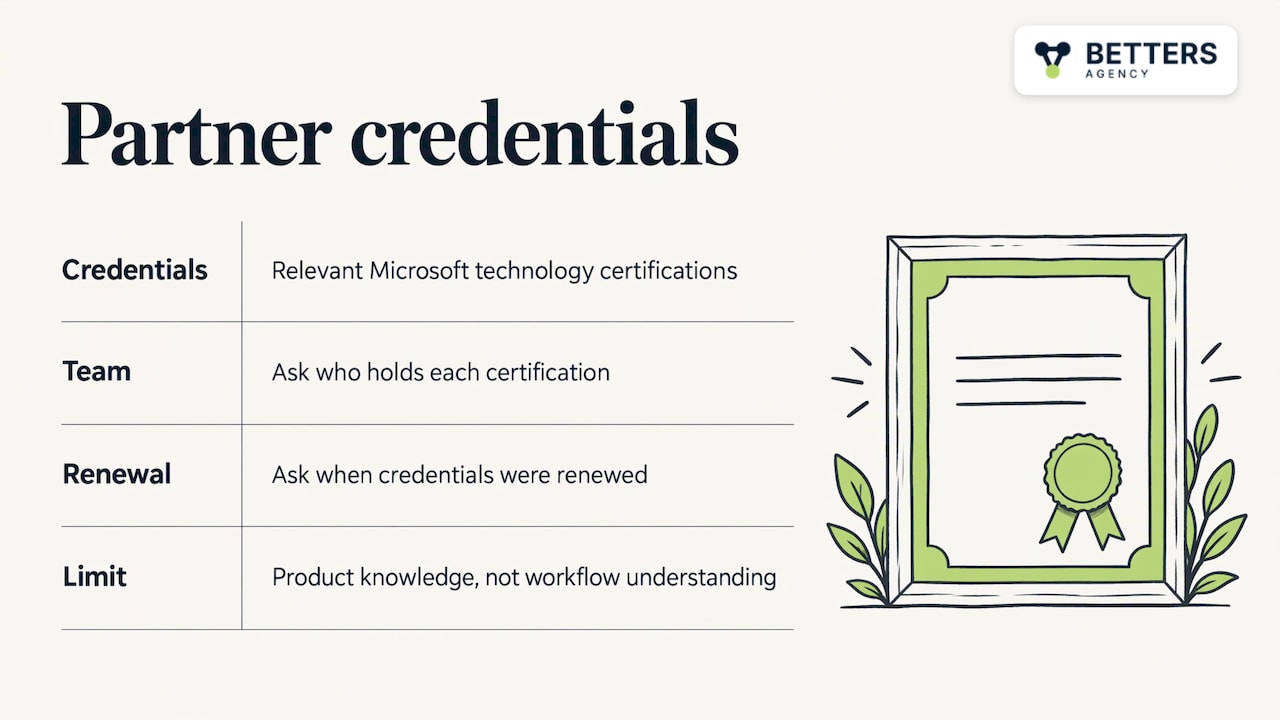
The same Microsoft post says a partner should show relevant Microsoft technology certifications, because with a managed cloud platform those credentials translate into solution competency. Ask which certifications the people doing your work hold and how recently they were renewed. Treat credentials as a minimum, not a verdict: they show product knowledge, not whether the partner will understand your approvals, billing or handoffs.
Who actually does the work
Many buyers meet a sales team and later find a different group building the system. Ask who will configure your environment and whether you can talk to that person now. With us, you work directly with the person who builds your system, which keeps decisions about data and design from being lost between roles.
Process first, software second
A good partner asks about your workflows before showing screens. Our approach prioritizes business process automation over software deployment, so the system matches how the organization operates and users have a reason to adopt it. We also work across Power Automate, UiPath, Zapier, Make and n8n, which means the automation tool is chosen for the process rather than the reverse.
What a sound implementation plan covers
Microsoft’s guide recommends preparing data in parallel with configuration: auditing and cleaning records, and migrating only what the workflows need, in sections with backups. It also recommends keeping configuration close to real workflows, with a solution architect owning the plan alongside data and integration leads.
A plan you can trust has these stages:
| Stage | What should be settled | Where it goes wrong |
|---|---|---|
| Discovery | Processes, owners, first-release scope | Scope is vague, so it grows later |
| Architecture | Data model, security roles, integration points | Decisions are made during configuration |
| Build | Configuration, custom modules, automations | Customization outruns the process |
| Data | Audit, cleanup, staged migration | Dirty records are moved as-is |
| Training | Role-based sessions, champions | Training is cut when budgets tighten |
| Launch and support | Cutover, monitoring, support terms | No owner after go-live |
This is why we get architecture and data decisions right before anything is configured. Fixing a data model after users have entered records costs far more than designing it correctly first. Our CRM strategy and architecture work is built around that sequence.
What drives cost and timeline
Microsoft’s guide says effort scales with first-release scope, process complexity, data condition, the number of integrations, customization, compliance needs, users to train and rollout model, and that the timeline should be set once scope is defined rather than taken from a fixed benchmark. Be wary of any partner who quotes a duration before asking about those factors.
Two drivers deserve extra attention:
- Customization burden. Heavy customization raises both build cost and long-term maintenance. Keep what the process needs and question the rest.
- Change management. One vendor guide lists scope creep, over-customization, complex integrations, low adoption and weak governance as the most common challenges, and notes that skimping on planning or training usually moves the cost downstream into rework and support requests.
We do not quote Microsoft licensing prices here, because they change and depend on the roles you assign. Ask any partner to separate software subscription costs from implementation fees so you can compare proposals on the same basis.
Governance, data integrity and adoption
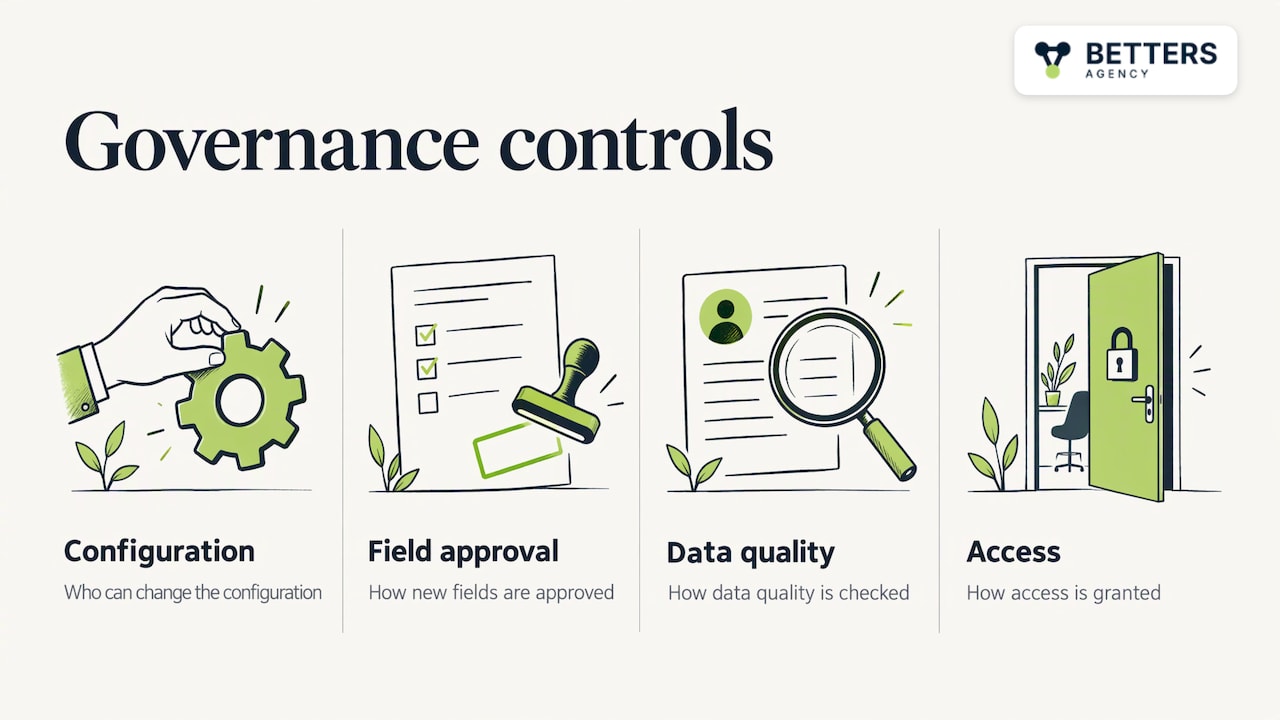
CRMs rarely fail on day one. They decay: fields multiply, duplicate records build up, permissions drift and people return to spreadsheets. Governance is the set of rules that prevents this: who can change the configuration, how new fields are approved, how data quality is checked and how access is granted.
Microsoft’s migration-partner post also points to a track record of driving adoption and active usage as evidence that customers realize value. So ask a prospective partner how they measure adoption, who owns data quality after launch, and what happens when the business changes a process. Our governance and data integrity and adoption and enablement services exist to answer those questions, and our experience includes 5,000+ users onboarded.
Contract terms to settle before you sign
TechTarget’s guidance on ERP contracts is a useful checklist for a Dynamics 365 engagement. Settle these in writing:
- Implementation scope, deliverables, responsibilities and change-order rules.
- Who fixes issues, including problems in custom code.
- Support hours and expected resolution times.
- Data ownership, portability, and return or deletion at the end.
- How AI features may use your data.
- Contract length, renewal, and termination notice or penalties.
A clear change-order rule matters most in project-based work, because it defines what happens when scope moves.
Mistakes to avoid
A buyer’s guide from GigWise lists price as the only deciding factor, weak industry fit, late data and integration review, adoption gaps and missing long-term support among the common errors. Two habits help. Compare proposals by what is included, what costs extra and how change requests are handled. And ask how the partner handles updates, maintenance and testing after launch.
Our perspective
We are a small firm, and that shapes how we work. The person who scopes your project is the person who builds it, so the process knowledge you share in discovery goes straight into the system.
Most failed CRM projects we hear about trace back to decisions made late: a data model improvised during configuration, automation added before the process was agreed, or training treated as optional. We put architecture, data and governance first because those choices are the hardest to reverse.
We also say when another platform fits better. Salesforce, HubSpot or HighLevel are sometimes the better choice, for example when a team is small, needs a marketing-led sales funnel and has no Microsoft footprint, or when the business already runs deeply on one of those tools. Dynamics 365 earns its place when your processes span sales, projects, service and finance, and when Power Platform automation can connect them. Our track record includes 100+ production automations and $10M+ in finance-validated benefit.
If you are unsure which route fits, our guide to choosing a Dynamics 365 partner sets out the options.
Derek
Start with a scoped conversation
If you are comparing partners, bring your process list, your data sources and your integration needs to the first call. We are an independent Microsoft partner, and we will tell you whether Dynamics 365, a Power Platform build or a different tool fits. See the packages for fixed-entry options, or the full service list for larger projects.
FAQ
How do I know if I need an implementation partner?
You likely do when internal expertise is limited, integrations or data migration are complex, timelines are tight or you want ongoing support. Microsoft’s implementation guide frames the decision this way. A simple, single-team deployment may not need one.
How long does a Dynamics 365 implementation take?
It depends on scope, data readiness, integrations and training needs, so set the timeline after scope is defined. Any fixed duration quoted before discovery is a guess. Ask your partner what a first release includes and what waits for later phases.
Should I choose a Microsoft partner or another platform?
Choose on your processes. Dynamics 365 suits organizations whose work spans sales, delivery, service and finance. Salesforce, HubSpot or HighLevel are sometimes the better choice for simpler or marketing-led needs. Our comparison page walks through the differences.
What should I ask a partner about after launch?
Ask who owns data quality, how governance changes are approved, what the support hours and response times are, and how adoption is measured. Put the answers in the contract.
Sources
- Dynamics 365 Partners | Microsoft Dynamics 365
- CRM Implementation Guide | Microsoft Dynamics 365
- 3 characteristics to look for in your Dynamics 365 migration partner
- Microsoft Dynamics 365 Implementation Guide (2026) | Tango
- ERP contracts: What you need to consider before negotiating | TechTarget
- Common Mistakes to Avoid When Choosing a Dynamics Implementation Partner | GigWise
Recommended
- Choose Your D365 Partner: Microsoft Ecosystem
- Dynamics 365 Consultants in Minneapolis Compared
- Leaders: Compare D365 Consulting vs. Alternatives
- Dynamics 365 Project Manager: Microsoft vs. Alternatives
Articles are for informational and educational purposes only, Betters Agency LLC is not a licensed financial advisor or legal counselor and does not provide these services, readers are encouraged to check multiple sources for accuracy.