Blog
CRM Strategy Consulting: What It Covers and How to Scope It
nbetters · · 12 min read
CRM strategy consulting explained for business leaders: what gets assessed, the five phases, how to scope an engagement, and when another platform fits better.
CRM strategy consulting is the work of deciding how your customer data, sales and service processes, and automation should fit together before anyone configures a system. It produces an architecture, a data model, a governance plan and a rollout sequence tied to business outcomes. As a small, independent Microsoft partner focused on Dynamics 365 and Power Platform, we treat strategy and build as one job: the person who designs your CRM architecture is the person who builds it, so the decisions made in the first weeks are the ones that survive go-live.
This guide is written for business leaders and operations owners who are weighing a CRM project and want to know what a strategy engagement should contain, what it should cost you in time and attention, and how to tell whether it is working.
Key Takeaways
- A CRM strategy engagement should end with written deliverables: a business case with measurable targets, a process map, a data model, a governance plan and a phased scope for the first release.
- Most CRM failures trace back to unclear goals, poor data and low adoption rather than to the software itself, so strategy work concentrates on those three.
- Define in writing what your people own and what the consultant delivers, including data cleanup, training and decision rights.
- Dynamics 365 and Power Platform suit firms whose processes extend beyond a standard sales pipeline, while Salesforce, HubSpot or HighLevel are sometimes the better choice.
- Automation and reporting should be designed in the strategy phase, not bolted on after launch.
Table of Contents
- What CRM strategy consulting actually is
- What a consultant assesses before recommending anything
- The five phases of a CRM strategy engagement
- Where workflow automation and data integrity fit
- Adoption is part of the strategy
- How to scope a CRM consulting engagement
- Risks that sink CRM projects, and how strategy reduces them
- When another platform is the better recommendation
- Working with us on CRM strategy and architecture
- Our perspective
- FAQ
- Sources
What CRM strategy consulting actually is
A CRM is a system of record for customers, deals, projects, cases and the conversations around them. A CRM strategy is the plan that decides what that system must record, who is accountable for the quality of that record, which processes run through it and how you will know it is paying off.
Consulting on strategy exists because the expensive mistakes happen before configuration. Microsoft’s own implementation guidance names the recurring problems: data quality and migration complexity, integration incompatibilities, low adoption, unclear goals and scope creep. Each is cheaper to prevent in a design workshop than to repair in a live system with real users and real records.
In practice, strategy work answers questions such as:
- Which business outcomes is the CRM meant to move: faster quotes, fewer dropped handoffs, cleaner renewals, better utilization?
- Which processes belong in the CRM, and which belong in another system that the CRM connects to?
- What is the single source of truth for each type of record, and who owns it?
- What should be automated, and what should stay a human decision?
- What will executives see in their dashboards, and what data must exist to produce it?
If a proposal moves straight to licenses, modules and a go-live date without answering these, it is a deployment quote, not a strategy.
What a consultant assesses before recommending anything
A useful assessment begins with your operations, not with a product demo. We look at five areas.
Processes as they actually run
The consultant documents how a lead becomes a customer, how a won deal becomes delivered work, and where information gets retyped, emailed or lost. The point is to find the handoffs, because handoffs are where records degrade. A sales-to-delivery handoff that depends on a forwarded email will eventually produce a project with the wrong scope.
Data as it exists today
This means counting duplicates, finding incomplete fields, identifying which spreadsheets and inboxes hold the real customer history, and deciding what is worth migrating at all. Microsoft’s guidance recommends auditing and cleaning data first and migrating it in sections with backups rather than in one pass. Our own write-up on a data quality plan to consolidate client records shows how that consolidation is typically approached for services firms.
Systems the CRM must talk to
Accounting, document storage, email, project tools and line-of-business applications all touch customer data. Integration incompatibility is one of the named risks above, so the assessment lists every connection, the direction data flows and what happens when a sync fails.
People and decision rights
Who can change a field, a pick list or a workflow? Who approves a new report? Without answers, a CRM drifts into a pile of one-off customizations. The assessment names an executive sponsor, the departments in scope for the first release and the person accountable for data quality.
Fit between the platform and the business
The last step is choosing, or confirming, the platform. This comes after the first four, so that the platform serves the process and not the reverse.
The five phases of a CRM strategy engagement
Microsoft’s Dynamics 365 implementation guide describes a five-phase roadmap built on its Success by Design framework. It is a sound skeleton for any CRM strategy, and here is how each phase looks when the work is done well.
| Phase | What happens | What you should have at the end |
|---|---|---|
| 1. Define strategy and outcomes | Business case, measurable targets, first-release scope, platform fit | A one-page statement of outcomes and an agreed scope boundary |
| 2. Plan people, processes and governance | Map current workflows, design target processes, set decision rights, plan change and risk | Target process maps and a governance charter |
| 3. Design and build | Configure the platform, build integrations, set security, clean and migrate data | A working build, a data model document, documented integrations |
| 4. Test, train and launch | User acceptance testing, a pilot, role-based training, go-live readiness | Signed-off test results and trained users |
| 5. Operate, measure and improve | Monitor adoption and data quality, review KPIs, keep improving | A reporting cadence and a backlog of improvements |
Two points deserve emphasis for a business leader.
First, phase 1 should tie the project to outcomes such as lead conversion rate, sales cycle length and customer satisfaction, as Microsoft’s guide advises, rather than only a go-live date. A project that launches on time and moves none of those numbers has not succeeded.
Second, phase 5 treats the CRM as a product that keeps evolving. Budget for it. A system that is configured once and left alone decays as your business changes.
Where workflow automation and data integrity fit
Automation and data integrity are the two places where strategy pays back fastest, and they depend on each other. Automation that runs on dirty data multiplies errors faster than a person ever could.
Data integrity is a design decision
The common failure modes are duplicate, incomplete and inaccurate records. Preventing them is mostly structural: required fields at the right stage, controlled pick lists instead of free text, matching rules that catch duplicates at entry, and a named owner for each record type. This is what we mean by governance. It is not a committee for its own sake; it is a short list of rules about who may change what, and a routine for reviewing quality. Our CRM governance framework sets out the practical version for business leaders.
Automation follows the process map
Once handoffs are mapped, the repetitive ones are candidates for Power Automate flows: routing a won opportunity into a project, creating approval requests, sending renewal reminders, syncing records between systems. We have built more than 100 production automations, and the pattern is consistent: the automations worth building are the ones that remove a manual handoff already documented in the process map. Automating a process nobody has defined produces a faster version of the confusion.
When a requirement goes beyond what configuration can do, custom development and integrations extend the platform. That choice belongs in the architecture stage, with the reasons recorded, so that a later upgrade does not break it.
Reporting is an output of the data model
Executives want to see pipeline, utilization, margin and renewals in one place. Power BI dashboards can do that, but only if the underlying fields were designed to be reported on. Deciding the metrics during strategy, not after launch, is the difference between dashboards that leaders open weekly and dashboards nobody trusts. See how this connects to CRM visibility for executive operating reviews.
Adoption is part of the strategy
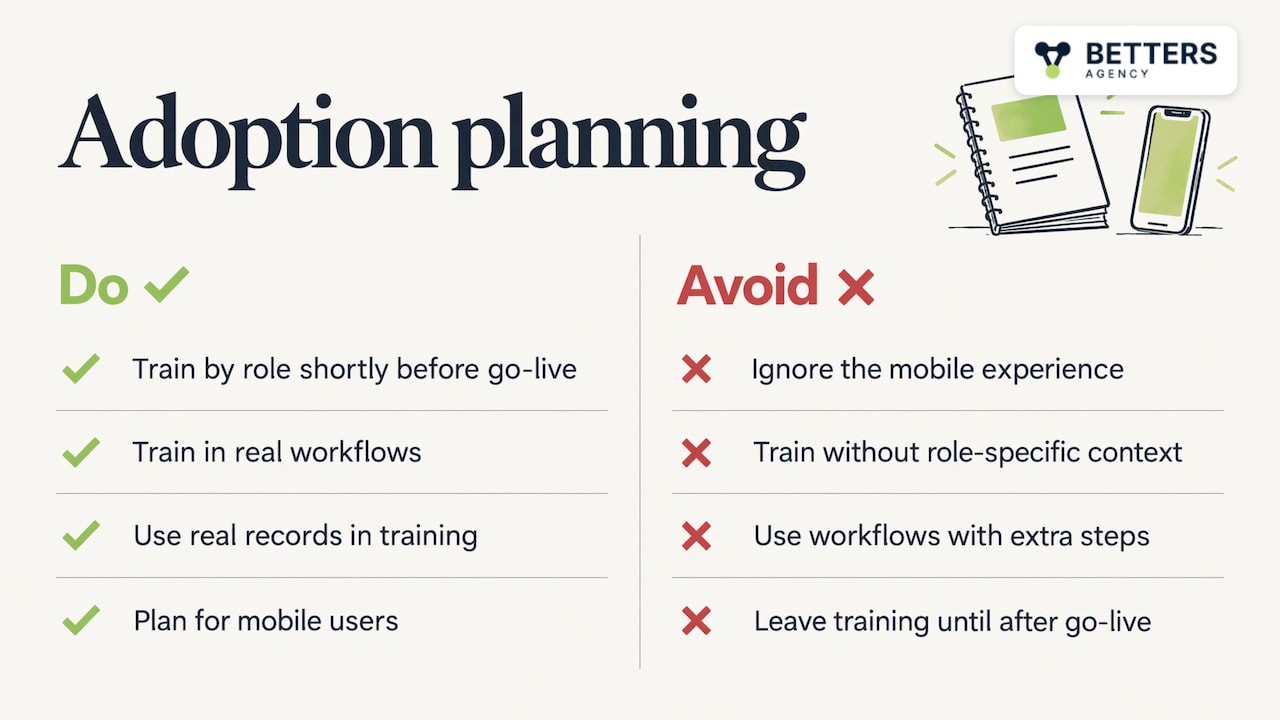
A CRM that people avoid is a failed CRM regardless of how well it was configured. Adoption work belongs in the plan from the start: role-based training, a pilot group, clear answers to “what is in it for me” for each role, and workflows that take fewer steps than the spreadsheet they replace.
Field and mobile users deserve specific attention. If your people record information from job sites, client offices or vehicles, the mobile experience decides whether the data gets entered at all. Planning for enterprise mobile app development and the change management around it is one way organizations think through how staff will actually use a system away from a desk.
Our adoption and enablement work has onboarded more than 5,000 users, and the lesson that holds across those rollouts is simple: train by role, in the real workflow, with real records, shortly before go-live.
How to scope a CRM consulting engagement
A good engagement is defined by deliverables and boundaries, not hours. Before you sign anything, get these in writing.
- Outcomes. The business results the project is meant to produce, with the measures that will show them.
- Deliverables. Concrete artifacts: a data model document, a process map, a completed integration with documented sync rules, a migrated dataset with a validation report.
- Division of work. What your team owns (data cleanup decisions, testing time, approvals, training attendance) and what the consultant delivers. Hidden assumptions about your team’s time are the most common source of schedule slips.
- Exit criteria. How both sides will know a phase is complete.
- Handoff. Documentation and training that let your own people run the system afterward.
- Change control. How out-of-scope requests are priced and approved, so scope creep becomes a decision instead of a surprise.
Also ask whether the person presenting the proposal will be the person doing the work. In a small firm like ours, the person who builds your system is the one you work with directly, which keeps design intent from getting lost between a sales conversation and a build.
For firms that want a defined starting point, our Dynamics 365 Sales CRM package starts from $1,495 one-off, and the Dynamics 365 Project Operations package starts from $2,995 one-off, for services firms that need project delivery tied to the CRM.
Risks that sink CRM projects, and how strategy reduces them
| Risk | What it looks like | How strategy work reduces it |
|---|---|---|
| Messy data migration | Duplicates and gaps carried into the new system | Audit first, clean, migrate in sections with backups |
| Incompatible systems | Syncs that fail or overwrite good data | Define and test integrations before go-live |
| Low adoption | Users keep private spreadsheets | Involve users in design, train by role, simplify entry |
| Unclear goals | No agreement on what success is | Measurable outcomes and an executive sponsor from day one |
| Scope creep | First release grows until it never ships | Written scope, change control, a phased roadmap |
These risks and mitigations mirror Microsoft’s own implementation guidance. Notice that almost none of them are technical. They are decisions about people, data and scope, which is why they get settled in strategy.
When another platform is the better recommendation
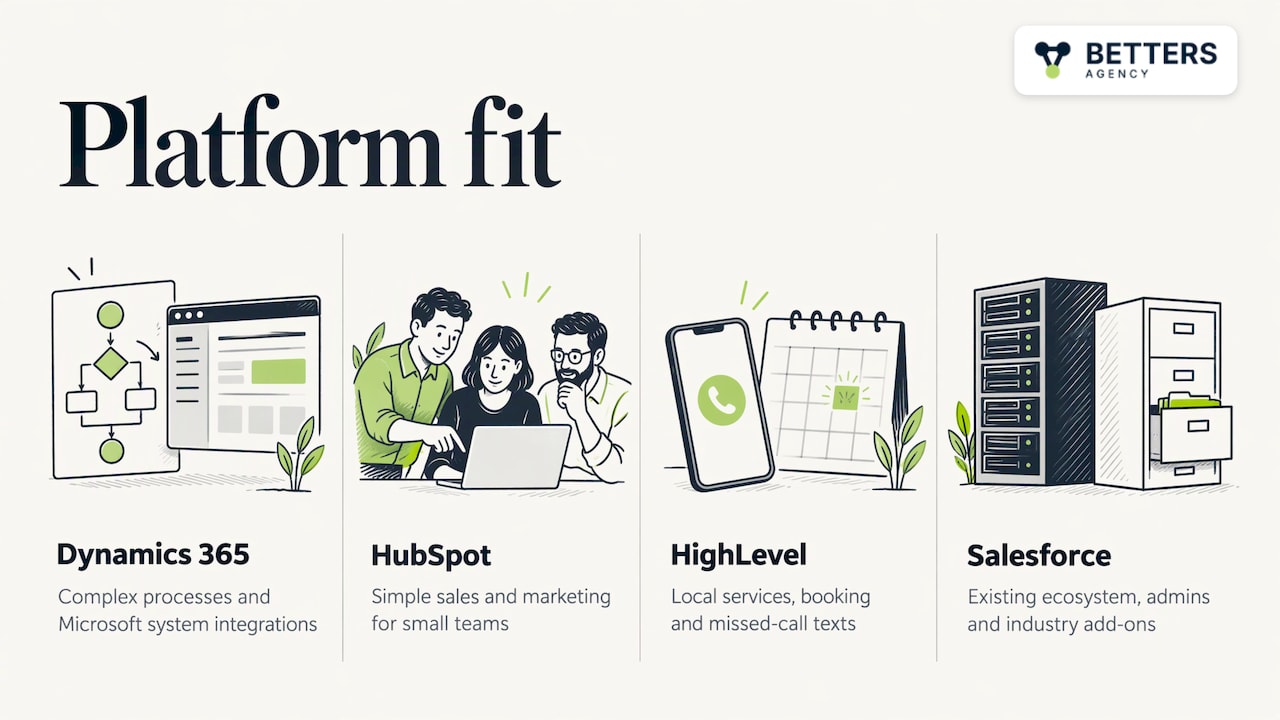
A strategy engagement has to be willing to say that the platform you started with is not the right one. Dynamics 365 and Power Platform fit best when your processes go beyond a standard sales pipeline: project delivery, resource scheduling, approvals, regulated records, or integration with Microsoft 365 and finance systems. If that describes you, our comparison of Dynamics 365 against Salesforce and HubSpot lays out the reasoning.
The trade-off is real, though. If your needs are a straightforward sales pipeline and marketing automation, with a small team that wants to be productive in days, HubSpot is sometimes the better choice. If you run a local service business that lives on missed-call text-back, review requests and appointment booking, HighLevel can be the better fit. Salesforce is sometimes the better choice for organizations already deeply invested in its ecosystem, with in-house administrators and a large catalog of industry add-ons.
Our recommendation is wrong for you when the platform’s flexibility would sit unused. Dynamics 365 rewards firms with process complexity and the appetite to govern it; for a team with simple needs, that flexibility is overhead. A strategy engagement should tell you so before you spend on implementation.
Working with us on CRM strategy and architecture
We are a small Minnesota firm and an independent Microsoft partner. Our CRM strategy and architecture work covers the decisions described above: process mapping, data model, governance, integration design and a phased plan. From there we can carry the work into Dynamics 365 implementation, Power Platform customization, business process automation, Copilot and AI solutions, Power BI data intelligence, and adoption and enablement, with governance and data integrity running through all of it. Across our work we have delivered more than $10M in finance-validated benefit, which is the standard we hold a project to: outcomes that finance can verify.
If you are scoping a CRM project and want the architecture and data decisions settled before configuration begins, see our services or start from our landing page and book a conversation about your processes.
Our perspective
Most CRM projects we are asked to look at did not fail because of the software. They failed because the architecture and data decisions were made implicitly, by whoever configured the first screen, and nobody owned them afterward.
That is why we put strategy ahead of configuration. We settle the data model, the ownership of each record type and the governance rules first, and we automate only the handoffs we have already mapped. It is slower for a few weeks and much faster for the next few years.
We are a small firm, and that is deliberate. You work directly with the person who builds your system, so the reasoning behind each decision stays with the work. We cover Dynamics 365, Power Platform, custom development, Copilot agents and RPA across UiPath, Power Automate, Zapier, Make and n8n, which lets us pick the lightest tool that solves the problem.
And if your needs are better served by Salesforce, HubSpot or HighLevel, we will tell you. A strategy that cannot reach that conclusion is not a strategy.
Derek
FAQ
What does a CRM strategy consultant deliver?
A good engagement delivers written artifacts: measurable outcomes, process maps, a data model, a governance plan, an integration design and a phased roadmap for the first release. These let your own people run and extend the system afterward. Hours billed without deliverables are a warning sign.
What are the main steps in a CRM process?
Microsoft’s guidance describes five phases: define strategy and outcomes, plan people, processes and governance, design and build, test, train and launch, then operate, measure and improve. The last phase never really ends, because the CRM changes as the business does.
Should I choose the CRM before or after the strategy work?
After, or at least in parallel. Platform fit depends on your processes, data and integrations, which the assessment uncovers. Choosing first tends to bend the process around the tool instead of configuring the tool around the process.
How long should my team expect to be involved?
More than most leaders expect. Your people supply process knowledge, data decisions, testing and training attendance. Agree those time commitments in the scope so the schedule reflects them.
Sources
- CRM Implementation Guide | Microsoft Dynamics 365
- Enterprise Mobile App Development: A Practical Guide
Recommended
- Measure Microsoft CRM Consulting Business Value
- CRM Governance: A Practical Framework for Business Leaders
- CRM Implementation Cost: What to Budget in the US in 2026
- CRM Business Value for Professional Services Leadership
Articles are for informational and educational purposes only, Betters Agency LLC is not a licensed financial advisor or legal counselor and does not provide these services, readers are encouraged to check multiple sources for accuracy.