
Blog
Automation in Manufacturing: A Practical Guide for Leaders
nbetters · · 8 min read
What automation in manufacturing covers, which technologies to start with, how to plan the project, and why process and data design come before software.
Automation in manufacturing means using machines, software and control systems to run production work with less manual effort. For a growing manufacturer, the decision that matters most is rarely which robot to buy. It is whether the processes around the machines (quoting, scheduling, work orders, service, reporting) are designed and governed well enough for automation to hold up. As an independent Microsoft partner and a small firm, we implement Dynamics 365 and Power Platform solutions for manufacturers, and we start with the process and the data before anything is configured.
Key Takeaways
- Manufacturing automation covers shop-floor equipment (robots, PLCs, CNC machines) and the business workflows that surround it, and both need a plan.
- NIST advises starting with low-value, repetitive tasks, not automating processes that are not lean, and looking first for off-the-shelf solutions.
- Field service automation (dispatch, work orders, maintenance history) connects the plant to customers and installed equipment, and it depends on clean data.
- Dynamics 365 and Power Platform are a strong fit for the workflow and data layer, though Salesforce, HubSpot or HighLevel are sometimes the better choice.
- Governance and adoption decide whether an automation is still working two years after launch.
Table of Contents
- What manufacturing automation covers
- Three levels of automation
- Where manufacturers usually start
- What the evidence says about returns
- Field service automation for manufacturers
- Where automation projects go wrong
- A practical sequence for your project
- Where Dynamics 365 and Power Platform fit
- Perspective
- How we can help
- FAQ
- Sources
What manufacturing automation covers
The NIST MEP National Network guide defines it as using machines, robots and control systems to automate repetitive tasks. NIST lists the benefits as less production variation, shorter task times, safer jobs and more time for employees to do advanced work, which also helps with the manufacturing talent shortage.
Two terms come up constantly:
- Factory automation is the making or assembly of distinct items, such as vehicles or electronics, by passing parts through a series of machines or work cells, according to the International Society of Automation.
- Process automation monitors and controls continuous measurements such as temperature, flow and pressure through controllers, sensors and valves, in settings like chemical plants and refineries, as EAM describes it.
Most growing manufacturers of discrete products sit on the factory side. Whichever side you are on, there is also a business layer: orders, quotes, schedules, inspections, service calls and reports. That layer is where much of the manual re-keying and delay hides, and it is where our work lives.
Three levels of automation
Rockwell Automation’s Plex describes three types, which help you match the investment to your product mix:
| Type | Best for | Main constraint |
|---|---|---|
| Fixed (hard) automation | Very high volumes of one product | High barrier to entry, hard to change |
| Programmable automation | Batches from dozens to thousands of units | Downtime to reprogram between batches |
| Flexible automation | Mixed products, frequent changeovers | Usually network-connected and more complex to run |
The trade-off is plain: the more flexible the system, the more it relies on good data about what to build and when. That is a business-process problem as much as an engineering one.
Where manufacturers usually start
NIST’s Automation 101 guide lists the ten most common first applications: grinding and surface prep, welding, painting and finishing, pick-and-place for CNC machines, pick-and-place for packaging, machine tending, material handling, flexible feeders, autonomous vehicles and loaders, and quality inspections. NIST’s robotics page adds that advances in sensors, software and vision systems are putting robotics within reach of even the smallest manufacturers.
On the software side, NetSuite lists the common building blocks: CNC machines, programmable logic controllers (PLCs, the industrial computers that direct machines), manufacturing execution systems (MES, which track production in real time and feed data to ERP), automated guided vehicles, computer vision and ERP software.
What the evidence says about returns
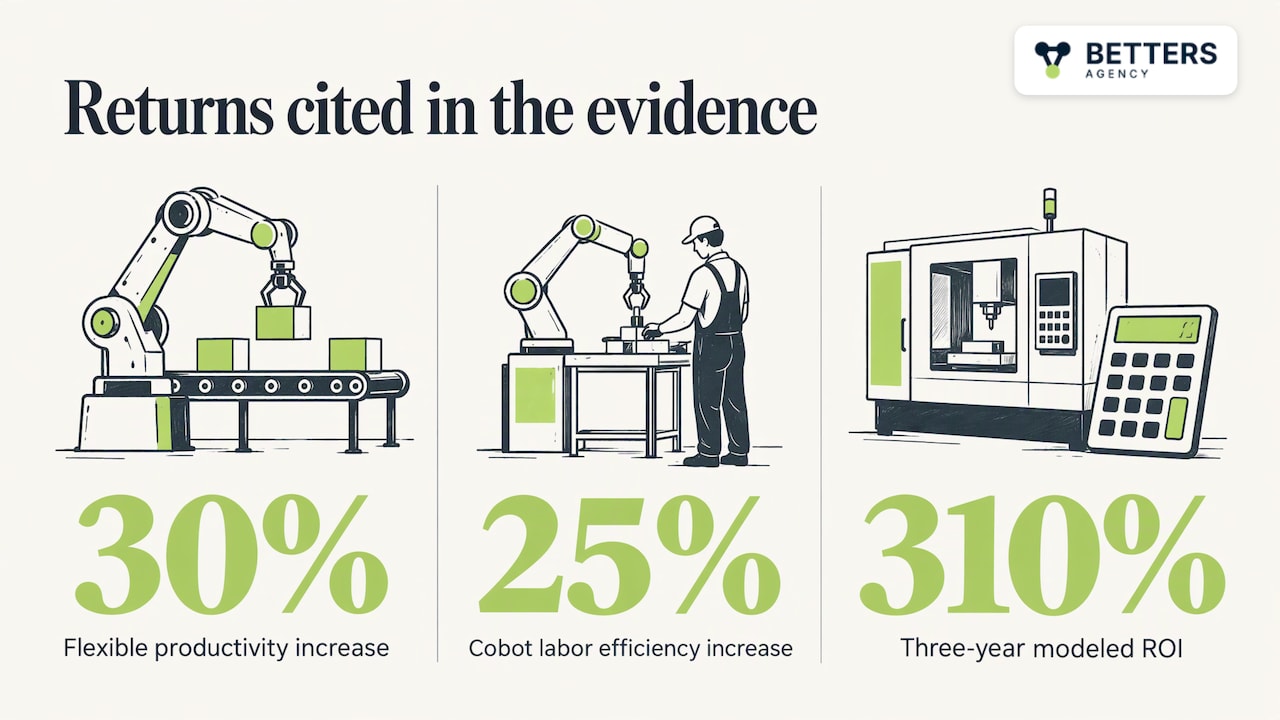
NIST’s guide cites 30% higher labor productivity with flexible automation and 25% higher labor efficiency with collaborative robotics. A 2024 peer-reviewed study of 62 US manufacturing SMEs found projected industrial IoT costs were significantly lower than projected savings, which suggests adoption is financially viable for smaller manufacturers despite high upfront costs.
Large-enterprise models exist too. A Forrester study commissioned by Augury modeled a 310% ROI over three years for a composite manufacturer with $20B in revenue. Treat figures like that as direction, not a forecast for a mid-size plant. Your own baseline matters more, which is why we start with measuring current process performance. Our guide on assessing CRM ROI for manufacturing leaders shows how.
Field service automation for manufacturers
Many manufacturers also service the equipment they sell, or maintain their own. Field service automation replaces manual scheduling, dispatch, work orders and inventory tracking with software, as PTC describes it.
Microsoft’s Dynamics 365 Field Service documentation shows what that looks like in practice:
- Work orders can be created from service cases, agreements, emails, web portals or IoT data.
- Dispatchers assign them using location, availability, skills and priority, manually or through automated scheduling optimization.
- When a technician closes a work order, equipment history and inventory levels update automatically, and an invoice for parts or labor can be generated.
- Service models range from reactive break-fix to preventive agreements to predictive, IoT-driven work orders.
The payoff is measurable in the field. Aquant’s 2025 benchmark of 157 service organizations found 14% of truck rolls are unnecessary on average, against 3% for the top 20%.
Where automation projects go wrong
A plant can buy excellent equipment and still lose the benefit if the surrounding system decays. The failure modes we see addressed in good projects are consistent:
- Automating a broken process. NIST warns against automating processes that are not lean. A faster version of a bad workflow is still a bad workflow.
- Dirty data. A work order that updates inventory automatically will update it wrongly if part numbers are inconsistent.
- No ownership. Automation World’s nine-step project guide stresses that operators who take ownership of well-trained systems drive the best outcomes.
- Scaling. In a Forrester study for Microsoft, a life sciences executive said a solution that cannot scale across sites quickly is not viable.
That is why our governance and data integrity work and our adoption and enablement work sit next to the build, not after it. Our CRM governance framework explains the controls.
A practical sequence for your project
Combining NIST’s advice with the Automation World steps gives a sequence that works for most mid-size manufacturers.
- Name a project champion and map the process. Document how an order, a quote or a service call moves today. Where we are involved, CRM strategy and architecture decisions are made at this stage, before anything is configured.
- Pick a low-risk first target. NIST recommends starting with repetitive, low-value tasks. Approval routing, order status updates and inspection logging are common candidates.
- Run a proof of concept. Prove the workflow on one line, one product family or one service territory.
- Build the business case. Include timelines and the baseline you measured in step 1.
- Build and connect. Integrations between CRM, ERP and shop-floor systems are where gaps appear, which our piece on CRM-ERP integration gaps covers.
- Test, train, and hand over. Factory and site acceptance testing and operator training come last, but they should be planned from the start.
- Govern it. Assign owners for data, workflows and change requests.
Where Dynamics 365 and Power Platform fit
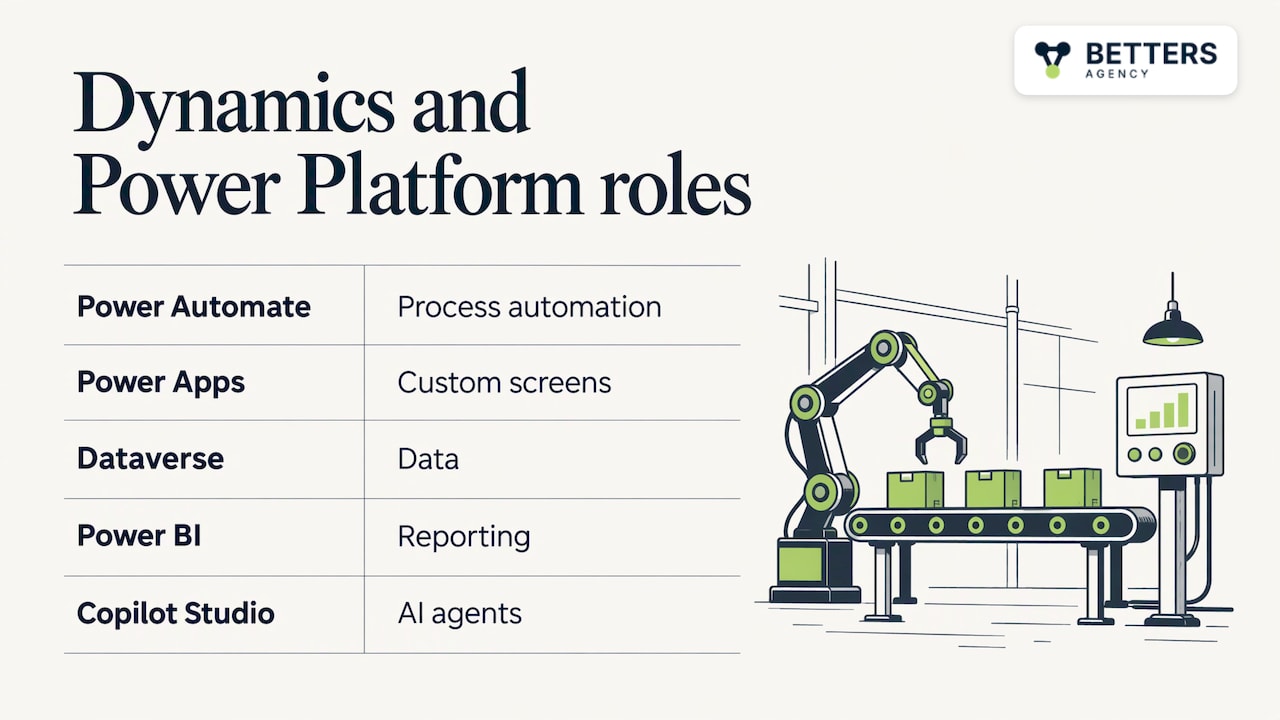
Plant-floor hardware is the domain of controls engineers and equipment vendors. The workflow and data layer is where Dynamics 365 and Power Platform do their work: Power Automate for process automation, Power Apps for custom screens, Dataverse for data, Power BI for reporting, and Copilot Studio for AI agents. Our walkthrough on implementing CRM for manufacturing automation goes deeper.
Honest trade-offs matter. If your team lives in one sales motion with no custom process and no Microsoft footprint, Salesforce, HubSpot or HighLevel are sometimes the better choice. Our comparison of Dynamics 365 with Salesforce and HubSpot lays out the criteria.
Perspective
Manufacturers often ask us which software to buy. The better first question is which decisions and which data the software has to get right. A work order, a quote or a production schedule is only as reliable as the definitions behind it.
We are a small firm and an independent Microsoft partner, and you work directly with the person who builds your system. We cover Dynamics 365, Power Platform, custom development, Copilot agents and robotic process automation across UiPath, Power Automate, Zapier, Make and n8n, so the tool follows the problem and not the reverse.
Our experience is 100+ production automations, 5,000+ users onboarded and $10M+ in finance-validated benefit. What drives those numbers is the unglamorous work: architecture and data decisions first, governance so the system does not decay, and adoption so people actually use it.
The case where our recommendation is wrong: if the real bottleneck is a machine, not a process, you need a controls engineer first. We will tell you when that is the case, or when a competitor is the better choice.
Derek
How we can help
If you are planning to automate quoting, scheduling, service or reporting, our services include Dynamics 365 implementations, business process automation, Power Platform customization, custom development and integrations, Copilot and AI solutions, governance and data integrity, and Power BI data intelligence. Packaged starting points on our packages page begin at $1,495 one-off for Dynamics 365 Sales CRM and $2,995 one-off for Dynamics 365 Project Operations.
FAQ
What is the difference between factory automation and process automation?
Factory automation handles discrete products, such as parts passing through machines and work cells. Process automation controls continuous variables like temperature, flow and pressure in plants such as refineries. Most assembly and fabrication businesses are on the factory side.
Where should a small manufacturer start?
Start with a repetitive, low-risk task and a process that is already lean, as NIST advises. Map the current workflow, measure it, then prove one automation before expanding. Order status updates and approval routing are common first targets on the business side.
What is field service automation?
It is the use of software to automate scheduling, dispatch, work orders, inventory and asset history for service teams. In Dynamics 365 Field Service, closing a work order updates equipment history and inventory automatically. It supports preventive and IoT-driven maintenance as well as break-fix work.
Is automation worth it for a smaller manufacturer?
A 2024 study of 62 US manufacturing SMEs found projected industrial IoT savings exceeded projected costs. Your own result depends on your baseline, so measure current cycle times, errors and rework before you commit.
Sources
- Manufacturers’ Guide to Industry 4.0 Technologies, NIST MEP
- Factory Automation and Machine Control, ISA
- Factory Automation vs. Process Automation, EAM
- The Rise of Automation in Manufacturing, Rockwell Automation
- Automation 101, NIST
- Robotics and Manufacturing Automation, NIST
- Manufacturing Automation Explained, NetSuite
- Cost Effectiveness of the Industrial Internet of Things
- Total Economic Impact of Augury, Forrester
- What is Field Service Automation, PTC
- Overview of Dynamics 365 Field Service, Microsoft Learn
- 2025 Field Service Benchmark Report, Aquant
- Manufacturing Automation Project Guide, Automation World
- Projected Total Economic Impact of Microsoft Industrial AI, Forrester
Recommended
- Estimate Automation’s ROI for Project Delivery
- Manufacturing Leaders: Integrate CRM and ERP Systems
- Automating Manufacturing CRM Data Consolidation
- Technical Guide to Implementing CRM
Articles are for informational and educational purposes only, Betters Agency LLC is not a licensed financial advisor or legal counselor and does not provide these services, readers are encouraged to check multiple sources for accuracy.