
Blog
Manual Reconciliation Automation With Microsoft Power Platform Business Value
nbetters · · 19 min read
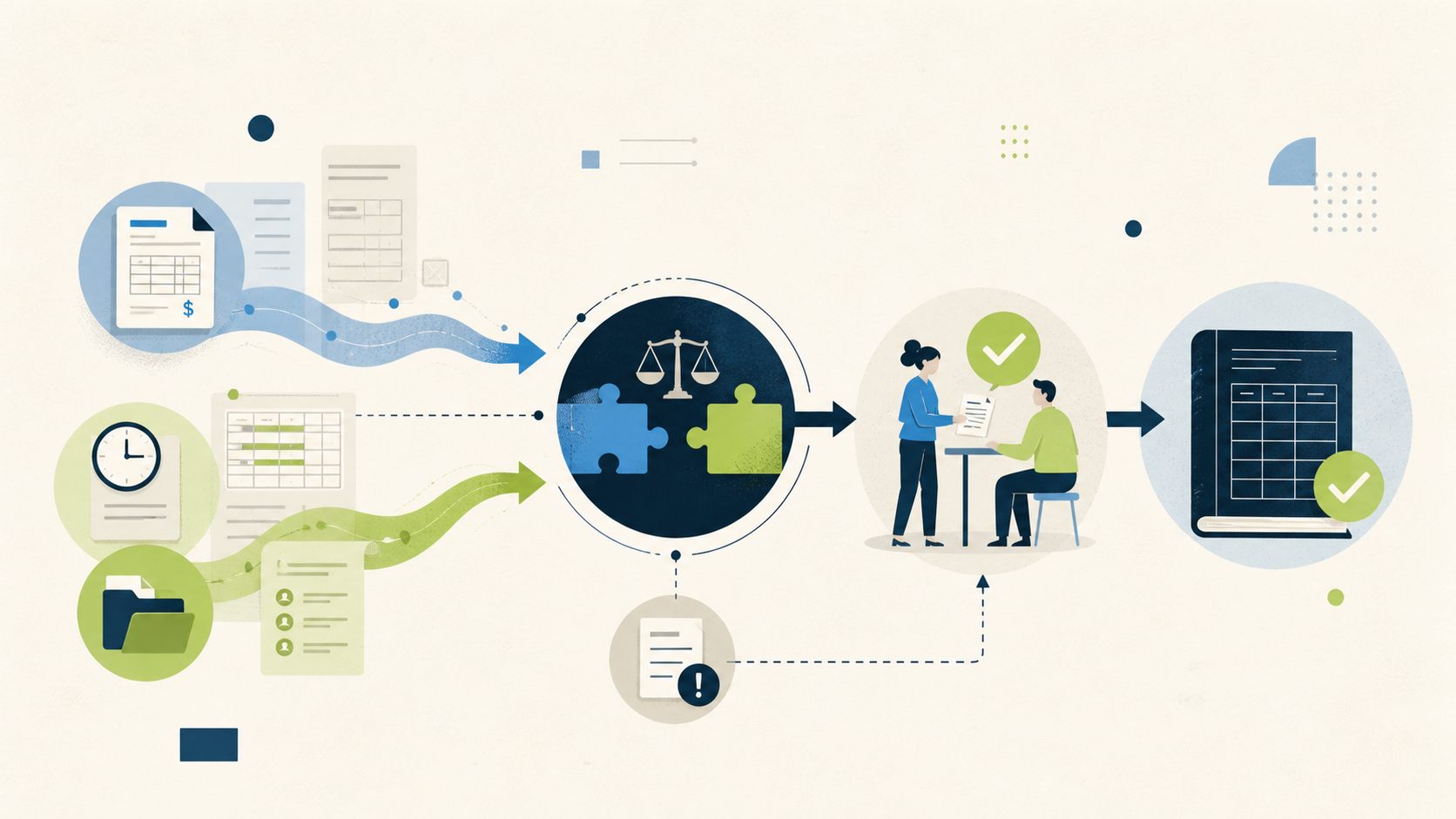
Manual Reconciliation Automation With Microsoft Power Platform Business Value A Minnesota operations leader receives the month-end reconciliation package, yet the team is still copying exports, comparing rows, chasing owners, and documenting exceptions…
Manual Reconciliation Automation With Microsoft Power Platform Business Value
A Minnesota operations leader receives the month-end reconciliation package, yet the team is still copying exports, comparing rows, chasing owners, and documenting exceptions across email and spreadsheets. The accountable owner can see hours consumed and decisions delayed. Leadership still needs a defensible baseline: elapsed time from both source extracts being available to an approved reconciliation result, plus the manual hours and exception counts inside that boundary.
Manual reconciliation automation with Microsoft Power Platform business value comes from improving that bounded workflow while preserving human accountability. The useful case is built from measured cycle time, manual touch time, exception aging, repeat work, and evidence completeness. The platform can support orchestration, governance, controlled deployment, and exception routing, but value depends on source quality, match policy, ownership, adoption, licensing, support, and the controls designed around it.
The investment fits when two sources can be identified, match rules can be declared, exceptions have accountable owners, and leadership can measure the current process. A policy clarification or spreadsheet redesign may be enough when the bottleneck is a disputed definition or one missing owner. Another platform deserves consideration when an existing application already owns the reconciliation, when a specialist automation tool fits the source boundary better, or when the required latency, volume, skills, and switching effort point elsewhere.
This leadership framework covers the baseline, value levers, governance, operating model, adoption, measurement, and an operational scorecard. It stays focused on the investment decision. The technical implementation and troubleshooting guide owns configuration, validation, replay, and runbook detail.
Define the reconciliation as one accountable workflow
A reconciliation compares two declared sources, applies an approved match policy, separates resolved items from exceptions, and records an accountable resolution. That description sounds simple. The leadership work lies in defining each term so finance, operations, delivery, data, and technology owners interpret the result the same way.
Start with one case boundary. Name source A and source B. Identify the event that makes each source ready. Define the period, business unit, accounts, projects, customers, or transactions inside the case. Record immutable source identifiers so an item can be traced back to its origin. Then state the permitted outcomes: matched, unmatched, ambiguous, duplicate, or another approved state defined by the firm.
The match policy needs a declared order. Exact identifier matches may be evaluated before combinations of date, amount, currency, project, or customer fields. The packet supports the recommendation to normalize keys, dates, currencies, statuses, and precision before applying deterministic rules. Leadership can leave expression design to the implementation team while requiring an accountable policy owner, a change process, and evidence that the policy was applied consistently.
Exceptions belong in the workflow design. An unmatched item may reflect timing, a missing source record, a data-quality issue, an approved business difference, or a policy question. An ambiguous item may satisfy more than one rule. A duplicate may represent repeated input or a legitimate repeated business event. The system can classify and route, while an accountable person decides how the business should resolve each case.
This boundary turns a vague automation request into an investment hypothesis: if complete source records enter a controlled staging boundary, approved rules classify the case, and accountable owners resolve exceptions with evidence, then leadership can test whether the workflow uses less manual effort and produces a more traceable result. The baseline records current conditions. A bounded pilot tests the hypothesis.
Build a baseline before discussing return
Leadership needs a baseline that can be reproduced. A demonstration shows what software can display. The baseline establishes the current operating cost and bottleneck, then gives the pilot result a valid comparison.
Define the baseline with six elements:
- Start event: The exact event that begins measurement, such as both approved source extracts becoming available.
- End event: The exact event that closes measurement, such as accountable approval of the case ledger and its remaining exceptions.
- Population: The periods, entities, accounts, projects, records, and exception types included.
- Owner: The person accountable for the definition, source quality, and interpretation.
- Observed result: The measured cycle time, touch time, counts, or shares from the selected population.
- Control condition: The review, evidence, or reconciliation requirement that must remain effective.
Manual hours need an activity boundary. Decide whether the measure includes file preparation, data cleanup, row comparison, exception research, approval follow-up, rework, and evidence assembly. A total without that boundary will be hard to compare later. Cycle time also needs a consistent clock. Calendar hours and working hours answer different questions.
Exception measures require denominators and categories. An exception rate could mean the share of staged records that enter an exception state. Exception aging could begin when the rule engine creates the exception and end when an accountable owner records a disposition. Reopened exceptions should have their own definition so the team can distinguish initial resolution from repeat work.
Evidence completeness can be measured as the share of resolved exceptions that contain the required actor, time, reason, source references, and approval evidence. That measure describes the firm’s own control design. Legal, accounting, security, and compliance conclusions remain with accountable specialists.
For a Twin Cities professional services firm, one bounded population might be a single project type, business unit, or billing period. Power Platform behavior stays the same across locations. Local context keeps the decision tied to the actual staff capacity, approval schedule, source owners, and support model that will carry the workflow.
Evaluate the value levers separately
Manual reconciliation automation with Microsoft Power Platform business value should be assessed through several operating levers. Each lever needs a baseline, an owner, a control condition, and an observation from the pilot.
Manual touch time
Measure the hours people spend preparing inputs, comparing records, researching exceptions, requesting clarification, recording dispositions, and assembling evidence for the selected case. Separate routine handling from exception investigation when the data allows it. The separation helps leadership see whether automation reduced routine handling while leaving legitimate judgment visible.
A lower touch-time observation can support expansion only when the same population and activity boundary are used. Review evidence completeness and unresolved discrepancies at the same time. Weaker evidence would undermine the stated operating goal even if the process became shorter.
Reconciliation cycle time
Measure elapsed time from the approved start event to the approved end event. Break out waiting time when source readiness or owner response can be observed. This shows where the process is spending time without inventing a cause.
Cycle time can improve because routine matching proceeds consistently, exceptions become visible earlier, or owners receive clearer work. It can also remain unchanged when source files arrive late or policy decisions sit outside the automated boundary. The pilot should preserve these distinctions.
Exception quality and aging
Count exceptions by declared category, owner, age, and disposition. A useful queue tells an owner what happened, which source records are involved, which rule produced the result, and what decision is required. Leadership can then inspect whether aged exceptions are concentrated in a source, rule, or ownership boundary.
The objective is a controlled exception process. Some differences are legitimate and require judgment. The investment case should value clearer ownership and evidence alongside any reduction in exception volume.
Repeat work
Measure cases or exceptions that must be reopened, reclassified, or reprocessed because the first disposition lacked data, used the wrong rule, or failed to persist complete evidence. Define the trigger for repeat work so the measure can be reproduced.
This lever can reveal where training, source quality, or policy clarity matters more than another automation step. It also gives the adoption lead a concrete signal for targeted coaching.
Evidence completeness
Define the evidence required for each exception outcome. That may include source identifiers, applied rule, owner, disposition reason, timestamp, and approval record. Measure completion against that declared set.
Evidence completeness supports traceability and review. The organization still needs its accountable finance, legal, privacy, security, and compliance specialists to decide what evidence is required, how long it is retained, and who may access it.
Management visibility
Choose a short set of leadership questions the case ledger should answer. Examples include which cases remain open, which exception categories are aging, which source produces unresolved differences, and which owners have work awaiting action. Measures should come from the governed case ledger instead of transient flow history.
Visibility has value when leaders use a stable definition and act on it. Ownership and policy still come from the operating model, which gives each measure an accountable reader and an expected decision.
Preserve human judgment through an exception-led design
The workflow should move complete, unambiguous records through declared rules and direct uncertain items to accountable people. This pattern keeps automation focused on repeatable work while preserving decisions that depend on context, policy, or professional judgment.
For each exception category, define four items:
- The condition that creates the exception.
- The role that owns the next decision.
- The evidence required to resolve it.
- The permitted disposition and escalation path.
An amount difference, for example, may route to a finance control owner. A missing project identifier may route to a data owner. An ambiguous match may require a process owner to decide whether the rule needs repair or whether the source records need correction. A source outage belongs with the application or integration owner.
The case ledger should preserve the reason, actor, time, and source evidence for a resolution. Re-running the workflow should be idempotent, meaning the same case and source identifiers can be processed without creating uncontrolled duplicate outcomes. The technical design must prove that behavior in the selected environment. Leadership’s responsibility is to require the acceptance evidence and fund the monitoring, replay, and rollback work around it.
An exception-led design also creates a clean adoption conversation. People receive defined work, see the source context, record a reason, and can escalate a policy question. Training can focus on decisions and ownership instead of software tours.
Treat governance as operating capacity
Governance is part of the investment because the workflow moves business data, uses connections, changes over time, and requires support. The leadership scope should include environment strategy, identities, security roles, data policies, connections, connection references, deployment controls, monitoring, replay, rollback, retention, and support ownership.
Microsoft’s Power Platform data policy guidance states that data policies classify connectors and control which connectors may share business data. Policy changes can suspend or quarantine resources that violate the policy, and enforcement may take time. This gives leadership a concrete control area to fund and assign. A data policy remains one part of the organization’s wider security, privacy, and compliance program.
Administrative scope and permissions also matter. The Microsoft guidance for managing data policies describes policy administration and scope. Before a pilot, name who can create or change a policy, which environments and connectors it covers, how changes are tested, and who receives an enforcement incident.
Connections and connection references need explicit owners. A connection authenticates access to a service. A connection reference allows a solution-aware component to bind to the intended connection as it moves between environments. The bound packet recommends this solution-aware design, while the exact portability behavior and supported binding must be verified during implementation. Leadership should require named owners for the identity, credential lifecycle, connection, reference, deployment binding, and incident response.
Separate development, test, and production responsibilities. Changes should be packaged, tested, approved, and supported through a declared release path. Microsoft’s Power Platform pipelines guidance supports sequential movement of the same solution artifact, stored solution exports, deployment approvals, and service-principal connections where connectors support them. Target environments require Managed Environments under the documented conditions. The architecture and tenant prerequisites still need current verification for the selected deployment.
Monitoring should tell owners whether a case was received, classified, routed, resolved, replayed, or stopped. Retry rules need a boundary so persistent failures become visible instead of cycling without ownership. A dead-letter or exception path should retain enough context for support to diagnose and safely replay the work. Rollback planning should identify the last accepted solution version, affected data, and the authority to restore service.
Put licensing and total operating effort in the decision
The investment includes more than initial configuration. Account for discovery, policy definition, source access, data cleanup, solution design, security review, licensing review, build, testing, deployment, training, monitoring, support, enhancement, and eventual retirement or replacement.
Microsoft’s Power Automate licensing guidance describes distinct Premium, Process, and Hosted Process models, connector entitlements, and unattended desktop automation considerations. Licensing depends on the operating model and can change. Verify the current guide, tenant entitlements, connector requirements, user patterns, attended or unattended execution, and contract terms before purchase or production approval.
Desktop automation can be considered when a source lacks a practical API or supported connector. The same Microsoft guidance carries machine, session, credential, and exception-handling considerations for that approach. Those responsibilities belong in total operating effort. A UI-dependent path can also increase testing and support work when the source interface changes, so leadership should compare it with source-system, API, connector, file, or data-engineering options available for the exact boundary.
Estimate effort by role and lifecycle stage. The process owner will spend time settling rules. Source owners will prepare access and data definitions. The platform owner will manage environments, identities, connections, deployment, and monitoring. The adoption lead will prepare communication, training, and feedback. Support will receive incidents and coordinate recovery. These costs are part of the case even when internal teams absorb them.
Financial interpretation should come from the firm’s own evidence. Translate measured hours, delay, rework, or risk exposure using finance-approved assumptions. Keep one-time effort separate from recurring operating effort. Record the confidence and source for each assumption. The packet supplies no universal payback period, project cost, or return percentage.
Assign a distinct operating model
One person may hold several roles in a smaller firm, but every responsibility and decision right should stay visible.
Executive sponsor
The executive sponsor owns the business outcome, approves the pilot boundary, accepts residual risk, and decides whether the evidence supports expansion, repair, pause, or decline. This role resolves cross-functional ownership conflicts.
Reconciliation process owner
The process owner defines case boundaries, match policy, exception categories, service expectations, and change approval. This owner keeps business rules explicit and coordinates decisions that cross finance and operations.
Finance control owner
The finance control owner approves reconciliation, review, evidence, and sign-off requirements. Accounting, tax, audit, and related professional judgments remain with the organization’s accountable specialists.
Source system owners
Each source owner is accountable for access, readiness, identifiers, data definitions, and correction paths. Two sources can have different owners. Both need named responsibilities because the automation depends on each boundary.
Platform and integration owner
This owner is accountable for environments, identities, connections, connection references, solution deployment, monitoring, replay, rollback, and technical lifecycle decisions. Implementation tasks may be delegated while accountability remains clear.
Data and measurement owner
The data owner defines normalization, measure logic, denominators, data-quality checks, retention inputs, and report interpretation. This role ensures that baseline and pilot observations use the same construct.
Adoption lead
The adoption lead plans communication, role-based training, feedback, reinforcement, and usage review. The role traces adoption issues back to process, data, training, or system causes and routes them to the correct owner.
Support owner
The support owner receives incidents, maintains escalation paths, coordinates recovery, tracks recurring causes, and owns the transition from project delivery to ongoing operations.
Plan adoption around accountable decisions
Adoption begins before configuration. People need a shared definition of the case, the rules, the exception categories, and their decision rights. A workflow that changes who owns an exception is an operating-model change even if the screen looks familiar.
Start by observing the current process. Ask participants to show where inputs arrive, how matches are evaluated, how uncertainty is handled, what evidence is retained, and where work waits. Record variations without declaring them wrong before the process owner settles policy.
Next, design role-based changes. Source owners need readiness and correction expectations. Exception owners need category definitions, response expectations, evidence requirements, and escalation paths. Support needs failure signals, diagnostic context, and replay authority. Leaders need measures that use the baseline definitions.
Pilot communication should state the boundary and stop conditions. Participants should know which cases use the new workflow, which remain on the existing process, where to report a problem, and who can pause the pilot. Training should use representative cases and approved exception types. A product tour can supplement that instruction, but the workflow and decisions remain central.
Collect adoption evidence alongside technical evidence. Track whether assigned owners acknowledge and resolve exceptions, whether required evidence is complete, whether work is being handled outside the governed path, and which categories generate confusion. Treat workarounds as diagnostic evidence. They may indicate a missing rule, an impractical step, insufficient training, or a support gap.
At each review point, the process owner and adoption lead should agree on corrective action. A rule issue goes through governed change. A source-quality issue returns to the source owner. A training issue receives focused instruction. A design burden that exceeds the value case can lead leadership to pause or redesign the scope.
Run a bounded pilot with explicit acceptance and stop conditions
A pilot should be small enough to observe and important enough to test the investment hypothesis. The packet supplies no universal duration, record count, or financial threshold. Choose a boundary that reflects the firm’s own volume, risk, and decision needs.
Define pilot acceptance in the same terms as the baseline:
- Both sources entered through the approved boundary with traceable identifiers.
- Declared rules produced reproducible classifications for the test population.
- Exception owners could see, understand, and resolve assigned work.
- Required actor, time, reason, and source evidence were retained.
- Reprocessing preserved one controlled case outcome for the same source identifiers.
- Monitoring exposed failures and support followed the tested response path.
- The team demonstrated replay and rollback for the selected failure scenarios.
- Baseline and pilot measures used matching definitions and populations.
Stop conditions should be equally explicit. Pause when source integrity cannot be established, access exceeds approved scope, a control cannot be demonstrated, duplicate outcomes cannot be prevented, exceptions lose traceability, deployment cannot be recovered, or support ownership is absent. A stop condition protects the decision. It is evidence that the design or operating model needs repair.
The pilot review should separate defects from findings about fit. A configuration defect may be repairable inside the approved architecture. An ownership gap may require leadership action. A licensing or connector constraint may change the economic case. A source without a stable automation boundary may point toward a different integration approach or platform.
Use an operational decision scorecard
The scorecard needs mandatory gates and repeatable actions. Rate each criterion Green, Amber, or Red using evidence from the baseline, design, and pilot.
Green means the criterion has a named owner, approved definition, and evidence that meets the pilot condition.
Amber means the gap is bounded and repairable, with a named owner, corrective action, required evidence, and decision date.
Red means a required owner, control, boundary, capability, or evidence path is absent, unacceptable, or unsupported for the proposed scope.
Apply the ratings to these criteria:
- Workflow ownership: Case boundary, process owner, source owners, and exception owners are explicit.
- Source and data readiness: Identifiers, readiness events, access, normalization, and correction paths are defined.
- Match policy: Rule order, outcomes, exception categories, change control, and test evidence are approved.
- Review and evidence: Human decision rights, resolution evidence, reconciliation approval, and retention inputs are defined.
- Measurement: Baseline, population, denominators, control conditions, and pilot observations are reproducible.
- Governance: Environment, identity, security, data policy, connection, connection-reference, release, replay, and rollback ownership is assigned.
- Licensing and operating effort: Current licensing has been checked and lifecycle effort is understood for the selected scope.
- Adoption and support: Role-based training, feedback, incident intake, escalation, and ongoing ownership are ready.
- Platform fit: The selected architecture supports the workflow within acceptable integration, latency, volume, skill, governance, and switching constraints.
Workflow ownership, source and data readiness, match policy, review and evidence, measurement, governance, and adoption and support are mandatory gates. Licensing and operating effort, plus platform fit, are also mandatory before production commitment.
- Proceed with a bounded pilot when every mandatory gate is Green, or when remaining Amber items have explicit pilot controls accepted by the executive sponsor.
- Repair before proceeding when any mandatory gate is Amber without an accepted pilot control. Record the repair, owner, evidence, and decision date.
- Decline or redesign when any mandatory gate is Red, when operating effort exceeds the value leadership is prepared to pursue, or when another approach fits the approved boundary better.
- Consider production expansion after the pilot when every mandatory gate is Green, control evidence remains intact, support ownership is active, and observed measures support the firm’s business case.
A failed control gate takes precedence over a favorable measure. The scorecard serves as a readiness rule instead of a weighted financial formula.
Compare Microsoft fit with responsible alternatives
A Microsoft-forward approach can fit an organization already centered on Microsoft identity, data, automation, analytics, or business applications when Power Platform aligns with the reconciliation sources and operating model. The decision still depends on licensing, connectors, skills, environment strategy, governance, latency, volume, support, and lifecycle effort.
A lightweight SaaS automation tool may fit a narrow workflow with standard connectors and modest governance needs. Specialist robotic process automation may fit an interface-dependent source that lacks a practical API or connector, provided machine, credential, session, exception, and support requirements are acceptable. A data-engineering platform may fit high-volume transformations or reconciliation logic already owned by a data team. An ERP-native capability may fit when the finance system owns the records, rules, and approvals. A process repair may fit when the main issue is an unsettled definition or missing owner.
Compare options on the same workflow boundary. Evaluate source access, rule complexity, system-of-record ownership, identity, data handling, deployment, monitoring, latency, volume, skills, licensing, support, migration, and switching cost. The Microsoft and alternatives decision guide develops that platform-direction question.
Questions leaders should answer before funding
- Which reconciliation case are we improving first, and who owns the outcome?
- Which two sources are inside the boundary, and what event makes each ready?
- Which identifiers, dates, amounts, currencies, statuses, and precision rules require normalization?
- Which match rules apply, in what order, and who approves changes?
- Which outcomes can proceed and which require accountable judgment?
- What actor, time, reason, source reference, and approval evidence must be retained?
- What exact events define cycle time, touch time, exception aging, repeat work, and evidence completeness?
- Who owns identities, environments, connections, connection references, data policies, releases, monitoring, replay, rollback, and support?
- Which licensing, connector, tenant, machine, and session requirements need current verification?
- What evidence permits a pilot, requires repair, stops the work, or supports expansion?
- Which alternative would fit better if the Microsoft option fails a mandatory gate?
Clear answers reduce ambiguity before build work begins. Missing answers identify the next leadership task.
Frequently asked leadership questions
Does reconciliation automation remove human review?
The approved model retains accountable review for exceptions, policy questions, financial judgments, and final approval. Automation can apply declared rules, route work, and retain evidence. People remain responsible for the decisions assigned to their roles.
Should leadership start with manual hours or cycle time?
Choose the measure closest to the bounded bottleneck. Manual hours fit a workload concern when the activity boundary can be recorded. Cycle time fits a delay concern when the start and end events are stable. Use both when the team can measure them consistently, and pair either one with a control condition such as evidence completeness.
Can a pilot proceed without a financial return percentage?
Leadership can consider a bounded pilot when the mandatory gates, scope, budget, risks, controls, and evidence plan are acceptable. The pilot still needs a reproducible baseline. Financial interpretation should use the firm’s approved labor, delay, rework, and operating-cost assumptions.
What if the sources have poor data quality?
Treat data quality as owned work. Define required identifiers and values, assign source owners, measure missing or invalid records, and establish correction paths. Leadership may decide that source repair is the first investment. Automation built on unstable inputs can produce a faster stream of exceptions without improving the business outcome.
When is desktop automation appropriate?
Consider it when a source lacks a practical API or supported connector and the operating model can support the required machine, session, credential, testing, exception, and recovery work. Compare it with other source, file, integration, or platform options before approval.
What should happen after the pilot?
Reapply the scorecard with the same definitions used at baseline. Review observed measures, control evidence, exceptions, adoption, support effort, licensing, and lifecycle cost. Expand, repair, pause, redesign, or decline according to the mandatory gate rules.
Bring one reconciliation to a measured review
Betters Agency recommends starting with one reconciliation case, accountable owners, and a reproducible baseline. Betters Agency has a commercial interest in this recommendation because it advises on Microsoft business applications and workflow improvement. The review should still point to a process repair, another platform, or a decision to wait when that is the responsible fit.
Bring one costly manual handoff, its source owners, its exception owner, and any available baseline evidence to a 25-minute Workflow Opportunity Review. Review a Workflow with Betters Agency to clarify the boundary, the decision gates, and the smallest responsible next step.