
Blog
CRM Data Migration Framework for Business Leaders
nbetters · · 15 min read
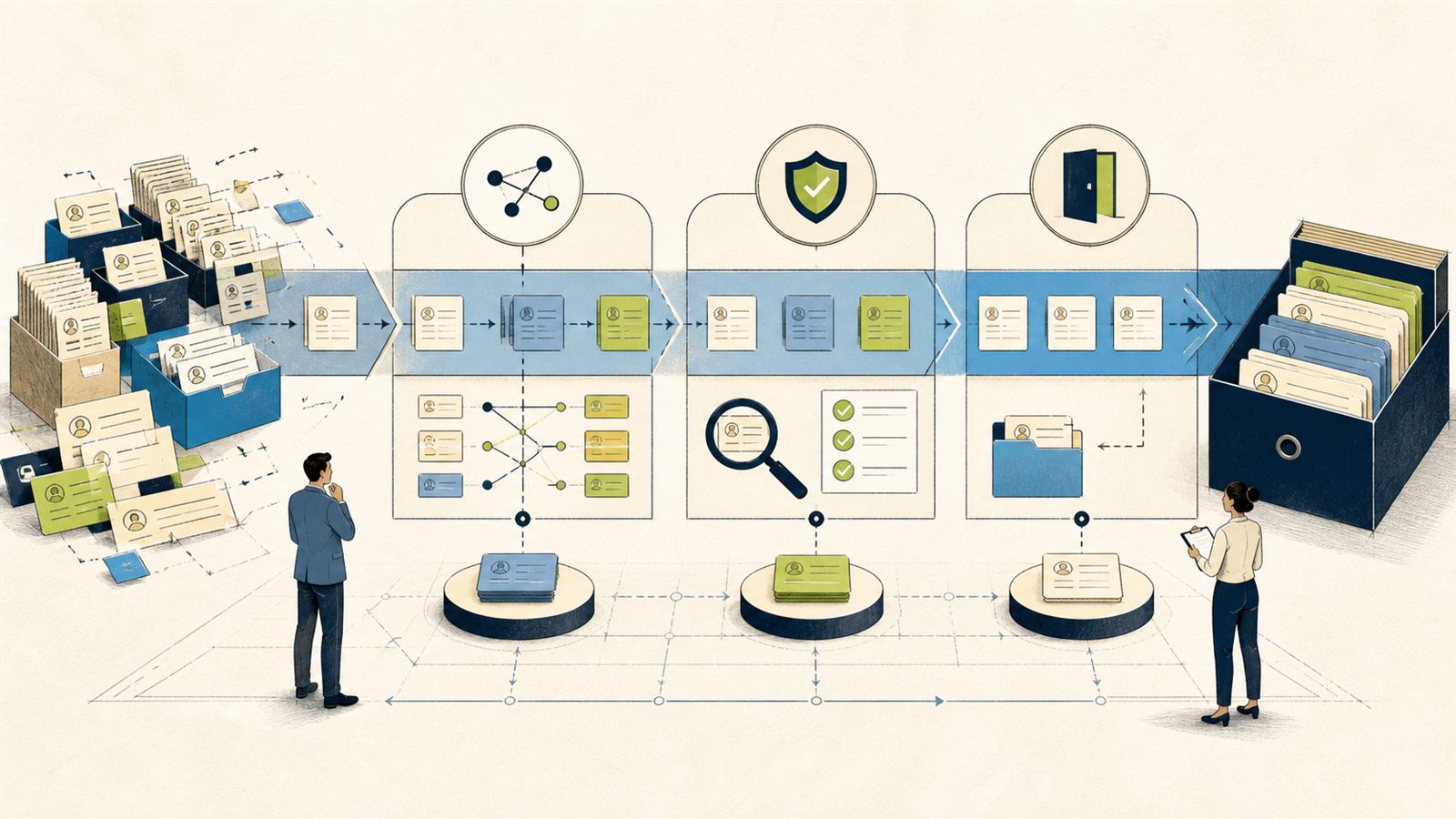
Data Migration CRM Business Value: A Leadership Decision Framework For a Minneapolis or wider Twin Cities professional services firm, a CRM migration is a…
Data Migration CRM Business Value: A Leadership Decision Framework
For a Minneapolis or wider Twin Cities professional services firm, a CRM migration is a business decision before it is a technical project. The real question is whether your pipeline, backlog, and sales-to-delivery history can be trusted enough to run the business on.
When leaders ask about data migration crm business value, the honest answer is that value appears when trusted records reduce manual reconciliation, sharpen ownership, and help people decide faster. A project can load every row and still leave the business worse off if record identity, relationships, security, and validation stay unresolved. The leadership job is therefore to fund a specific outcome, govern the risk, name the owners, and hold the result against a baseline. Approving a data copy is a smaller thing than approving a business improvement, and the difference is where most of the value lives.
Betters Agency provides Microsoft and workflow consulting and sells implementation services, so treat this as an informed and interested perspective. The framework below is written to hold up whether or not you engage us, and every recommendation here is designed to be something your own team can score without outside help.
What business value actually means here
Leaders often reduce data migration crm business value to a software upgrade, but value here is the reduction of a specific, named friction that costs your firm time, accuracy, or decision speed today. It is measurable only against a baseline you capture before the work starts. A leader who funds "a better CRM" is funding an abstraction. A leader who funds "a weighted pipeline the delivery lead will staff from without rebuilding it in a spreadsheet" is funding a result that can be verified in operation.
That distinction matters because the technical migration and the business outcome are separable. You can complete a flawless load of accounts, contacts, opportunities, and projects and still see no change in behavior if the people who use those records distrust them, cannot find them, or were never asked what "correct" looks like in their daily work. The value case has to be written in the language of decisions and owners, then defended with evidence after go-live.
Executive context
Microsoft’s own architecture guidance frames CRM migration complexity around schema differences, data volume, relationship depth, dependencies, data quality, security, and business continuity. Each of those is a business variable as much as a technical one. Volume shapes the cutover window and the risk of a long freeze. Relationship depth decides whether your project and billing history survives the move in a usable form. Data quality sets how much trust your teams place in the new system on the first day they depend on it.
The practical framing is to treat the migration as a controlled operating change scoped to one decision the CRM data must support. That decision might be a reliable weighted pipeline, a clean sales-to-delivery handoff, or a backlog view that finance and delivery both accept. Fund that outcome first, and let the technical work serve it. The companion technical data migration CRM guide carries the implementation spine, including staging, mapping, and reprocessing. This page stays with the investment and governance decision so a sponsor can approve, delay, or decline with clear eyes.
The business problem behind the migration
Project-centric firms depend on CRM data for pipeline, resourcing, sales-to-delivery handoffs, billing context, and reporting. When that data is fragmented across systems and spreadsheets, the symptoms are concrete. Duplicate accounts split one client’s history into two partial stories. Pipeline numbers get argued in the meeting instead of used to make a call. Delivery leaders cannot see committed work early enough to staff it, so they hedge with contractors or miss dates. Reconciliation becomes a recurring manual tax, and critical knowledge lives in a few people’s heads where it is one resignation away from loss.
A migration earns funding when it removes one of those bottlenecks in a way you can measure. For a Twin Cities engineering or IT consulting firm of roughly 40 to 249 people, the decision can look like this: can the resourcing lead trust the CRM backlog enough to schedule staff directly, without rebuilding it in a spreadsheet first? If the honest answer today is no, that gap is the value the migration has to earn, and it is exactly the thing you can baseline now and re-measure after go-live.
Name the bottleneck precisely before you cost the project. "Our CRM is messy" scopes nothing. "Sales and delivery disagree on which of the top twenty opportunities are truly committed, because commitment lives in three places and no field is authoritative" scopes a migration, an owner, and a test. The narrower the named decision, the easier it is to prove or disprove the value, and the smaller the first responsible step becomes.
Value levers to measure, not to assume
These are outcomes to track and prove after go-live. Present them to your team as targets that must be earned, and pair each with the measure that will show whether it happened.
- Pipeline and backlog trust. The signal is fewer disputed numbers in the pipeline review and less shadow reporting in private spreadsheets. Count the parallel spreadsheets that stay in active use a set period after cutover, and watch whether that number falls as trust grows.
- Reduced reconciliation. The signal is less manual matching between CRM, delivery, and billing. Measure the hours a month your team spends reconciling the same client across systems, captured before and after.
- Usable sales-to-delivery history. The signal is that a handoff carries the context delivery needs without a follow-up meeting. Measure the share of newly won projects that start with complete scope, contact, and commercial context already in the record.
- Clearer ownership. The signal is that every record type has one accountable owner. Measure the count of record types with a named owner against the count that belong to everyone and therefore to no one.
- Faster exception resolution. The signal is that bad records surface and get fixed quickly. Measure the aging of open data exceptions, not only how many exist.
- Safer reporting. The signal is that leaders share one trusted view in the meeting. Measure how often a decision is delayed because two reports disagree.
- Controlled system retirement. The signal is that a legacy tool can be turned off responsibly. Measure whether the source can be decommissioned on a planned date with its data preserved, instead of kept alive indefinitely as a fallback.
Each of these depends on the quality of scope, mapping, validation, and adoption, which is what the governance work protects. Treat them as hypotheses to test, and let the measurement framework below settle whether the investment paid off.
The total operating effort behind the number
A migration’s cost is more than the load. Budget for the discovery that names the decision and the scope, the mapping and validation work, the security design and its testing, the rehearsal of cutover and reprocessing, and the adoption effort that turns a correct system into a used one. Ongoing effort continues after go-live: someone maintains the security model as roles change, monitors data quality, and keeps the audit configuration matched to what the business needs to prove. When leaders fund only the load and treat governance and adoption as free, the cost reappears later as lost trust. Put the whole operating effort in front of the sponsor so the decision reflects the real commitment, not only the visible part. This needs no invented figures; it needs the work named and each piece assigned an owner and a rough level of effort your team can estimate from its own context.
Governance and risk
Governance is where a migration earns approval, and a few platform facts should shape your risk posture and your questions to the technical team.
Security is a design decision. Dataverse security roles follow a minimum-required-access model, and tenant administration alone does not grant data access inside an environment. The leadership implication is that access has to be designed and tested with representative roles from real jobs, so a delivery consultant, a sales lead, and a finance approver each see what they should. Ask to see access proven with sample users before broad cutover.
Evidence is configured. Dataverse auditing is set at the environment, table, and column levels and consumes log storage. Audit coverage is therefore a deliberate scope choice with a running cost, and configured auditing is one input to compliance rather than a finished compliance outcome. Decide which tables and columns genuinely need change history, and record that decision with an owner.
Recovery has limits worth understanding before you rely on it. Microsoft recommends a manual backup before major changes where supported, and an environment restore is an emergency control instead of a simple record-level undo. Your working rollback plan is the combination of preserving the source, staging your loads, and being able to isolate and reprocess the specific records that failed. Confirm that plan exists and has been rehearsed, because the first test of recovery should happen before a live incident, not during one.
One branch belongs squarely in the risk discussion: every record does not have to be copied. Dataverse can surface some externally managed data through virtual tables, which keeps the source system authoritative when that is the better operating choice. Persisting data into Dataverse matters most when you need its security, workflow, and native reporting together on that data. Choosing what stays outside is a governance decision that shrinks scope, cost, and risk at once, and it deserves a deliberate owner instead of a default of moving everything.
Operating model: name the owners
Migrations stall when accountability is vague. Name each of these roles distinctly, keep them separate, and make sure each person knows the decision they own.
- Executive sponsor. Owns the business case and the go or no-go decision, funds the work, and clears organizational blockers when two departments disagree. The sponsor holds the outcome, so the sponsor decides when evidence is sufficient to proceed.
- Process owner. Owns the workflow the CRM data must support and defines what "good" looks like in operating terms. This is the person who can say whether a migrated pipeline is genuinely usable for the weekly commitment call.
- Data owner. Signs off on in-scope records, exclusions, retention, and archival. The data owner decides what history is worth carrying, what gets archived, and what is left behind on purpose.
- Technical migration lead. Owns mapping, staging, load sequence, and the reprocessing plan. This role turns the business decision into a repeatable, verifiable load with a way to recover failed records.
- Security and platform owner. Owns roles, record ownership, access, environment configuration, and platform constraints. This role proves that the right people see the right records and that the environment can carry the work.
- Adoption lead. Owns training, change communication, and the transition to the new system. Keep this role distinct from the technical lead, because delivering correct data and landing real usage are different jobs with different skills.
- Business validators. The people who confirm that migrated records mean what they should, using samples drawn from their real work. Validators come from sales, delivery, and finance, and their sign-off is the evidence that records are trustworthy.
When one person wears several of these hats in a smaller firm, make the hats explicit anyway. The point is that each decision has a name attached, so nothing important falls into the gap between "IT did the load" and "the business owns the outcome."
Adoption: earning trust in the new records
A technically correct migration that no one trusts is a failed investment. Adoption planning should begin before cutover, while there is still time to change what gets built. Give validators room to test the records that matter to them, using their own live examples, and treat their objections as design input. Communicate what is changing and why in the language of each team’s daily work, so a delivery lead hears about staffing and a finance approver hears about billing context.
Plan for concentrated support in the first weeks, when questions and exceptions cluster and first impressions harden. Assign the adoption lead responsibility for tracking whether people are actually using the new records to make decisions, and for routing early issues to the owner who can resolve them. Adoption is a measurable outcome, and it belongs in the measurement framework alongside data quality, because a clean system that people route around has produced no value.
Measurement framework
Decide your baselines before the migration so you can prove change afterward. A measure without a baseline is a number without meaning, and a measure that does not match its own label misleads the sponsor. Define each one against the exact thing it claims to track, state the comparison boundary, and use the data you actually have. Useful business measures include:
- Duplicate exception rate. The share of a record type flagged as a suspected duplicate, measured against the total in that type, before and after cutover.
- Unmapped or invalid values. The count of fields that fail their mapping or validation rule at load, tracked by table so you can see where quality is weakest.
- Relationship and reference errors. The count of records whose links to parents, owners, or related rows fail to resolve, which is where a lost history shows up.
- Reconciliation effort between systems. The hours spent manually matching the same entity across CRM, delivery, and billing, sampled over a defined period.
- Trusted-report coverage. The share of the decisions your leadership team makes weekly that can be sourced from one agreed report instead of competing exports.
- Critical-workflow pass rate. The share of your named critical workflows that complete correctly on migrated data in a rehearsal, before you depend on them live.
- User readiness. An honest read of whether the people who must use the system can complete their core task on it, gathered from the validators rather than assumed.
- Post-go-live issue aging. Not only how many issues are open, but how long they stay open, because slow resolution erodes trust faster than a high initial count.
These measures keep the value conversation honest. They replace a vague promise with a before-and-after view the sponsor can hold owners against, and they give the whole effort a definition of done that survives contact with reality.
Decision scorecard
Treat these nine gates as mandatory. Every gate needs a named owner and evidence before broad cutover, and an intention to do the work is not evidence.
- A business sponsor and process owner agree on the single decision the CRM data must support.
- A data owner signs off on in-scope records, exclusions, retention, and archival.
- The target model and mapping are versioned and reviewed.
- Every migrated record type has an identity strategy and a duplicate-control rule.
- Relationship sequencing and cyclic dependencies have a tested handling plan.
- Security, ownership, and access are tested with representative roles.
- Reconciliation and business validation have named acceptance owners.
- Cutover, delta capture, failed-row reprocessing, and source preservation are rehearsed.
- Adoption, support, and post-go-live measures have owners.
Map the result to one of three actions, and keep any financial threshold out of it, because an invented ROI number adds false precision to a governance call.
- Bounded pilot. All nine gates have owners and evidence, and the remaining risk suits a controlled rehearsal on a limited scope. Proceed with a pilot, then decide on broad cutover from real results.
- Repair before pilot. One or more gates lack evidence but can be closed without changing the strategic destination. Fix those gaps, then re-score against the same nine gates.
- Defer or decline. Destination, ownership, security, source quality, or operating model is unresolved enough that loading data would create unmanaged risk. Stop, fix the underlying decision, and re-open the scorecard when it is genuinely ready.
The scorecard is deliberately repeatable. Two different leaders scoring the same migration should reach the same action, because the gates are concrete and the mapping is fixed.
When a full migration fits, and when a lighter path serves
A full migration into Dataverse fits when you need its security model, workflow, and native reporting working together on the same data, and when the record relationships and history are worth carrying forward for the decision you named. In that case, persisting the data pays for the mapping and governance effort because the downstream operating controls live in one place.
A lighter path serves other situations. When an external system must stay authoritative, the virtual-table option keeps the source in charge and avoids a copy you would have to keep in sync. When the problem is a single messy report instead of a fragmented estate, a focused data cleanup or a reporting fix may deliver the outcome on its own. The discipline is to match the size of the intervention to the size of the named problem, and to accept that the smallest responsible step may be something other than a migration this quarter.
Designing a bounded pilot
When complexity or uncertainty is material, a bounded pilot should come before broad cutover. A good pilot is small enough to complete on a short timeline and real enough to prove the value. Choose one record type and one decision, for example the top of the weighted pipeline for one business unit, and carry only the related records needed to make that decision trustworthy.
Set the pilot’s acceptance conditions in advance: the identity and duplicate rules hold, the relationships resolve, representative users see the right records, the validators accept a sample from their real work, and the target workflow passes on migrated data. Define the stop conditions with equal care, so the team knows which failures mean repair and retry and which mean stepping back to the strategic decision. Capture the same baseline measures on the pilot that you plan to use at scale, so the pilot produces evidence and not only a good feeling. A pilot that meets its acceptance conditions makes broad cutover a smaller, better-understood decision. A pilot that fails has done its job by surfacing the risk cheaply.
Questions a leader should be able to answer
Use these to test whether the migration is ready for funding, and to keep the conversation on decisions rather than tools.
What single decision will trusted CRM data improve?
If the answer is a list, the scope is too wide for a first step. Pick the decision that is most expensive for you today in disputed numbers, rework, or missed staffing, and let it define the pilot.
Who owns the outcome after go-live?
The sponsor owns the business case, and the process owner and adoption lead own whether people actually use the result. Name them before the load, because ownership assigned after a problem appears arrives too late.
What is our baseline, and how will we know it improved?
Capture the specific measures now. Without a stated baseline you cannot prove value, and the migration becomes an article of faith instead of an investment.
What is our real rollback plan?
Confirm that the source is preserved, the loads are staged, and failed records can be isolated and reprocessed. An environment restore is an emergency control, so your everyday recovery has to be the staged, reversible load.
What are we deliberately choosing to leave in place?
A good scope has explicit exclusions. Deciding what stays in a legacy archive or remains authoritative in an external system is part of controlling cost and risk.
A bounded next step
Before you fund a full migration, prove the value on one workflow. Pick the single decision that hurts most today, whether that is a weighted pipeline, a sales-to-delivery handoff, or a backlog view, score it against the nine gates, and run a bounded pilot if it qualifies. If you are still weighing platforms, the Microsoft versus CRM alternatives piece works through destination fit, including where Salesforce, HubSpot, or leaving data at the source may be the better call for your firm.
If you want a second set of eyes, Review a Workflow with us: bring one costly manual handoff, and we will help you score it against these gates and decide the smallest responsible next step.