
Blog
CRM Rescue Consultant Minnesota Business Value
nbetters · · 14 min read
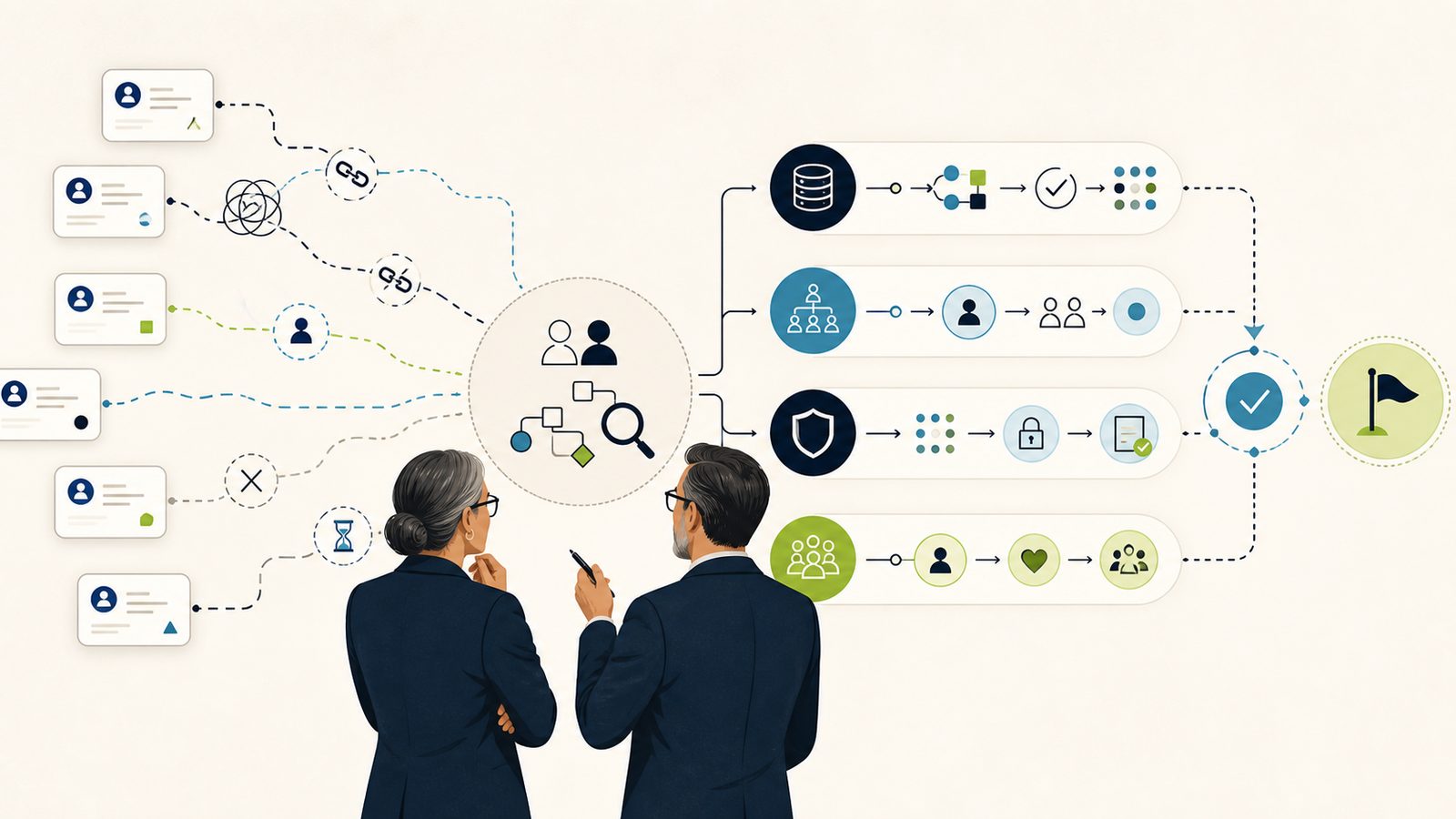
If your CRM has quietly stopped supporting the decisions it was bought to support, the question in front of leadership is not really technical.
If your CRM has quietly stopped supporting the decisions it was bought to support, the question in front of leadership is not really technical. It is an investment question. This page lays out the CRM rescue consultant Minnesota business value case in plain operating terms: what a rescue restores, what it costs in effort, how to govern it, how to measure it, and a decision scorecard that tells you when to proceed and when to pause.
Here is the direct answer up front. The value of a CRM rescue is not a headline return number. It is the restored quality of a handful of operating decisions your business runs on every week: which deals are real, which follow-ups happened, whether a sold project was cleanly handed to delivery, and whether your pipeline and backlog reports can be trusted in a leadership meeting. A rescue is worth funding when those decisions are degraded, when a named owner will stand behind the fix, and when you can make the smallest responsible change in a reversible way. It is not worth funding as an open-ended rebuild with no owner and no exit criteria.
A quick disclosure before we go further, because it belongs in the open. Betters Agency sells Dynamics 365 and Power Platform consulting, so we have a commercial interest in this work. We also tell clients plainly when the right move is to repair the CRM you already own, simplify a broken process, or choose a different tool. A rescue that ends with an honest recommendation to do less is still a good outcome.
What a CRM rescue consultant actually does for a Minnesota firm
For a project-centric professional services firm in Minneapolis, Saint Paul, or the surrounding Twin Cities market, a CRM rescue is controlled service recovery, not a redesign sprint. The consultant stabilizes the operating process first, preserves evidence of what is broken, and freezes unrelated changes so the picture stops moving. Only then does anyone touch configuration.
The practical output is a bounded plan around one critical business journey, with a named owner, rather than a laundry list of everything wrong with the system. That focus matters for a 40 to 249 person firm where the same operations or delivery leader often wears several hats. You are not buying a transformation. You are buying the return of one decision loop that your business already depends on, done in a way you can extend later.
A good rescue also produces something durable: an incident-style record of affected journeys, symptoms, users, recent changes, integration dependencies, data-quality exceptions, and a reproducible test. That record is the real asset. It converts vague frustration ("the CRM is a mess") into a specific, ownable problem a leader can fund and measure.
The operating problem behind a stalled CRM
Before you weigh value, name the problem in business language. CRM decay rarely shows up as one dramatic failure. It shows up as small, compounding operating symptoms:
- Pipeline stages no longer mean the same thing to sales and to delivery, so the forecast is argued rather than trusted.
- Follow-up tasks are created but not completed, and no one can see the gap until a deal goes cold.
- The sales-to-delivery handoff drops details, so projects start with missing scope, budget, or contacts.
- A duplicate and error backlog grows in the background until reports quietly diverge from reality.
- Access exceptions accumulate: people either cannot see records they need or can see records they should not.
- Automations fail silently, and someone rebuilds the missing step in a spreadsheet.
Each of these is a decision the CRM was supposed to support. When leaders describe "weak adoption," this list is usually what they mean. The rescue value case is built by picking the one symptom that costs the most in rework, delay, or blind spots, and restoring the decision behind it first.
A note on honesty here. These are failure modes, not statistics. We do not claim any one of them is the most common cause in Minnesota firms, because we have not measured that and would not ask you to act on an invented prevalence number. Start from the symptom you can actually observe in your own system.
Value levers: what a rescue restores
Think of business value as a set of levers a rescue can move. Each lever ties to a decision, an owner, and a way to observe improvement.
Pipeline integrity. When stages are defined and used consistently, the forecast becomes a planning input instead of a debate. The lever is decision quality in your revenue meeting.
Follow-up completion. When the system reliably shows which commitments were kept, managers coach to a real gap instead of a feeling. The lever is fewer deals lost to silence.
Clean sales-to-delivery handoff. When a won opportunity carries complete, validated information into delivery, projects start on schedule with correct scope. For a firm that lives on billable project work, this is often the highest-value lever because it protects margin at the exact moment margin is set.
Trustworthy data. When duplicates and errors are governed, pipeline, backlog, and utilization reports reconcile. Leaders stop keeping a private spreadsheet next to the CRM.
Governed access. When the right people see the right records, the CRM becomes a shared source of truth rather than a set of personal views.
Working automation. When flows run and failures are visible, staff stop rebuilding missing steps by hand.
Notice what is deliberately absent from this list: a promised dollar return. We will help you baseline and measure each lever, but we will not manufacture a savings figure to justify the project. The business value is the restored decision and the reduced rework you can observe, not a spreadsheet fiction.
Total operating effort: what leadership is really funding
The sticker cost of a rescue is the consulting engagement. The real cost is total operating effort, and a leader who budgets only for the consultant will be surprised. Fund the whole shape of the work:
- Diagnostic effort. Capturing evidence, reproducing the failing journey, and separating access, data, automation, and customization causes takes focused time from people who know the process.
- Your team’s time. A process owner and a few representative users must be available to reproduce symptoms, review findings, and test the fix. This is not optional participation; it is where accuracy comes from.
- A safe repair path. Reversible change requires non-production environments and disciplined release, which is effort even when the change itself is small.
- Testing and sign-off. Validating against the failed business journey, not just "does it save," is real work.
- Adoption. Re-teaching the corrected process and confirming people use it is often larger than the technical fix.
- Ongoing ownership. Someone must keep governance, data quality, and monitoring alive after the consultant leaves, or the system decays again.
On the platform side, Microsoft’s application lifecycle management guidance describes environments that separate data, apps, and processes, and solutions that transport components between environments, with source control recommended for solution source, as documented in Microsoft’s ALM basics. Importantly, solutions carry components, not your business data. That distinction is a cost driver: data cleanup, migration validation, and reconciliation are separate work from moving a configuration fix, and budgeting for one without the other is a common way rescues run over.
Risk and governance
A rescue touches a live system that your business runs on today, so risk management is not paperwork. It is the difference between a fix and a second outage.
Reversibility first. Microsoft advises creating a manual backup before major customization or a version update, and Dataverse environments also have system backups, as described in Microsoft’s backup and restore guidance. Treat an environment restore as a broad recovery control with region, capacity, and source-and-target constraints, not as a one-click rollback of a single component. Your plan should define both a component-level rollback and an environment-level recovery option before anyone changes production.
Do not remove what you have not inspected. Solution layers show the order and property detail of component changes, and the active layer determines runtime behavior, as documented in Microsoft’s solution layers article. The governing caveat is a leadership-level risk: removing active unmanaged customizations cannot be reversed and may lose data. A responsible rescue inspects and records layers before touching them, and never makes removal a generic first move.
Security boundaries are a governance decision. Dataverse security roles govern app and data access within an environment, and tenant-level administration does not automatically grant direct Dataverse data access, per Microsoft’s database security guidance. Before changing business logic, agree on who should see and do what, and reproduce access failures with a representative role.
Evidence, within limits. Configured Dataverse auditing can log record changes and user access when enabled at the environment, table, and column levels, as described in Microsoft’s Dataverse auditing guidance. It is genuinely useful for building a timeline, but it has permission, retention, storage, delay, and coverage limits, so leadership should not treat it as a complete automatic forensic record of every change.
Governance that grows with use. Microsoft’s adoption guidance is clear that governance should evolve with adoption and include policies, defined roles, environment management, data access, solution standards, and monitoring, as set out in Microsoft’s govern-at-scale guidance. For a mid-sized Minnesota firm, that means right-sizing governance to your scale and risk rather than importing an enterprise control set you cannot sustain.
The operating model: who owns what
A rescue fails quietly when accountability is vague. Name each role, even if one person holds more than one in a smaller firm. The accountabilities must stay distinct even when the people overlap.
- Executive sponsor. Owns the decision to fund, unblocks the team, and accepts the go or no-go.
- Business process owner. Owns the target journey and defines what "working" means in business terms.
- CRM product owner. Owns priorities and the backlog for the CRM itself.
- Platform administrator. Owns environments, backups, and platform configuration.
- Solution architect or technical lead. Owns the technical repair approach and the smallest-change path.
- Data steward. Owns record survivorship rules, duplicate handling, and data-quality standards.
- Security owner. Owns roles, access boundaries, and exceptions.
- Integration owners. Own each connected system and its data contract.
- Adoption lead. Owns retraining, communication, and confirming the corrected process is actually used.
- Release manager. Owns the move from non-production to production and the rollback trigger.
- Support owner. Owns what happens after go-live when a user hits a problem.
Write these down before the work starts. In practice, the sponsor plus a strong process owner plus a clear technical lead carry most of the weight, but leaving adoption or data stewardship unassigned is exactly how a rescued CRM decays back to its original state.
Adoption plan
Adoption is where CRM value is won or lost, and it is a leadership responsibility, not a training afterthought. A rescued configuration that no one trusts is not rescued.
Build the plan around the one journey you fixed. Show the specific people who live in that journey what changed, why, and what is now expected. Confirm the change with the adoption lead by watching real usage of the recovered journey, not by counting attendance at a session. Governance and adoption move together: as more of the team relies on the corrected process, the governance around roles, data standards, and monitoring has to keep pace, consistent with the same Microsoft govern-at-scale guidance referenced above.
Do not promise that automation removes human judgment. It should remove repetitive rework and make the right next step obvious, while people keep ownership of the decision. That framing tends to land better with experienced staff who have seen tools imposed on them before.
Measurement framework
Measure the rescue against restored operating decisions, each with a baseline, an owner, a source, a review cadence, and the decision it informs. Candidate measures include pipeline-stage integrity, follow-up completion, sales-to-delivery handoff acceptance, duplicate and error backlog, access exceptions, automation success rate, report reconciliation, active usage of the recovered journey, time to resolve production incidents, and release success against exit criteria.
The discipline is to define the baseline before you change anything, so improvement is observed rather than asserted. Data-quality measurement deserves its own control. Dataverse duplicate detection uses published match-code rules and supports detection during specified create, update, and import paths as well as scheduled jobs, per Microsoft’s duplicate detection guidance. The caveat is a leadership guardrail: documented limits apply, not every path shows a warning, and a rule must be tested before any cleanup. Define the surviving record and ownership rules, run a sample, reconcile downstream integrations, and only then apply larger cleanup.
We do not attach a guaranteed financial result to these measures. The honest promise is that you will be able to see whether the decision improved, which is what leadership actually needs to decide whether to continue, extend, or stop.
The decision scorecard
Use this scorecard to decide whether a rescue may proceed. It is built around mandatory gates and a repeatable rule, so two leaders reading the same evidence reach the same decision.
Mandatory gates. All five must be green, or amber with a named owner and a clearing date, before a rescue proceeds:
- Named sponsor and process owner. A specific executive sponsor and business process owner are committed by name.
- Access to production evidence. The team can reach the logs, layers, roles, and audit configuration needed to diagnose the real system.
- A reversible non-production path. There is a way to make and test the smallest change safely, with a defined rollback, before production.
- Agreed security and data boundaries. Who may see and change what is decided in advance.
- User participation in testing. Representative users are available to reproduce symptoms and validate the fix against the failed journey.
The decision rule:
- Any mandatory gate red. Pause the rescue. Do not fund production change until the red gate is cleared. Fund only the work needed to turn that gate green, such as securing a sponsor or provisioning a safe environment.
- All gates green, or every amber gate has a named owner and a clearing date. Approve a bounded diagnostic and a pilot on one journey with defined exit criteria. Do not authorize an open-ended rebuild.
- Evidence of platform misfit or a justified switching case. Commission a separate alternative assessment before investing further in the current platform. Repairing the wrong system well is still the wrong outcome.
This maps directly to Microsoft’s readiness thinking. Dynamics 365 testing guidance ties scope, cycles, ownership, and entry and exit criteria to business processes, data, integration, security, usability, operability, and continuity, as described in Microsoft’s testing strategy guidance. Go-live readiness adds test sign-off, data-migration validation, external dependencies, change management, support, monitoring, cutover ownership, and explicit go or no-go criteria, per Microsoft’s go-live checklist. These are non-financial governance gates, and they are exactly what a scorecard should hold a rescue against. For the broader lifecycle frame, Microsoft’s Success by Design implementation guide follows Strategize, Initiate, Implement, Prepare, and Operate stages, as outlined in Microsoft’s implementation guide overview; use it as a shape for the work, not as a promise of success.
When repairing the CRM is not the right investment
Leadership value sometimes means declining the rescue. Three situations should redirect the money.
First, keep and repair a sound incumbent. If your current non-Microsoft CRM has a reasonable data model, working integrations, real skills around it, and genuine adoption, switching may only relocate the same process problem at higher cost. Repair the incumbent.
Second, a simpler CRM can fit a simpler motion. For a small, standardized sales process with limited integration and governance needs, a lighter tool may be enough. HubSpot positions its small-business CRM around ease of use, quick implementation, and essential features without enterprise-level complexity, as stated on HubSpot’s small-business CRM page. That is HubSpot’s own positioning, not an independent verdict, and not a claim about price, timing, or superiority; treat it as a starting point for your own evaluation.
Third, do not replace the CRM when the real problem is an undefined process, weak ownership, or an integration outside the CRM entirely. Fix that bounded bottleneck first, and you may find the CRM was never the issue.
Because we sell Dynamics 365 and Power Platform consulting, we hold ourselves to stating this plainly: Microsoft is often the stronger default when the CRM is already Dynamics 365 or Dataverse-centered and the surrounding work uses Power Platform, but the evidence for those mechanisms does not prove that switching to Microsoft is always cheaper or faster. If you want the full platform-direction argument, our companion piece compares Microsoft against credible alternatives, and for the hands-on diagnostic sequence, see our CRM rescue technical guide.
Your next step
If one CRM decision loop in your business has stopped being trustworthy, the responsible next step is small. Bring one costly handoff to a 25-minute Workflow Opportunity Review and we will help you name the owner, frame the gate readiness, and decide whether a bounded rescue is worth funding. It is a working conversation, not a sales pitch, and it is the fastest way to turn a vague CRM frustration into a fundable, measurable decision.
You can also see how a rescue sits within our broader Dynamics 365 consulting work, or compare options first with our CRM comparison guide.
Frequently asked questions
What is the business value of a CRM rescue consultant in Minnesota?
The CRM rescue consultant Minnesota business value case is the restored quality of the operating decisions your CRM supports: a trustworthy pipeline, completed follow-ups, a clean sales-to-delivery handoff, reconciled reports, and governed access. For a Twin Cities professional services firm, the highest-value lever is usually protecting margin at the handoff into billable project work. The value is measured as observed improvement in those decisions, not as an invented return figure.
How do we decide whether to fund a rescue or replace the CRM?
Run the decision scorecard. If any mandatory gate is red, pause and fix that gate first. If all gates are green, or every amber gate has a named owner and a clearing date, fund a bounded diagnostic and a pilot on one journey with exit criteria. If the evidence points to platform misfit, commission a separate alternative assessment before investing further.
What does a rescue cost beyond the consulting fee?
Budget for total operating effort: diagnostic time, your team’s participation, a reversible non-production path, testing and sign-off, adoption, and ongoing ownership. Data cleanup and reconciliation are separate work from moving a configuration fix, because solutions transport components, not business data.
How is the risk controlled?
By reversibility and inspection. The plan defines a component rollback and an environment-level recovery option, takes a manual backup before major change, inspects solution layers before removing anything, and agrees security and data boundaries in advance. Auditing supports a timeline within its documented limits.
Will a rescue guarantee better numbers?
No, and be cautious of anyone who promises that. A rescue is designed so you can observe whether a specific decision improved against a baseline you set beforehand. That evidence lets leadership decide whether to continue, extend, or stop. We do not promise rankings, savings, compliance, or error elimination.
Who needs to be involved from our side?
At minimum a committed executive sponsor and business process owner, a technical lead, a data steward, a security owner, an adoption lead, and representative users for testing. One person can hold more than one role in a smaller firm, but keep the accountabilities distinct so nothing important goes unowned.